3 hours ago
Constitutional Locking Law Leaves Citizens Without Health Insurance
Periskopi(9 months ago)
(9 months ago)When the roof of a burning house fell on him, fireman Africa Gashi did not think only of pain and healing. His mind went to spending: “Can I pay? Am I going to a private hospital or a state? Are drugs too expensive... For 23 years of service, [...]
His mind went to spending: “Can I pay? Am I going to a private hospital or a state? Are drugs too expensive...
For 23 years he says that he has been hurt several times and that he has always covered his own expenses by personal savings.
This is not just the fate of this fireman from Pristina.
All his colleagues, as well as Kosovo police officers and other citizens, remain without functional health insurance, despite the mandatory health insurance law passed by the Kosovo Assembly on 5 December 2024.
Great Load, Continued Danger
The Fire Brigade in Pristina, whose member is Gashi in the last three months alone, has been forced to intervene up to 30 cases within one day.
Besides the capital, they have also gone to nearby villages, but often to other municipalities, such as: Podujevo, Obiliki, Istog of Gracanica.
Dangerous interventions often end with injuries, Gashi tells Radio Free Europe.
And we're thinking about spending. And that directly affects our pocket”, says 45-year-old.
Law blocked in Constitutional Court
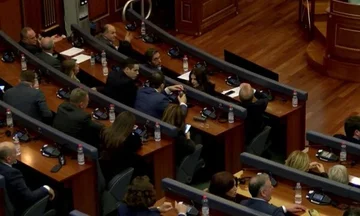
Although the Assembly approved the Law on Competitive Health Insurance, it has not yet entered into force.
The Democratic Party of Kosovo rejected it at the Constitutional Court, claiming there had been procedural violations.
Contacted by Radio Free EuropeThe Constitution confirmed only that he accepted the request on December 13, 2024, but still nine months later he has not made a decision.
In the duty ministry of health, they say they are awaiting bias, but, meanwhile, working towards law enforcement.
“In the function of creating preconditions for full functioning of health insurance, the Ministry of Health has formed working groups for the drafting of strategic documents necessary for implementing law”, the Health Ministry's Media Office's response reported.
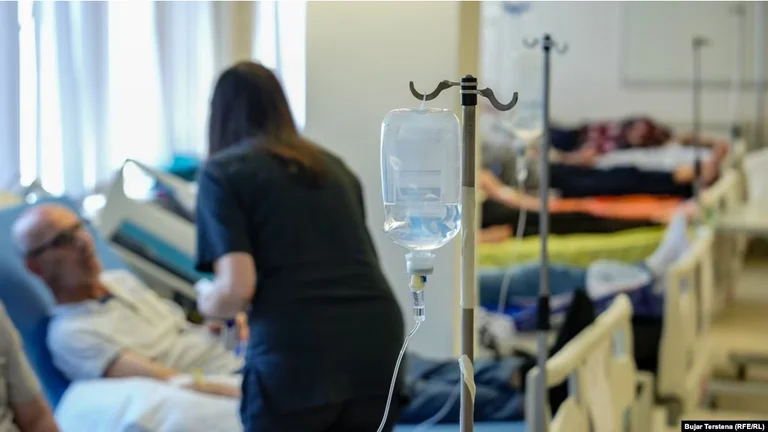
Services to public health institutions in Kosovo are offered free of charge only for certain categories, such as children, pensioners or social cases, while others are worth co-paid for health care.
Its amount ranges from 1 to hundreds of euros, depending on the service the patient receives.
For treatment not realized in public institutions, the responsibility of covering costs is to have the Health Insurance Fund, which is managed by the Health Ministry.
Last year, this fund had 12m euros, out of which 99% were spent.
But bureaucratic procedures, until patients receive the necessary means, last for weeks and sometimes for months.
Hence, many citizens including firemen Africa Gashi have to afford the expenses of both private hospitals and abroad.
Health insurance has only those who receive it from private companies.
Experts: Lack of capacity and political will
Health policy professor Liridon Blace sees failure to implement the law as indication of the lack of institutional preparation.
<x0). The implementation of health insurance requires clear infrastructure, contribution collection mechanisms, fair funding management, and a good strategy for including all citizens so that those working in the informal sector. As far as I know, the government has not taken steps in these ways. I'm afraid that even if I do, implementation will bring a lot of problems”, Blace says.
He adds that in the absence of health insurance, citizens often pay out of pocket, and some “completely renounce medical treatment”.
Bujar Vitija, editor-in-chief of the newspaper “Shneta”, reporting on the health sector in Kosovo, says the situation is the result of lack of political will.
The “Law has existed since 2014, but no government has implemented it. The problem was not the law, but the unwillingness to make it happen. We are the only country in Europe without health insurance”, says the Year.
For Faith Kodra, of the Association of Patients' Rights, the problem is even deeper.
Health institutions, according to him, often fail to meet conditions for services, while the Insurance Fund does not have the professional capacity to manage the process.
He works with limited staff of about 50 workers, while it would take about 400 members.
In such a situation, rather than being given security to citizens, there is the risk of defaulting the fund itself”, Kodra says.
The controversial law envisions that employers and workers pay 3.5 percent of the gross salary .7 percent, but it remains unclear when and how the collection of these contributions will begin.
Political parties, in any election campaign, promise health insurance, providing deadlines that are never held.
Such a security would have helped us a lot of”, says Gashi, who along with many quick response colleagues, risked himself to save others. /Periscope/