5 hours ago
Arifi: Sinan with the Vuchy people: Forced Cooperation or Dangerous Compromise?
Periskopi(9 months ago)
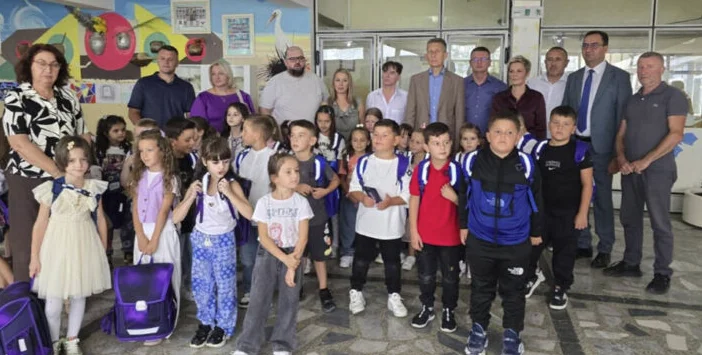
(9 months ago)The Government of Serbia Co-ordination Body Service this beginning of the school year distributed bags and school tools for the first students in Presevo, Bujanoc and Medvedja. The political activist from Presevo, Valon Arifi, has reacted to this, who has shown that the Government of Serbia Co-ordination Service Chairman Aleksandar Martinovic is the closest man [...]
The political activist from Presevo, Valon Arifi, has reacted to this, who has indicated that the Government Co-ordination Service of Serbia Director Aleksandar Martinovic is the close man to Serbia's president, Alexander Vuciq.
On one hand, there was Dr. Aleksandar Martinović, chairman of the Co-ordination Body and one of the closest peoples of Serbian President Aleksandar Vučić. It is Martinoviqi who has long defended Belgrade's policies for using addresses to make a process that Valley Albanians experience as ethnic administrative cleansing. For any criticism, Martinoviqi has a simple answer: The charges are groundless and unacceptable”, he said.
According to him, on the other hand, Ardita Sinani, Presevo chairman and political adviser to Kosovo Prime Minister Albin Kurti appeared beside him. The same Sinan, who once named Martinovic's appointment as clear proof that Serbia's government is far from democratic values. Today, she goes out on her side in official activities, becoming part of the same propaganda scene.
Full text:
The Government of Serbia Co-ordination Body Service this beginning of the school year distributed bags and school tools for the first students in Presevo, Bujanoc and Medvedja. Apparently, a gesture of state care for children in one of the poorest areas of the country. But behind this warm protocol photo lies a deep political contradiction.
On the one hand, there was Dr. Aleksandar Martinović, chairman of the Co-ordination Body and one of the closest peoples of Serbian President Aleksandar Vučić. It is Martinoviqi who has long defended Belgrade's policies for using addresses to make a process that Valley Albanians experience as ethnic administrative cleansing. For any criticism, Martinovici has a simple answer: “The charges are unfounded and unacceptable. ”
On the other hand, Ardita Sinani, Presevo chairman and political adviser to Kosovo Prime Minister Albin Kurti appeared beside him. The same Sinan, who once named Martinovic's appointment as clear proof that Serbia's government is far from democratic values. Today, she goes out on her side in official activities, becoming part of the same propaganda scene.
These two images create a bitter paradox: Martinovici in Belgrade speaks of “barazi, peace and multiethnic co-existence”, while on the ground it protects policies Albanians consider discriminatory. Sinani, meanwhile, from her role as Kurti's adviser, is part of the rhetoric against the Serbian regime, but in practice appears in common photographs with Vuciqi's people.
Dilema is clear: is this a necessary collaboration for the benefit of children and the local community, or a dangerous political compromise that normalizes the Vučić regime and his loyal man Martinovovici?
The Albanians of Presevo, Bujanoc and Medvedja continue to live under the shadow of passive addresses, lack of representation and open institutional discrimination. Meanwhile, Albanian political elites appear in front of cameras side by side those who hold and still hold responsibility for the situation.
The biggest irony is that on September 1st, as school bags were distributed in the Valley in the presence of Martinovici and Sinan, Serbia itself experienced a turbulent day. Serbian students boycotted the lesson, supported by students and citizens, expressing their dissatisfaction with power.
The evening of that day, a major protest took place in Belgrade against the regime of Aleksandar Vučić and his associates, including Martinoviqi. Serbian citizens took to the streets to oppose authoritarianism, corruption and the serious situation in education and society.
So as power in the south tried to sell as the child's “guardian, thousands of citizens in the capital viewed that very power as a major problem.
Then, the common picture of Sinanı Martinovic is not an insignificant protocol detail. It is a mirror of the big dilemma: how to protect the interests of Albanians in the Valley without becoming the face of the regime that is challenged daily by Serbian citizens themselves.
If such cooperation is a must, then should be clearly and openly stated. But if it is a silent political compromise, then the Valley Albanians deserve to know who is representing them and who is using them for photography.