4 hours ago
US 21-point plan to end the Gaza war opens the way to the creation of Palestinian state
Periskopi(9 months ago)
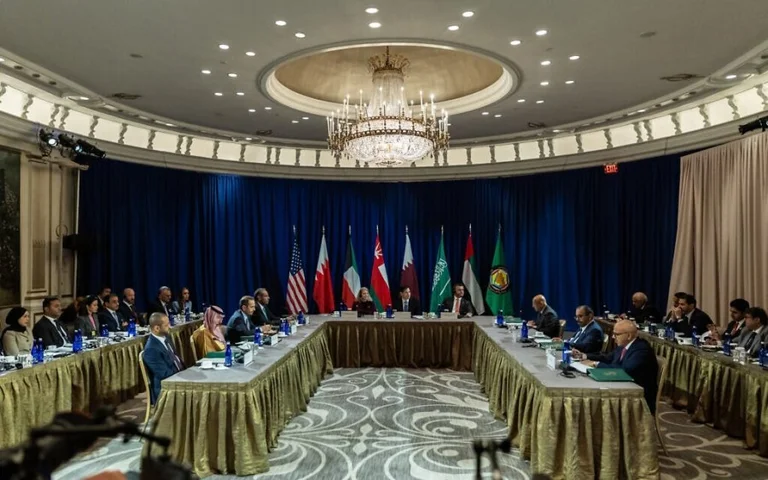
(9 months ago)The US proposal to end the war in Gaza encourages Palestinians to stay in the Strip, and envisions the creation of a path towards a future Palestinian state, according to a copy of the plan provided by The Times of Israel. The 21-point document, shared by the US with a small number of countries [...]
The 21-point document, shared by the US with a small number of Arab and Muslim countries earlier this week in the Magnaries of the United Nations General Assembly, also contains clauses that have been key elements in various proposals drawn up by various parties interested in recent months from the release of all hostages to the removal of Hamas from power.
But the decision to clearly encourage Palestinians to stay in Gaza culminated in a major evolution for Trump administration on this issue, given that Trump in February shocked most of the world with the talk about taking Gaza from the US and the permanent shift of its entire population of about two million people.
These comments gave considerable impetus to the idea among the prime minister's far-right coalition partners, Benjamin Netanyahu, and even among the most moderate Israeli political figures, which since then have been actively working on “encouraging volunteer migration” of Gaza residents, though without success to date.
Moreover, the proposal that envisions a possible road to a future Palestinian state after Gaza's reconstruction has advanced and the reform of the Palestinian Authority has been completed also seems to be a major departure from the Trump administration's policy to date, given that it has avoided expressing support for a two-state solution.
The plan, provided by The Times of Israel and confirmed by two sources familiar with the issue, even envisions that the United States create a dialogue with Israel and Palestinians to agree on a “political cohorizon” for <x2 peaceful co-existence”.
While these conditions are the main attraction for Palestinians, the proposal, drafted mainly by US special envoy Steve Witkoff and expected to be processed in the coming days, also includes clauses Israel has long demanded.
They include a commitment for Hamas to disarm, demilitarisation of Gaza and the establishment of a process for the delegisation of the population.
These demands will likely make the proposal difficult to sell Hamas, and the creation of a possible route to a future Palestinian state from the plan could be a red line for Prime Minister Benjamin Netanyahu, who has long campaigned to prevent a two-nation solution.
But US President Donald Trump was optimistic Friday about his chances, telling reporters earlier in the day that an agreement may already have been reached, before posting on the Social Truth that <x009 intensive negotiations have continued for four days and will continue as long as necessary to reach a successful” agreement.
“All countries within the region are involved, Hamas is well aware of these discussions and Israel has been informed at all levels, including Prime Minister [Benjamin] Bibi Netanyahu”, he added, referring to the prime minister by his nickname.
The US proposal is still quite low in detail, and subsequent negotiations are likely needed, even if the parties agree on the plan.
What are the 21 points?
The following is the content of the plan, which is pre-evaluated at the request of resources that have provided it.
1. Gaza will be a closed-in zone, without terrorism posing no threat to its neighbours.
2. Gaza will be rebuilt for the good of its people.
3. If both sides agree to the proposal, the war will be ended immediately, with Israeli forces stopping all operations and gradually withdrawing from the belt.
4. Within 48 hours of public acceptance of the deal by Israel, all the dead and living hostages will return.
5. After the hostages are returned, Israel will release several hundred Palestinian security prisoners serving life sentences and over 1,000 residents of Gaza arrested since the start of the war, along with the bodies of several hundred Palestinians.
6. Once the hostages return, Hamas members who commit themselves to peaceful coexistence will be housed, while members wishing to leave the belt will be able to pass safely to the host countries.
7. After this agreement is reached, the aid will flood into the Strip at no lower rate than the standards set out in the January 2025 hostage deal, which included 600 aid trucks a day, along with rehabilitation of critical infrastructure and entry of waste disposal equipment.
8. The aid will be distributed without interference from either side of the United Nations and the Red Halfway, along with other international organizations that are neither related to Israel nor to Hamas.
The text of this clause seems deliberately unclear and apparently leaves a space for the continued functioning of the European Humanitarian Foundation, since technically it is an American organization, even if it was the idea of Israelis associated with the government and was designed to adapt to the prosecution of war by the Israeli government.
9. Gaza will be governed by a temporary and transitional government of Palestinian technocrats, who will be responsible for providing daily services to the people of Stryp. The committee will be monitored by a new international body established by the US in consultation with Arab and European partners. It will create a framework for financing Gaza reconstruction until the Palestinian Authority has completed its reform programme.
This is the first mention in the American plan of the Palestinian Authority with headquarters in Ramallah. Israel has ruled out authority as a potential Gaza ruler, thus cancelling what has become the key to recruiting Arab aid in post-war Belt management, given that the international community sees the unification of the West Coast and Gaza under a single governing body reformed as essential to long-term stability and peace.
The apparent decision to reserve the AP's role for an undetermined later date is likely a difficult pill to swallow from Rama God, but also has a limited impact on these discussions.
Point nine seems to borrow much from former United Kingdom Prime Minister Tony Blair's plan to end the war, which was first discovered by The Times of Israel earlier this month.
Blair and former White House senior adviser Jared Kouchner have been working on the Gaza file for months, while being Witzkoff advisors.
10. An economic plan for the reconstruction of Gaza will be developed through the gathering of experienced experts in the construction of modern Middle Eastern cities and through review of existing plans aimed at attracting investments and creating jobs.
11. An economic zone, with reduced tariffs and access tariffs, will be established, to be negotiated by participating countries.
Twelve. No one will be forced to leave Gaza, but those who choose to leave will be allowed to return. Furthermore, Gaza residents will be encouraged to stay in the Strip and offer them the opportunity to build a better future there.
13. Hamas will have no role in Gaza government. There will be a commitment to destroy and stop building any offensive military infrastructure, including tunnels. The new Gaza leaders will commit to peaceful co-existence with their neighbours.
14. Regional partners will provide a security guarantee to ensure Hamas and other Gaza factions fulfil their obligations and that Gaza no longer pose a threat to Israel or its people.
15. The US will work with Arab and other international partners to develop a temporary international stabilisation force, which will be deployed immediately in Gaza to oversee security at the Strip. The force will develop and train a Palestinian police force, which will serve as a long-term internal security body.
16. Israel will not invade or annex Gaza, and the IDF will gradually hand over territory currently occupied, while substitute security forces will establish control and stability in the Strip, reports Times of Israel..
17. If Hamas delays or rejects this proposal, the above points will continue in areas without terror, which the IDF will gradually hand over international stabilisation force.
This is the first mention of the possibility of the agreement being implemented in part, even if Hamas disagrees.
18. Israel agrees not to commit future attacks in Qatar. The US and the international community acknowledge the important mediating role of Doha in the Gaza conflict.
Nineteen. A process will be established for the customisation of the population. This will include an interreligious dialogue aimed at changing mentality and sodiums in Israel and Gaza.
20. When Gaza's reconstruction has progressed and the AP reform programme has been implemented, conditions may be in place for a reliable path towards Palestinian citizenship, which is known as the aspirations of the Palestinian people.
The clause gives no details about the Palestinian reform programme and is not final about the time when the road to citizenship can be set.
21. The US will create a dialogue between Israel and Palestinians to agree on a political horizon for peaceful co-existence. /Periscopi