4 hours ago
Unbelievable but true, the second inscription of Emperor Justinian is revealed in “Ulpiana”
Periskopi(10 months ago)
(10 months ago)It was remarkable when two years ago in the Archaeological Park “Ulipana”, an inscription was found by Justinian himself, as there were no direct inscriptions from him. Now it's incredible to find the second inscription by Justinian, which is accurately pointing to the date of the city's reconstruction. So said French professor Christopher Goddard, [...]
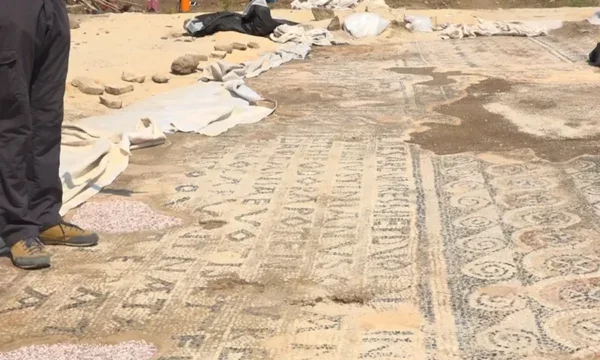
It was remarkable when two years ago in the Archaeological Park “Ulipana”, an inscription was found by Justinian himself, as there were no direct inscriptions from him. Now it's incredible to find the second inscription by Justinian, which is accurately pointing to the date of the city's reconstruction.
So said French professor Christopher Goddard, who heads the team of French archaeologists. They, along with archaeologists from Italy and Kosovo, have made remarkable discoveries at the <x0-Ulpiana” Archaeological Park, where it has been working on the ancient city's past since 2017.
They, in addition to many other facts, have discovered two unique inscriptions belonging to Emperor Justinian himself, rare traces in the Roman world and located in the same building in the city called “Justiniana Secuda”.
This area, which has been rebuilt after an earthquake that destroyed the city of Ulpiana in 518 AD, has been in the focus of excavations to reveal its history. The new town “Justinana Secuda”, built about a mile east of the original settlement, covers about 19 hectares and holds a large Christian church, considered one of the largest in the provincial cities of the time.
French professor Christophe Goddard, who is leading the excavations, was declared to Kosova Preris, that archaeologists ' interest relates to a dig that occurred in 1953, revealing the existence of the town of Ulpiana.
Through field geophysics observation, the team was given an opportunity to develop a detailed plan of the city, revealing major roads and large buildings. The church, measuring 79m in length and 23m wide, shows the religious and cultural importance this city has had in Justinian's period.
The first discovered inscription dates back to building the city in the period between 535 and 545, while the second inscription accurately defines the year 545, confirming the timing of church reconstruction.
This discovery is extremely important since it is the first time that there are two such inscriptions adopted by Justinian in a provincial city.
We were lucky that two years ago we found an inscription by Justinian himself. He was the only one we knew. We had no direct inscriptions from Justinian. We had Roman inscriptions that mentioned him, but not by his hand. It's unique and it's right in this building. We found him two years ago. And this year, we were in another building and we made a series of discoveries, one of them was a new inscription that date very accurately to the moment the basilica was built. The first inscription was published two months ago with a very careful study, where we could say that this city was built between 5355545, based on the analysis of that first inscription. The second inscription, however, gives the correct date "is between January and April 545. So we were right, but now we have a new accuracy, and we have a lot of other accuracy that we are still studying in the text. Finding a Justinian inscription was already remarkable to find two in the same building is incredible. It's surprising again. Although, in a way, it's not surprising because we know Justinian was from this province he was very close to it.”, he said.
Goddard also said the financing of the project is largely supported by the European Union, France's Foreign Ministry and the Kosovo Ministry of Culture. Also, the help of the Government of Kosovo has been crucial to the purchase of land in which excavations are located, enabling the protection of this historic wealth from agricultural activities.
For Kosova Prees was also declared archaeologist Ilir Culaj, who expressed happiness in these new findings.
Culaj says that excavations are being developed by an international project that is also helping anthropology students engage in excavations.
This project not only contributes to the dawning of Ulpiana's history and Justiniana Secuda, but also prepares new generations of archaeologists through international training programmes, connecting the past with the future of scientific research in Kosovo and beyond./Periscopi/