4 hours ago
Troubled skies: Military Conflicts Changing World Aviation
Periskopi(10 months ago)
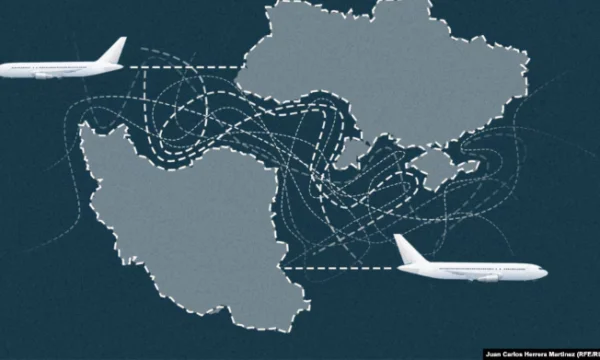
(10 months ago)Up in the sky, world airlines are disappearing. Where pilots once flew on a direct continental route, they are now navigation into a sky that looks like broken glass to millions of flights that are being accomplished through crowded corridors. At the same time, large air spaces, surprisingly, remain [...]
This change is not random. The spread of wars, regional hostilities, and military escalations in recent years has made the heavens of the world more dangerous and unpredictable than ever since the Cold War. From Russia to the Middle East to Africa, <x0 minusions of stop-flying” have increased, bringing international aviation into crisis and reshaping economy, security and flights.
Russia's air chaos: New Normal
Early in July 2025, chaos engulfed airports throughout Russia. During the weekend of July 5th and 6th alone, over 2,000 flights were canceled or postponed following a series of afraid attacks conducted by Ukraine, which caused much of the Russian airspace to be closed.
At Moscow's Sheremjetevo airport, the passenger Tatyana described the situation as “a disaster”. The waiting places were overloaded, with people lying on the floor and basic services, such as drinking water. “There was nowhere to sit and people were sleeping on plaques”, she said.
In St Petersburg, taxi drivers wanted up to 80,000 rubles (1,025 dollars) for trips to Moscow, after train tickets were sold after closing at Pulkovo Airport. On July 6th alone, more than 15,000 passengers were stranded in Sheremejevo, while smaller airports in Kalugla, Tambov and Pskov suspended all operations.
Russian defence officials claimed they had dropped up to 120 fears that night, some of whom were knocked just a few miles from Moscow. Authorities cited “external intervention” as the reason for repeated air space closures, which have now become common. In Russia, airports have been closed over 600 times since the launch of Ukraine's Russian occupation in 2022.
Locked in Heaven
But if you lock up an airport is terrible, imagine if you're trapped in the sky. In June of this year, after Iran launched missiles towards the US base Al Wedeida in Qatar, surrounding states immediately closed their airspace. A Kantas company plane from Perth to Paris stayed for 15 hours in the air doing walking before returning to Australia. Another was forced to divert his flight to Singapore.
India-Pakistan tensions in May 2025 led to the closure of key air corridors, forcing flights between Europe and Southeast Asia to travel longer and more expensive routes. The duration of flights increased to ten hours, while unforeseen power supply stops at unknown airports became routine.
Data from Flightdar24 shows that pilots now face super-loaded super-currendor “ ♫x1> narrow roads filled with aircraft and areas on both sides, where there are flying stops. Flights to such heavy traffic significantly increase the risk of accidents, while air traffic controllers make extraordinary efforts to manage the situation.
Over the Red Sea, Libya, Sudan, Syria, and parts of Sub-Saharan Africa, flights are increasingly diverted because of security concerns. Air control in conflict zones is often irregular or lacking, and pilots are forced to coordinate air diversions by using old - fashioned channels or alternative communication routes.
Environmental and economic consequences
All these flight deviations have a huge cost to the environment. According to a recent study conducted by the University of Reading in the United Kingdom and the Pierre-Simon Lallac Institute in France, the avoidance of Russian airspace has caused an increase of 8.2 million tonnes in carbon dioxide emissions within a year. Flights affected by this deviation have burned an average of 13 percent more fuel, and the largest increase has been recorded on air routes between Europe and Asia and North America and Asia.
Another research, conducted in 2024 by Victoria Ivannikova, a well - known aviation researcher at Dublin City University, found that Europe's limited flights to Asia now cost airlines up to 39 percent more per fuel and release up to 40 percent more carbon dioxide figures for an industry that is already facing great pressure for designation.
Winners and Losers in the Wars of Heaven
Chinese air carriers have seized opportunities to use Russian airspace. Their roads from Europe to Asia are faster and cheaper, increasing competition for Western companies that have no access to the same corridors.
British Airways, for example, was forced to cancel London line - Pekin and one of London's daily flights -Hong Kong during the summer of 2024 due to huge financial losses.
Finnair, Helsinki's main company, has lost its advantage in the relationship between Europe and Asia. A flight to Shanghai, which once lasted nine hours with the Chinese airline Juniao, now lasts 12 hours or more with Finnair.
Even in the United States, airlines are feeling the pressure. United Airlines, for example, has moved Delhi'Njuark route from a 13-hour direct flight to a 15-hour journey across Europe and the Middle East, due to the closure of Russian airspace. This adaptability, although responding to difficulties, is evidence of the sustainability of the aviation industry, reports the REL.
Air India company initially capitalised on the situation, but then lost the advantage following restrictions on airspace from Pakistan, following the terrorist attack in contested Kashmir in April this year.
Missiles in the Sky
In areas near war zones, the skies are no longer just meant for commercial planes. Military activity is now on civilian roads. In February, China conducted unannounced naval exercises in the Tasmanian Sea. Commercial planes were forced to change their route during flight after a Virginia Australia pilot mistook a warning on an unusable radio frequency.
In December 2024, a Russian air defence system accidentally crashed an AZAL flight from Azerbaijan near Aktau in Kazakhstan. Thirty-eight out of 67 people on board lost their lives. On another occasion, a cargo plane from Kyrgyzstan crashed in Sudan by rebel warriors who confused it with a military plane.
These are not isolated incidents. Ukrainian International Airlines Flight PS752 crashed from Iran in 2020, while Malaysia Airlines's MH17 Flight was destroyed by a missile supplied by Russia over Ukraine in 2014. Both tragedies served as severe warnings: commercial planes are increasingly at risk of becoming collateral damage.
The world air travel system, once a marvel of speed, security, and interconnection, now resembles a complex network of geopolitical interests. Every conflict reshapes the map. Any closure, any road change and any air space ban adds delays, emissions and costs./Periscopi/