6 hours ago
Subtitles:
Periskopi(10 months ago)
(10 months ago)Four hours on a pit road that looks like craters from grenades. Neither is there an apology, or there is no equal at all. Stones and branches that crash onto the chariot. The temptation to give up and go back is huge. And then suddenly: super absorption asphalt of the younger generation, paved [...]
No other car has ever made it here. We have the whole highway to ourselves. Is that a gift from heaven? Or is it simply the work of a corrupt employee who has eliminated a fund? After a few minutes, the answer comes: The highway suddenly ends, and without warning on an unforgivable path, interrupted by dozens of small canyons that the last heavy rain has created. We're able to do emergency brake right on time.
The pits on the street and a state street registered by error on Google Maps: These things you need to consider if you go on a road trip to Albania. However, it is worth exploring this small Balkan country by car, which is not even the size of Brandenburg. A dwarf country, but it offers everything: from sandy beaches in the Adriatic to the high alpine mountains, from the Orthodox Church to the Ottoman mosques.
A car can be rented in Albania easily and relatively cheap. Moreover, many Albanians working in hotels and locals speak German, Italian or English. Who is willing to face the chaotic traffic of cities such as Tirana or Durres and the holed roads in rural areas will be rewarded with rich rewards: picturesque villages, staggering beaches and spectacular views of the Albanian Revolution. On the way, there are endless opportunities to expand the horizon.
Lesson 1: Don't rely on Google Maps
Albania's bad ways do not come out of nowhere. The country has a turbulent and partly tragic history in the recent past. When Enver Hoxha's Stalinist dictatorship collapsed in 1990, the Mediterranean country plunged into almost a chaos of civil war, from which it slowly recovered.
Today, Albania is a candidate state for the EU, where hasty progress clashs uncompetitive with pre-industrial conditions. So, well-encumbered roads still don't exist on Google Maps, but, on the other hand, mosquito trails have sometimes been marked as highways. However, tourism has risen significantly in recent years. Even though professional marketing of destinations is still under construction, the country has been transformed thanks to the good word that spreads with its mouth to a rest advice that is no longer so secret. In addition to landscapes, travelers are thrilled by cheap prices and almost limitless hospitality of Albanians.
So I made my wife's destination appealing. The ferry to us begins from Italy, across the Adriatic, to Durres; there we rent a car and want to explore the country's south. The first destination is Berat, a city of Ottoman architecture, and then the road takes us along Vjosa (the last great wild river in Europe) to the thermal springs at Permet. From there only a few mountain necks remain to reach the rugged coast of the Albanian Renaissance with its long beaches.
To move forward, you must rely not only on digital maps but also on local advice from time to time.
Lesson 2: Expensive Machine - Sensitive Subject
Our travel tool is a small, red C1 Citroën. With it, he stands out in Albanian cities as a poor man. On the road to Berat, you can almost stand alone Luxury, smooth UV. German brands like Mercedes, BMW and Audi are especially popular. And in the village, there are still many old “cans.
The boss's car provides a strange contrast to the ruined facades of houses scattered across the landscape. Albania, with a gross domestic crop per capita of around $10,000, is among Europe's poorest countries; 4.5 per cent of the population is malnourished, while many houses remain unfinished skeletons for lack of money. So where does this <x0m2-2-2-2 body come from?
Who could know better than those who run these fancy cars around? From a white BMW X5 in front of us three young men with wide shoulders and strong jaws. The driver doesn't take my somewhat embarrassing question in humor:
Look at the streets. You must have big, strong cars. ”
A convincing argument. And when they saw their stature and their keen looks, other questions had no place.
Lesson 3: Don't give up at night
It's evening, we're close to Berat and we realize that there are people whose bad ways might be a priority. The more dark it gets, the more they appear in the light of the lanterns. Bowed down and lonely walk along the road sometimes women, but mostly old men, dried up by life. Where they come from and where they go, I can't even explain the old man we finally stop by to offer them a seat in the car. At one time I too have been on the road, and I know how good it is when they take a few miles with them.
We need some time until we find a place that sounds like the word that the old man, with his jacket torn, keeps repeating. A high finger, a smile, is how communication works in such cases. That the old man doesn't talk much, it's not bad, because he smells terrible alcohol.
On arrival, the elder thanks. Again a cloud of breath mixing beer and wine. Then he pulls the handle hard, tries to open it in vain. Only when something dances, I remember that child protection must be activated. I go out and open the door to the old man.
He thanks again, then leaves fast. I leave behind the broken handle of the door. Goodbye, rental car guarantee.
Lesson 4: Enver Hoxha? Good man
Tomory, our host in Berat, better. “Those are all the poor who still walk from village to village,” he tells us, “older people like me, retired about 200 euros a month.” His fate is that he has a lovely home in the historic center of Berat. Today he rents rooms for tourists. With that money he bought a bicycle and financed his son's studies in Tirana.
And I'd like to travel in my lifetime,” says Tomori from his terrace with a view of Berat's center. Because of the typical white houses with many symmetrically placed windows, Berat is also named “The city of a thousand windows. ”
Tomori would have wanted to see Italy, or the United States, he adds. But because of the costs it was impossible. Once, under Enver Hoxha's dictatorship, it was the radio that nurtured his curiosity about the great world. In secret, in his room, he heard Italian stations; he loved the songs of Adriano Clentano and Caterina Caselli.
He speaks fluent Italian. But then I was afraid no one would understand,” Tomory shows. Had the wrong people learned that he heard Italian radio, they would have arrested him as a spy.
However, Enver Hoxha, the paranoid dictator of the time, still calls him a good man. In socialism, at least each had a secure life; his son wouldn't have to leave. There was neither drugs nor crime back then.
Today, these are them. So for Tomor, even the job with the bosses' cars is clear: Everybody sleeps under the pillow gun.” For him, the bicycle remains more loving.
Lesson 5: Old cars also apply as status symbols
From Berat the journey continues toward the wild mountains of Permeti, where tired feet from the long journey relax again in thermal water of the bean's resources, with a temperature of 25 to 30 degrees. In the background lies the X - century stone bridge with the bows of the Catin Bridge V III, which gives you a sense of time travel.
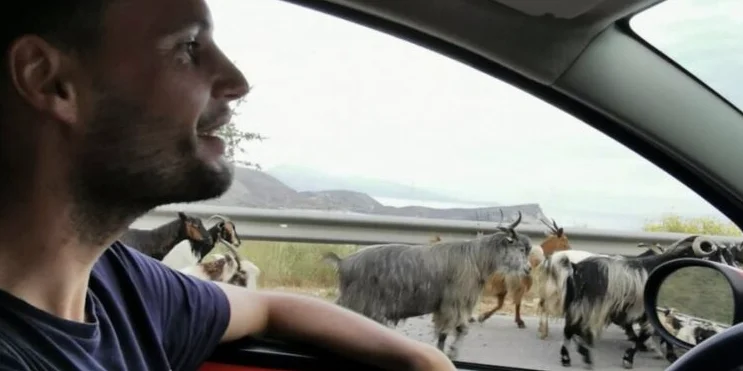
The harsh mountains are soon replaced by the bucolic hills. The road from Permeti to the Adriatic passes by flocks of sheep and old stone walls. Interestingly, the deeper you enter the Albanian province, the less the fuoristrada is seen. And yet, they should be more needed here. Instead, there are people on donkeys or on old tractors who cough and smoke.
If you ask the common people here, everyone has their own theory about the origin of luxury cars. Some, like Tomory, associate it with the drug trade; others talk about corruption. And he, they say, is central to the capital.
The only question is that cars in Albanian society have extraordinary importance. And who drives an old Mercedes-Benz scratched, keeps it always bright. Almost every yard is found in every parking lot.
A owner of such a wash thus explains Albanians' love for the car: “A car is for many Albanians the most important asset. They work out, they live here, sometimes there. The house remains secondary, the car becomes more important.” And that's understandable: Albania is a typical immigration country, the remittances of Albanians to the diaspora are irreplaceable for the economy. In a country where good life has depended for decades on how mobile you are, the automobile inevitably gets a special meaning.
Lesson 6: Trust Hospitality
At the end of our road trip, however, we face police control. It's late afternoon and our lights weren't on. “Youour driving license”, says the policeman from the open window, when you understand I don't speak Albanian. I get anxious. I had lost my Italian license just before this trip, so I only have a temporary Italian flight permit, which here has no validity. The cop looks at me carefully. “Tourist?” Ask. I nod. “You can go.”
Here again was that legendary Albanian hospitality. Once again he saved us. For him, the underestimated Albanian cuisine has no doubt been worth the trip.
However, the police do not spare only tourists. Despite frequent street raids, we did not see any banned four - wheel - drive vehicles; they were always small like ours. And it's not about getting worse. I, as an ignorant tourist, could ask naive questions and still owners of the four - wheel - drive vehicles to leave me alone. But it would not be so easy for local police to come out without consequences.