8 hours ago
How does the Special justify accepting documents from Serbian authorities?
Periskopi(10 months ago)
(10 months ago)Acting Justice Minister Albulen Haxhiu has been the first official to have informed the public in Kosovo that the Special Court in The Hague has accepted some documents handed down by Serbia's authorities as material evidence. Haxhiu and other officials in Kosovo have reacted sharply to the decision. Court, side [...]
As at times, Kosovo authorities have been mobilised in recent days and unanimously rejected the Special Court's decision to accept documents from Serbian authorities in the quality of material evidence.
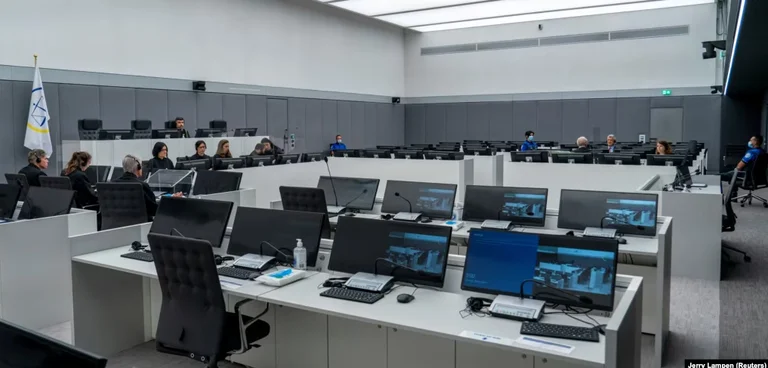
The Special Court with international judges and prosecutors has been established with Kosovo laws in 2015, but operates at The Hague in the Netherlands and investigates the alleged crimes of members of the Kosovo Liberation Army (UÇK), against ethnic minorities and political rivals, from January 1998 to December 2000.
The main case in The Hague is taking place against former KLA leaders, against former President Hashim Thaci, former Prime Ministers Kadri Veselini and Jakup Krasniqi and former Kosovo delegation Rexhep Selimi, respectively. They are accused of war crimes and crimes against humanity, which have rejected the fourth.
The court has confirmed that it has accepted Serbian documents in this case.
What did the court say?
Special Court spokeswoman Angela Greep has told Free Europe Radio that the panel has made the decision to accept Serbian materials on May 29th and that it is up to the prosecution and defence to choose which evidence they want to use to support their respective cases.
She has said that the evidence is accepted on the “principle facieque”, which means, according to the first impression, but that doesn't mean they will necessarily be used in the act of judgment.
The judiciary “Panel found that documents in question are important, for example, for the assessment by the panel of the existence of an armed conflict between the KLA and Serbian forces, at least from March 1998 to September 1999, as indicated in the confirmed indictment”, she said in response.
Greep has quoted the court panel as saying that documents are authentic. They have dates, stamps, titles, protocol numbers and are signed.
The provative value of these materials will largely depend on the degree to which the claims and information they contain are supported (or rejected) by further evidence”, the spokeswoman said.
According to court documents, the defence has rejected the acceptance of additional documents, arguing that Serbian state documents would have to be submitted to an additional critical assessment, due to their origin, and that many documents have minimal connections or nothing to the charges.
What did state leaders say?
Kosovo President Vjosa Osmani has seen with great concern the Special's decision, saying it was historically testified that each evidence of Serbia's state against the Albanian people and the KLA is forged.
“They have only one goal, to rewrite the history”, Osmani said at a news conference on August 5th.
According to incumbent Justice Minister Albulen Haxhiu, the Special decision raises serious doubts about the impartiality of the case's own judges.
The KLA war veterans' organisation (OVL-UÇK) has also criticised this decision and named it an extra reason for organising the August 7th protest in Pristina, in which “for justice” has been called, writes REL, broadcast Perixopi.
The Open response of civil society
But beyond statements, civil society expects more from the State.
Through a public reaction, Ramadan Ilazi, Armend Bekaj, Visar Jampazi, Florian Qehaja, Besa Luza, Besa Kabashi-Ramaj, and Gezim Visoka have demanded that Kosovo institutions react with a unified and co-ordinated stance in defence of national interests.
“International Criminal Tribunal for the former Yugoslavia (ICTY) has documented with numerous evidence that Serbian state organs, such as the Interior Ministry and other security mechanisms, have been involved in systematic crimes against Kosovo Albanian civilians. Accepting documents produced by institutions that are directly involved in ethnic cleansing, war crimes, deinformation campaign and denial of Kosovo's right to exist as a state seriously jeopardises public confidence in the integrity of the judicial process in the Special Chambers (special Court)”, is said in public response.
Asked what specifically are required by state institutions, Ramadan Ilazi from the Kosovar Centre for Security Studies (QKSS) has told Radio Free Europe, that the most urgent issue now is the consolidation of Kosovo institutions.
The “Constituent Assembly is formed, the Government is formed, because the situation we are in shows a high level of fragility for Kosovo in relation to any other” process, he has said.
As a second step, Ilazi has cited the formation of a task force from the Parliament, Government and Presidency, which would examine legislative issues related to the functioning of the tribunal.
The prosecution has wrapped up presenting evidence in the trial against former KLA leaders in April this year and now has the order of defence, for which the state of Kosovo has allocated about 33m euros.
Since its establishment, the Special Court has issued several counts of war crimes as well as for obstructing justice. It is financed mainly by the European Union, with additional contributions from several other states, including the United States. /Perixopi/