5 hours ago
From the prisons of the Serbian regime to Albanian ods, Hava Shala's powerful tale of reconciliation
Periskopi(10 months ago)
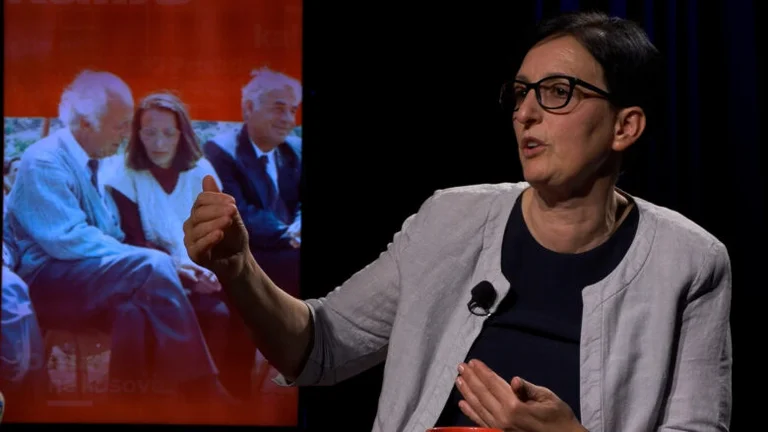
(10 months ago)Hava Shala, one of the initiatives of the Women's Appropriation Movement, remembers her activity from suffering and imprisonment as a young woman fighting for freedom against the Serbian regime, the idea of the Movement then stopping revenge among Albanians. The small prison cell, with the bright light of the lamp [...]
The small prison cell, with the bright light of the lamp that still causes it headache, became the place where a spoken but unwritten idea arose that a few years later completely by chance became a popular movement that changed the course of the Albanian reality of 1990.
For him, at that time, 17-year-old disobedience to Serb oppressive power under the former Yugoslavia, the 1994-1998 prison has been at the same time devastating, but also driving. Behind the bars, his beliefs were reinforced to rebel against the oppression of Albanians from the regime, while within it a force arose to stop the brothers.
Blood feuding is not fair at any time, but it can become especially harmful when the real enemy tries to use it as an alibi to conceal his crimes, is convinced of Havana Shala, who descended from the Pella Baran, former professor of Albanian Literature, well-known in the concept of taking afe.
I'm saying: “Akile [her prison companion Akile Dedinca] I'm saying: “The people are on the move, we're feeling it, it was seen, it was emotional... When people move, they can do great things. And it was time for something big to be done in this direction. One big thing was taking blood out. And, we thought we'd write a letter that we'd send to our friends and friends who were outside in the hope that something could be done in this direction”. This letter, as Havana Shala showed on “Calxon Pernime” had failed to send it because of strict checks inside the prison.
She was arrested in 1984 as 18-year-old, along with six other girls and two other boys, in the case known as “Peja Girls Group” due to the writing of political letters and reading of banned books and magazines.
Part of the prison was spent in Lipjan, part of Mitrovica.
He was released from prison in 1988. After she was released from prison, she joined the Women's Appropriation Movement.
On May 1, 1990, one of the main gatherings for the reconciliation of the creatures, known as Luca's <x0-Verce gathering”, was organised, and Shala was one of the initials who addressed the audience. She and her fellow inmates were side by side with activists Anton Chetta and Zeeria Cana in bringing things together.
“
Havana recalls the time when there were protests and demonstrations against the Serbian regime in 1990 that for the first time she had seen people being beaten, wounded, and killed in Pec.
The killing of a young man had become one of the causes that had led him to a coincidence of its departure for reconciliation. At the time, while remembering Shala has been about 24-year-old when Fatmir Uka had been killed quite near her. He and his friends had tried to move his body to the hospital so that other demonstrators would not see him.
We took it with our own hands, we had it blooded. We got it and we're out in the rest of town. They wouldn't let us take him to the hospital. It was a play that day. Many people were killed and injured”- she showed.
On the way, near the Peja stone bridge, Shala says she has entered a furnace to avoid following the police, and there she met a man who had sought her help to seek faith in a blood feud of his relatives in Lumbardh.
There's a Bralich man named Gashi, don't mistake his name, Abdel Gashi, whose family, a relative of kin, was in blood with the Leka family in Lumbardh. And he says: I saw the young people of two families and I'm afraid they'll get killed. In protest, in demonstrations. He says, "Please do something. I'm scared, he says. The idea was to be trusted until the demonstrations were past”- she showed.
However, she said that she did not believe that someone in the demonstration was killed. Callo. com, Transmitt Periscope.
While Shala shows that the same person had gone to her father's in the evening, since she had taken refuge at her dates at Strellc, Decani, to ask her to help, considering that her group of political prisoners were known in Pec.
Havana's father had gone to announce, but this had left the answer pending, not believing that Albanians could be killed among themselves at a time when the wrong was expected of the enemy. However, that same evening, she says she had heard in the news that Serbian officials are trying to hide her crimes by accusing Albanians of killing themselves.
“On the news was said through radio television speakers read a letter from a Yugoslav-level Interior Minister, and said that the murders, they killed 24 people on those days and once became 40. More. He said they are not killed by police, the army [Serbian], but they are killed that they [Albanians] are a people who kill themselves”- Shala indicated.
At that moment, Shala had reflected that “probably needs humanity such coincidences” in order to produce large shares.
Well, for me not to do anything immediately was sign them an alibi, alibi for their crimes. The next day I said to make the reconciliation of the blood... the price of the blood started in Lumbardh, that Mr. Gashi's word I'm going to do something” she said.
The next day, they had met former political prisoners Lulzim Etem and Brahim Dres, who agreed with their idea of what happened at Adam Grabovci's watch, went to a meeting with Professor Rexhepe Qruja to be oriented by him and to the proposal of exhumation that the right man for oda is Anton Chetta.
It wasn't a question of whether or not to be asked, but of how. To do it ourselves, we had no doubt that we could do it, but we had only one doubt that we could be arrested. We were willing to be arrested at any moment. We weren't selfish and we wanted the Movement to become” she says.
The first settlement of the species had gone to Lumbardh to the Leka family.
We went that day and were hosted by Professor Anton Chetta. He told us: “Yes, you found the point” He said: "The “Yes, it's a smart job. It's okay. It says: “you get us out of the office that we almost roted”. He was joking, but he was very real about what he said. He told us: “Yes, we also need Zeqa, Zekiria Cana. It deals with human rights”- it showed.
Ode for Woman in Ode of Men
Among the men with the mustache, and seemingly stately, Hava Shala and her friend, Myrvette Dressey, and other young people, had called for blood feuds from Albanians to stop. She even tells them that manhood is measured by giving up such habits.
As a calm was felt in the Ode, Shala, who nearby had Myrsshain Cana, told her with full conviction that it is time to stop the bloodshed and help Kosovo with our lives and death.
At this moment, perhaps more will help with death. except the death of those who are killed by the hands of one another, and by the deception of the enemy, so that you will be convinced. Allow those dead to help with their lives all of Kosovo”- says Shala in an ods of men, in recording that the cameraman Kurti had done it at the time.
Shala, in a very simple dress with her hands expressing her determination in what she spoke, fearlessly required that men open their paths to stop the phenomenon that she had then involved the people.
I'm sorry that the woman did not attend the men's watch before, but I'm glad that right now they attend when our fathers measure manly, and we've read about bravery in history. Mateni please man, the people are looking for him. Kosovo is looking for” -- it is addressing men in the Ode.
And for this occasion of her talk at Oda and so many others that she doesn't even remember how much, she says that no one ever pointed his finger at her or judged to be a woman at the time men were considered to be the ones who speak.
It's never been a problem to be a woman. Maybe we've been witness to the impossible. We had become an opportunity. We overstepped the bounds of men, and delivered them from their borders. Because being together, you're much stronger than being just” - it shows.
However, she believes that their simpleness as a girl and the recognition of the umbrellas enabled her not to be stopped, judged, or anything else. According to her, she has heard cases that some girls have been expelled from the Odas because in case of death they have gone in solemn dress.
You go to someone when he's dead and you ask him for blood... she, death has been very present. We've known the pain. And that at this time everyone has a greater obligation to do something for the country”- she says.
She says there have been cases that have gone to 3-4 times in the same family to seek blood forgiveness, but there have been cases that have gone 20 times. For killing each other, she judged the regime that, according to her, has left people with nothing, no institutions, no jobs, no money, and therefore deeply rooted the problem. She remembers there were cases of medge murders.
In its view, blood forgiveness has been a very, very complex problem because you had to get into human pain.
We've never dared to forget that the person who's entered man to ask for the blood of the boy, of the boys, of the father, of the uncle, of the family must be morally witness to his willingness to give something of himself. Because you just have the right to ask someone for something”- she says.
Shala still carries the consequences of the violence she's experienced in prison that even the bright light on the “Kalxon Pernime” prevented her from remembering the prison.
I've been hit in my muscles. The little cell that you had space. Cells had no windows but a narrow iron space. There was no sunlight in the room. That window fell in the hallway. The light of the lamp in the room was very strong. That light caused severe headaches”- said Shala, pointing to kidney problems as a result of the prison.
Chetta's new friends
Anton Cetta, a folklore collector's researcher, was at the helm of the Women's Appropriations Council in the early 1990s. Thanks to his contribution and accomplices to this Assembly, which is the largest in Albanian history, 106 families extended the hand of reconciliation, even though they were surrounded by Serbian occupiers.
The youth initiative group of reconciliations had become good friends of Chetta, that Shala cannot forget some of the ʹmesel and orders he left before he died. His speech, Shala, says they have followed him and continue to follow him even now when she does not live in Kosovo.
The idea for organising a magnificent gathering of “Luqa”'s summers was that of a group of students along with their two professors. Pos, Have Shala were also Musa Berisha, Myrvete Dreselj, Ethem Ceku, etc., and two professors Anton Cetta and Zekiria Cana. Those who contributed to this assembly are also personalities like: Mark Krasniqi, Dom Lus Gjergji, Ibrahim Dresaj, Azem Shkreli, Mulla Ayni Ramadani, prof. Ramiz Kelmendi, Nimon Alimusaj and Mother Ayse Gervala.
After the magnificent gathering of Luka “ ” in Decan, Shala says the road was open, people opened the doors and opened hearts.
After May 1, 1990, it has been evidently easier to come in and ask for blood, and it is more likely to be forgiven because it was readiness. He wanted to forgive land, do something for Kosovo. Here is the miracle of reconciliation. Thanks to this extenuation force, it was the action that took place on the Sea”- Shala, pointing to cases during this gathering that someone who did not have cases of blood forgiveness had forgiven land for Kosovo.
The magnificent gatherings were organised throughout Kosovo and other ethnic sites, such as Kacanic and Lug of the Drin, Dukagjin, Luqa's Verra, Shala and Karadak, at Llap, Drenica and Gollak, in Has, Reke, Podrim, Lapush, Podgur and Rugova, Kosovo Place and other areas.
During the period of existence, February 2, 1990, May 17, 1992, of the Women's Forgiveness Movement, the Wounds and Congestions, reached more than 2,500 reconciliations or pardons, where we have: over a thousand bloods, more than 500 wounds and 1,000 confusions.
A Chetta's Amele, Shala told him about the philosophy of the oda, the lie, and the way people behave in the Oda.
“Anton said everyone speaks in oda. Someone knows the order of someone does. But Oda has a principle that doesn't say to someone: <x1 WHARE”, or Oda is a high instance of wisdom, of popular philosophy. Said one thing, he said: “said an elder please give me the word today, I want to say something, to look smart in that sense. And, you know, you mean and you said something. But the elder said, "Well done" to the “." He used to say that sort of thing by making us know that even in our old age we're in our “your mouth is pretty good if you're also”
Shala has been living in Switzerland since before the war, says she has received bids to get involved in politics, but that is not what she wanted. Asked how she would reconcile politicians in the Kosovo Parliament herself, she simply answered with a message from Chetta.
For the last time I saw her before she left for Switzerland, Anton Cetta told me: “I'm easier than you, than you young” He said: “I won't live long and it's easy for me to die unorthodox. I wish you Have Shala and your friends to live unorthodoxly. It's his last word”.
If I were in Parliament every day I would think of this message from Professor Anton Chetta”- he wrapped up the Hava Shala conversation. /Periscope