5 hours ago
Former MPB Minister: Kosovo remains without home gods
Periskopi(10 months ago)
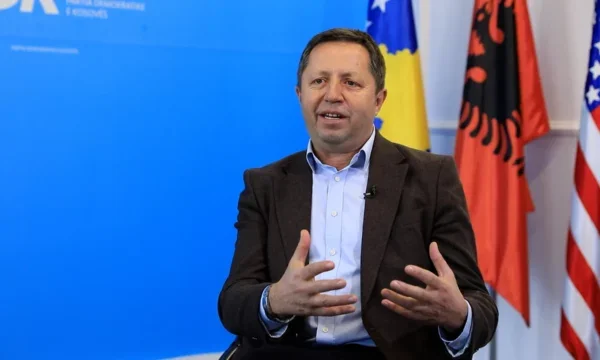
(10 months ago)Former Minister of Internal Affairs and former Kosovo deputy Zenun Pajaziti has commented on the political situation created after the Kosovo Assembly was rejected. Pajaziti says Kosovo has remained without home master “” as she said the country's president took an unprecedented move with the withdrawal of her request from the Constitutional Court. [......]
Former Minister of Internal Affairs and former Kosovo deputy Zenun Pajaziti has commented on the political situation created after the Kosovo Assembly was rejected.
Pajaziti says Kosovo has remained without home master “” as she said the country's president made an unprecedented move with the withdrawal of her request by the Constitutional Court
That's his complete opinion:
Kosovo is in a serious institutional and political moment. Although we have a glorious history of resistance, of building the state, and of dedication to democratic values, we are now confined to a frightening stagnation. We're left without home gods, without a common voice and, unfortunately, no devoted international friends to mediate our internal crisis.
Instead of co-operation and public maturity, we are facing political arrogance and unilateral decisions that are deepening distrust and paralyzing institutions. The country's president, in an unprecedented move, withdrew the request by the Constitutional Court that would have to clarify an important issue regarding the mandate's decree to form the government. This action, despite its reasoning, has left the system with many constitutional rules, enabling public opinion to understand who protects the state's standards and what is the real role of independent institutions.
This is not the only sign of the crisis. The prime minister's arbitrary stance regarding the establishment of the previous institutions with the Constitution is also troubling. The refusal to co-operate with partners, as well as to create mechanisms that guarantee equality and institutional functioning, harms not only internal order but also Kosovo's reputation in relation to our strategic partners.
This is when personal calculations and unfair political ambitions towards our country should be cut off. Institutions are not arenas for power games, but pillars that carry a state that has paid a lot for freedom. Getting out of this crisis requires more than political statements; it requires national maturity, political restraint, and belief in justice.
Justice, in particular, is often lonely without full political support and constant pressure. The Constitutional Court, which should be the last guarantee of democratic functioning, is silent in some key moments. It must be active, bold and independent in its mission, to interpret the Constitution, offer judicial clarity and establish justice in times of uncertainty.
Justice should also be a leader in combating crime and abuse of power. If the institutions of justice do not take over to protect the law equally, then the slide toward a damaged system becomes inevitable. No reform makes sense without a law that does not fear power, and is equal to all.
There are world examples that testify that even countries that have experienced deep crises have known how to find a way through dialogue and maturity. In Spain after the 2017 crisis, central institutions and the judiciary acted with discretion and determination. Today, that crisis is partly out of proportion and Spain has become institutional normal. This could also be a clear lesson for us: without political maturity and functional justice, there is no long-term stability.
Kosovo does not have the luxury to stay in the country. Youth is leaving, citizens are losing confidence, while institutions are losing responsibility. It's time for a serious twist, a political, institutional and moral twist. Integration into the European Union and partnership with NATO cannot be achieved with stagnation, but with bold steps towards functioning democratic order and rule of law.
Our glorious history should serve, not as a shield for today's failures, but as a guide to building a more righteous and secure future for all. We owe him.