6 hours ago
What exactly is meant by the “security reserves for Ukraine”?
Periskopi(10 months ago)
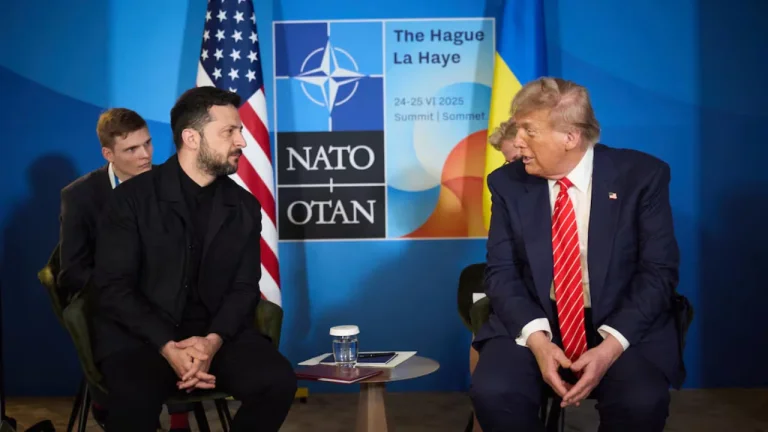
(10 months ago)After this week's historic meetings at the White House, President Volodymyr Zelensky says Ukraine and its allies “are already working on concrete content of security guarantees”. And Britain has sent Chief of Defense Staff Admiral Sir Tony Radaki to Washington to determine how the United States can help. But [...]
And Britain has sent Chief of Defense Staff Admiral Sir Tony Radaki to Washington to determine how the United States can help.
But what do the “security reserves really mean?
There's a wide spectrum here, ranging from “to field links”, to the threat of paralyzing economic sanctions on Russia's oil exports, a letter said. BBC, broadcast Periscope.
Let us begin with what Ukraine wants and will not, at least not for the foreseeable future, and that is NATO membership.
US President Donald Trump has ruled out this possibility, but there are many other NATO members who also object to it in silence, such as Slovakia, mainly with the argument that this would significantly increase the chances that the transatlantic alliance would be involved in a fierce fight with Russia.
However, it is clear that Ukraine will need solid security guarantees after reaching a peace agreement to prevent Russia from returning and making a second or third <x0 bite, or”.
That's why Sir Keir Starmer and France's President Emmanuel Macron created the “Will Coalation” with over 30 countries in order to offer Ukraine some international security after signing a peace agreement.
And patrolling Ukraine's airspace is a possible option.
This can be done by placing aircraft on existing air bases in neighbouring Poland or Romania, with US participation.
But they would still need clear and strong rules of commitment if they were something more than a symbolic gesture.
In other words, pilots need to know whether they can counterattack or not if Russia violates the peace agreement, for example, by firing a rocket into a Ukrainian city.
The Black Sea is another area where Western security guarantees can help keep Russia's fleet away and secure the free flow of commercial ships from ports such as Odessa.
Meanwhile, on earth the situation becomes more problematic.
Ukraine is a large country and the front line actually extends over 600 miles, or over 1,000km.
The “Coalation” cannot gather enough troops to decide to defend that line, even if Russian President Vladimir Putin agreed to that, which he would not do.
The Kremlin has reiterated its absolute opposition to the presence of every NATO body in Ukraine under any logo.
So military support here is likely more in the fields of training, intelligence and logistical support, helping Ukraine rebuild its damaged army, along with an ongoing supply of weapons and ammunition.
However, a major question remains about what Russia will accept as a security guarantee for Ukraine.
Many online commentators have suggested Moscow should not have a word on the issue.
But no country in the “Emergency Coalation” is prepared to send troops to Ukraine if this is rejected by Russia. Nobody wants to start World War III.
John Foreman, a former British military member in Moscow who has followed every turn of this conflict, says: “Russia can accept a security guarantee from the US for Ukraine in exchange for formal recognition of conquered territories, effectively dividing Ukraine for a long time, and no (strong) NATO's (guards) in Ukraine and not Ukraine in NATO... (But) whatever happens, the Game Coalition is not the replacement for the power of the United States 1118x>
Will the United States intervene?
Many military experts have said that any next “security force” offered by “The Gates Coalation” should have contributed from the US, something for which until the Alaska summit last week, Donald Trump had refused to engage.
He has now said the US will be involved, but without troops in the field in Ukraine.
In an ideal world, what Ukraine and its allies would like from Washington is like US support for this future imaginary force, but, most importantly, a strong commitment that if Russia violates the peace agreement, then the American military power will especially be available to support Europeans.
Trump has indicated that US air support will be available in some way, but given how many times he has changed his attitude on how to end this war, this “is not as soothing”.
Lieutenant General Ben Hodges, who commanded American Army forces in Europe, says he is skeptical that “The U.S. are really serious about the security guarantees for Ukraine and will provide more than just words”.
He adds: “Europeans do not trust Vladimir Putin and are not in doubt of who the aggressor is in this war. They are concerned that Trump is unable or unwilling to acknowledge Russia is aggressor. Putin will not hold any agreement unless he is forced to do so”.
While former British Defence Secretary Sir Ben Wallace believes the West, collectively, has not been firm enough in Vladimir Putin's opposition.
Until Trump or Europe or both of them are prepared to do something to make Putin want a change, then little will be achieved”. /Periscope