6 hours ago
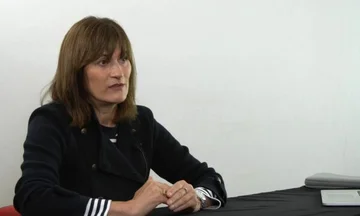
<x) Leah Yip talks with Elif Shafak about writing in the era of demagogues
Periskopi(9 months ago)
(9 months ago)The Guardian Albanian Author of the former “Free” and Turkish novelist discuss increasing populism, censorship, and how today's conflicts come all from unresolved trauma of the past Lea Ypi, winner of awards, her book “Free”, details the experience of growth in Albania, both before and after communist rule. [...]
Albanian author of the free “” and Turkish novelist discuss increasing populism, censorship, and how today's conflicts come all from unresolved trauma of the past
The memories of Lea Ypi, the winner of awards, her book “Free”, details the experience of growth in Albania both before and after communist rule. Her new book, “Downstream”, rebuilds the life of her grandmother, who arrived in Tirana from Thessaloniki as a young woman and became closely involved in the country's political life. Currently it holds the Ralph Miliband seat in politics and philosophy at London School of Economics.
Turkish writer Elif Shafak is the author of more than 20 books, both non-effective and fictional, including the novel selected by Booker “10 Minutes 38 Seconds in this Strange World” and, recently, the “Are Rivers in the Sky”. When the pair spoke in videoconference, Ypi traveled to India and Shafak home in London, their conversation focused on threats of censorship and increasing populism, the challenges of being writers with multiple identities, and the importance of representing complex historical events in their work.
Alif Shafak: It's an age of anxiety. There's so much anxiety, in the east and in the west, young and old, so many people are worried now, it's quite vulnerable. And I think in many ways, it's the golden age for demagogia, for the populist demagogue to enter the stage and say: “let me. I'll make things simple for you.”
Leah Yip: What I'm impressed with is the contrast between this truly rich life found in literature and academy, and the politics of politics. There's an experiment in literature, with cultures and languages, and that's how you feel about complexity. You have almost the opposite of the political sphere, where everything is about simplicity. It's about being inside the message, not making it very complex. Must be short. It must be very simple, on the verge of habitality. And more and more, it's also exclusive. So there is this tendency in contemporary political disinformation to say: All right, let's kick out immigrants a feeling you can only have a fair friendship if you have homogenous company.
Alif Shafak: It is also important to talk about censorship. Not only the pressures that come from the outside or from the top but also from the inside - autocensury. How can we overcome this? I come from a place where words are heavy. Anything you write about, from gender sexuality, memory in history, can offend authorities. I experienced this when one of my novels, Istanbul's “Bastard”, was tried: it tells the story of an Armenian-American family and a Turkish family through the eyes of women, but it deals with the memory, the amnesium and the biggest taboo still exists in Turkey today, which is the Armenian genocide. When the novel was published, the prosecutor sought three years in prison. The words of the fictional characters were brought to court as evidence. And during that time, there were people burning EU flags, spit in my picture, burning my picture, calling me a traitor.
Years later, two of my books were investigated for obscenity crime: 10 Minute 38 seconds in this strange world because there's a sex worker in it, and looking because it deals with topics like child abuse, in a country where we have children's brides, which, in my opinion, means child abuse. The reason you mention this is because these are the realities of society where we come from. We must create a space for ourselves in which we forget all of this. Because if we start thinking, will people be offended? Will the Authorities Disturb? Then we can't produce any single lines.
Leah Yip: What has been important to me about growth in Albania and then sailing in transition from communism to the post-communist period is that living in a totalitarian society makes you very, very sensitive to propaganda of all kinds, all the time. And so, in fact, there was never this interruption where I first lived in a free world and then I became part of the free world, always dealing with staying alert to see where there are censorship, ideological manipulation and propaganda even coming from places that at first seem completely harmless and innocent.
You're always thinking about the one who's missing critically in a society in which he lives: where's the vacuum in democracy? There is all this praise for freedom, yet we live with politicians and people who make decisions that so clearly restrict the freedom of other people everywhere.
In Albania we have this expression: “Istanbul is burning and the aging is creating”. You're worried that in some ways, what you're doing is completely insignificant, but you tell yourself: my job is to just be critical and put pressure on and remember, try to make people think about how the past shapes, how these ideas repeat, and how these political conflicts in the present have all a history and all come from some unresolved trauma in the past.
Alif Shafak: We have so much in common: the subjects, the themes we deal with, the geography we come from, but the silences we dig into. I think for both of us, memory is important, not to get stuck in the past, but because without recall we can't fix.
Leah Yip: It starts with understanding how every voice there is always the result of a relationship of power or something. This was my experience with the script of “Downtown”, which was about my grandmother, and entering the archives. It turned out that research was very difficult for a woman who lived in the 1920 ' s and 1930 ' s. She lived in Thessalonica, which while this cultural city was growing was still very Ottoman. He had just become part of the Greek state, and they completely shaped the disk of what they wanted to show and how it was shown.
If you rely on official authoritarian resources, they all have their own agenda, and the way they build the archive, the way they write the story, even the way they form literary traditions, they always have a agenda that is usually the agenda of the ruling people. So how do you challenge this? I think only when literature becomes resistant can she challenge this, but she has to aim clearly to do that.
Alif Shafak: I think being a writer is a little bit like being a language archaeologist: you have to dig through layers of stories, but also a layer of forgetfulness. Of course, with the Ottoman Empire, we are talking about a multiethnic, multilingual, multireligious empire that lasted for over 600 years. It's very complex and history changes according to what it shows, but also what we're aware of is who's not allowed to tell the story. This is what we want to achieve.
So the way Ottoman history is taught in schools, and I went to Turkish schools: there is a void and that empty space almost always is filled with ultranationalist imperial homes, sometimes ultrareligious, that speaks of that great empire that we were. Wherever we went, we brought justice and civilization. The moment you start asking: Okay, what about women's stories? How was the Ottoman Empire for a prostitute, for a harem concubine, for a peasant woman with no access to power or authority? Then there's a big silence. Or the moment you start asking about minorities, perhaps a Jewish miller, a Kurdish peasant, an Arab farmer, a Greek sailor. How was the Ottoman Empire to them? Or an Armenian silversmith? Again, great silence.
But if I can add that quickly, I don't like it when writers try to preach, teach, or lecture, and I think that's something we should be very careful about.
Leah Yip: Literature has this democratic function only because it doesn't preach. If he preached, he would lose it. If you were to tell your readers: “So you should see the world, that's right and that's wrong”, then you become authoritarian.
And then, in fact, literature loses that power it has to continue with the reader. I don't think the book is finished when the writer writes it: he keeps writing in his own recession, the way people discuss it, the way his topics feed on social and cultural debates in a broader sense.
When “Free” was released, people continued to send me this picture of [Turkish president] Erdogan with the book during a summit to discuss the Armenia-Azerbaijan peace treaty. It's kind of uncomfortable on one level, because you see this book and you know how you wrote it, and you know what you wanted to write, and it all had to do with freedom, and then suddenly you see these very authoritarian characters with it. In any society, some politicians adopt art of all kinds, but I tend to say simply: “Yes, but this is also part of the history of the book”.
It's a place of uncertainty, and I also have a vague attitude toward it; I don't like the fact that I'm the writer who writes about Albania, or Communism, or what it is like to live in totalitarianism and then capitalism. What makes it special for me, and I'm sure this is the same for you, is that it's a small place from which you can actually rebuild the world. Albania is a country that was under the Ottoman Empire, but my hometown, Dursey, was a Roman city. It has one of the biggest amphitheaters in the Balkans. It used to be a Helen City. Thereafter, it was a center for Byzantineism. It was conquered by Venice. So in these 100 square meters downtown, you have a millennium history of Europe.
I always laugh when I hear discussions about EU membership, because I think, when haven't we been touched by the EU? When has Europe ever left us alone?
Alif Shafak: It's a serious experience to be a Turkish novelist, and for a female novelist, I think it's a little bit more serious, because you have to deal with the extra layers of mysogenia and the patriarchate. I don't want to paint a stark picture, but I want to be honest: they hit you on one page, and you always have that pain, but they kiss you on the other page, because readers read. History matters, especially in countries where democracy is shrinking: if a country is going back, ironically literature and the arts become increasingly important. So there is this very separate existence.
Leah Yip: I don't know if it's a depressing sign of the time that we have all these really interesting debates in the culture world that don't really reflect on anything that happens in the political world, where, in fact, if there's something, it's the opposite, where you have simplicity, reduction and exclusion. How is it that we still can't find a way to connect both?
Alif Shafak: I can never forget being an immigrant in the United Kingdom. But also, I'm someone who really believes in multiples. Of course, being Turkish is a big part of my work and what I am, but Britain also gave me a lot. English gave me much, and I have written in this language for over 20 years now. How can I deny giving me a sense of home? But I'd like to think of myself as a citizen of humanity, as a citizen of the world, which has been so underestimated at this time by populist demagogy. We're told that if you're a citizen of the world, you're a citizen of nowhere, and that's something I want to challenge. I think that's wrong. We're living in a very complex era. We have major global challenges ahead, and everything, from the climate crisis to the possibility of another pandemic to deepening and expanding inequality, shows how deeply interrelated we are.
Interviewed for The Guardian by Alex Clark