6 hours ago
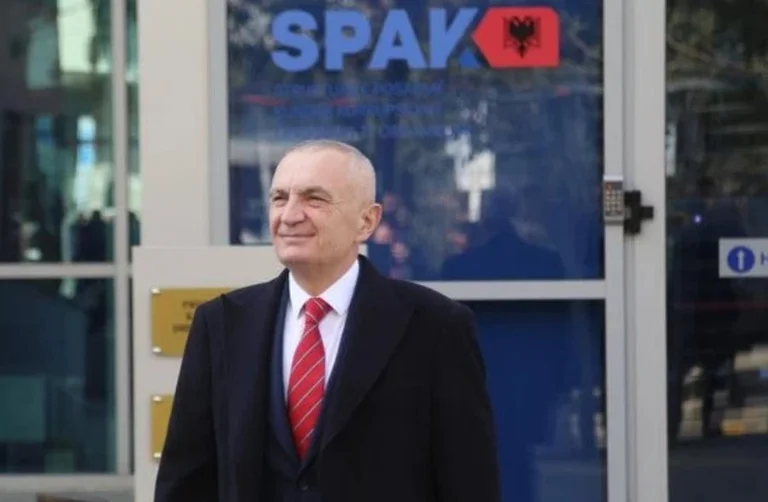
JCKKO Explains Why Former President Ilir Meta was left in prison
Periskopi(10 months ago)
(10 months ago)The JCKKO has made the decision this Thursday not to replace the security measure “prison arrest” for former President Ilir Meta. In the decision to say that the evidence is “alive” listing that witnesses will be questioned in the trial and cannot be affected by it. According to the Special Court, Meta's role is most [...]
In the decision to say that the evidence is “alive” listing that witnesses will be questioned in the trial and cannot be affected by it. According to the Special Court, Meta's role is heavier after formalising investigations and accusations. This is the point you consider the measure to be proportional
The former president and currently head of the Freedom Party are accused of some serious criminal acts, including passive corruption and money laundering. The court estimated that the risk of Meta's influence on the evidence and witnesses still remains high.
JKKO's justified decision for Freedom Party President Ilir Meta:
At the conclusion of the trial of this case, thanks to evidence submitted to the trial, the Court estimates that in the concrete case, we are not registered to be before any of the cases envisioned in the law when the court may be able to replace the personal security measure “arrest at” with another softer security measure. More specifically, the court estimates:
First, we are not ahead of the occasion when the security measures applied no longer respond to the importance of the fact or to the punishment that could be imposed. Under the trial, new circumstances later established and related to the criminal work for which security measures have been established were not identified, which would lead the court to the conclusion that the measures of security carried out no longer respond to the importance of the fact or sentence that could be set. On the contrary, during the trial proved that the prosecution organ (the Special Prosecutor) with the ruling dt. 26.05.2025 “For taking the person as a defendant and reporting the prosecution” based on K.P.'s Article 34. Criminal has decided: “1. Taken in the quality of the defendants, the under-investigated person Ilir Metaj charged with carrying out figures of criminal acts “passive corruption of senior state officials or locals” in 3 (three) cases out of which, in 2 (two) the cases have been carried out in co-operation, “Cleaning of criminal products or criminal activity (4)x6> carried out in co-operation, and more than once and “Refuse to make statements, not to hide or declare false assets, selective persons' interests and public employees, or the person who has any legal obligation for 2688 different statements, 2520/07, KVE. As of the above, it is found that at the moment of development of this trial, compared to the timing of the implementation of the personal security measure “arrest at the prison” procedural positions and researchers are more serious because due to the evidence that has been collected during the investigation, he has already received the quality of the defendant by formally communicating to him and the charge in his charge. So, in concrete cases, in the case of the prosecution, at the moment of developing this trial we have a consolidation of it.
Under these conditions, the court estimates that even at the moment of the development of this trial personal security measures “prison arrest” assigned to indictees Ilir Metaj, it continues to be proportional to the importance of the fact and the sanctions predicted for concrete criminal acts for which he is charged (entine 229 of the KPP).
Second, the court estimates that we are not before insurance needs are eased. An argument against the defendants Ilir Metaj and his defenders during the trial were alleged that the security needs have eased after the prosecution's body has completed the investigation by collecting all the precious evidence needed for the trial of this criminal case, and in these conditions there is no longer any danger of having to influence the authenticity of evidence.
The prosecution rejected this claim, stressing that in the concrete case there is no easing of the security needs as long as the prosecution has been consolidated and the researcher has assumed the quality of the defendant by ascribing to you and corresponding charges. Also, according to the prosecution's body, it is estimated that the risk for obtaining evidence follows that this is possible, as during the trial it will be required to be asked as a witness to a number of people who are part of the political subject where the defendant is president. In these conditions, the prosecution's body estimates there is again the danger of the defendant being influenced by obtaining evidence in the concrete case so that these citizens can make statements in favour of his position in relation to prosecution.
In terms of this claim, the court finds that the prosecution body (the Special Prosecutor) is based on Article 327 of K. P. The criminal on 28.07.2025 with the action “No credit for completing the investigation” has notified defendants Ilir Metaj of the outcome of criminal prosecution investigations (in the report has personally signed defendant Ilir Metaj and his chosen protector, av. Cameron Cabrani. In the application of Article 327/4 of K.P. The prosecution's body criminal has announced that he has the right to present memory and documents within ten days, to ask the prosecutor to conduct additional investigations, make statements or ask that he be questioned.
Also, the court finds that the detention measure “in prison is assigned to indictees Ilir Metaj, justifying the existence of, among other things, condition related to the risk of “decomposing the test” according to the forecast of point 3, “a” of Article 228 of the Penal Procedure Code. Courts have estimated that in the concrete case, the presence of the circumstances in which the assessment is established is at risk of the omnipresent freedom of mass security of the researcher (the defendants) Ilir Metaj can poison the evidence or restore the finding and fixing of their natural state. In risk assessment, according to the letter “a” forecast of Article 3 of K 228. P. The crime, the court has taken note of the fact that citizen Ilir Metaj because of the function he currently has or the functions he has had in the past, can exercise his influence to influence the process of obtaining and veracity of other evidence, unlike those documentaries, such as the question of persons who have knowledge of the facts of the investigation, as he is being investigated for several criminal acts. In this way, the power and ties the defendant has created due to the functions he currently has, had or his position in society, create illegal practical opportunities to influence potential witnesses of criminal fact, and also to other public subjects, with the aim of “the deletion of evidence”, to facilitate his position in relation to prosecution.
Even at the moment of the development of this judgment, it is found that criminal proceedings no. 122/2022 Special Prosecutor's Against
View Decisions No. 59 (87-2024-333), dt. 19,11,2024 and No. 165 (87-2025-253) date 17.07.2025 of the Corruption and Organised Crime Court follows that it is still in the phase of the preliminary investigation as no request has been submitted to “for sending the case to trial”, although the prosecution's body has announced the prosecution's outcome.
In these conditions, by comparing the needs of security and the importance of the fact that this provision has been taken with the current state in which the facts and circumstances at the moment the procedure required to replace them do not result in new circumstances relating to the person under investigation, created after making the decision on the arrangement of personal security, which are such as to soften security needs or circumstances related to the fact.
The court estimates that in the concrete case the prosecution's body has communicated to the defendants the procedural act of reporting the outcome of the investigation has not eased security needs by eliminating the risk of obtaining and veracity of evidence. According to our criminal system of nature, evidence is formed during the judicial debate, so all the data gathered by the prosecution body in the phase of preliminary investigations take their place in the trial. It is true that reports on facts and circumstances on which the prosecution will support the prosecution's whereabouts during the investigation, but the value of testing they receive during the trial phase. In this direction, completing the phase of preliminary investigations does not diminish the risk of damage to evidence. The most sensitive is this when we are in front of living evidence, which is such that not only is shaped exclusively during the judicial examination but there is unstable nature in terms of facts and circumstances that present the judicial process. These tests, as long as the moment of fact occurs either under the influence of internal and external factors, tend to lose the ability to reproduce the given as it has been perceived. In contrast, frozen evidence does not change over time and under pressure from various factors. Even here, however, it should be considered that the way to obtain such evidence can be found as in violation of the law and as such evidence to be declared useless, which would result in the need to retake it.
In this context, the court estimates that, if it can be admitted that the risk of obtaining evidence is reduced by managing frozen evidence from the prosecution body during the phase of preliminary investigations, this cannot be said of living evidence. The Witnesses and the rest of the people, or even the experts, if their question arises, will have to reproduce what they have perceived before the court and answer the questions of the latter and the parties. The exception is made only in the case when the defendant seeks short trial and the court acknowledges it, taking the statement given during the phase of preliminary investigations. Such a fact does not turn out to have occurred in the concrete case, as the issue still lies in the phase of preliminary investigations. In this regard, living evidence is always threatened by the influence the defendant can exert on them.
The prosecution body (The Special Prosecutor) informed the court that during the investigations conducted under criminal prosecution no. 122/2022 has been questioned by a considerable number of citizens who are aware of criminal facts of the investigation. Part of them have been and continue to be also currently members or enjoy positions on the political subject in which the incorrigible is currently president. The prosecutor suggested to the court that all these citizens would be sought by the prosecution's body to question the witness's quality by being considered living evidence.
Under these conditions, the court estimates that there is again the danger that citizens Ilir Metaj because of the function he currently has or the functions he has had in the past, can exercise his influence to influence the process of obtaining and veracity of other evidence, unlike those documentaries, such as the question of persons who have knowledge of the facts of the investigation, as he is being investigated for certain criminal acts. In this way, the power and connections the defendant has created due to the functions he has actually had or had in society, create illegal practical opportunities to influence witnesses, and also to other subjects with the purpose “degeneration of the test”, to facilitate his position in the process.
In conclusion, considering all that was reasoned and analyzed as follows, the Court estimates that there is no room for replacing the measure of personal security with character constraints “prison arrest” envisioned by K.P.8. The crime, against defendants Ilir Metaj, with any other measures easier.