6 hours ago
“Graca” for procrastinating the Parliament
Periskopi(10 months ago)
(10 months ago)For some analysts of political circumstances in Kosovo, the Vetevendosje Movement is using the Framework Constitution Process as a strategic game to extend government lives in office and gain political advantage. According to Agon Maliqi, a clear example was the constitutional session of August 26th, where the Speaker of the Parliament was elected. [...]
For some analysts of political circumstances in Kosovo, the Vetevendosje Movement is using the Framework Constitution Process as a strategic game to extend government lives in office and gain political advantage.
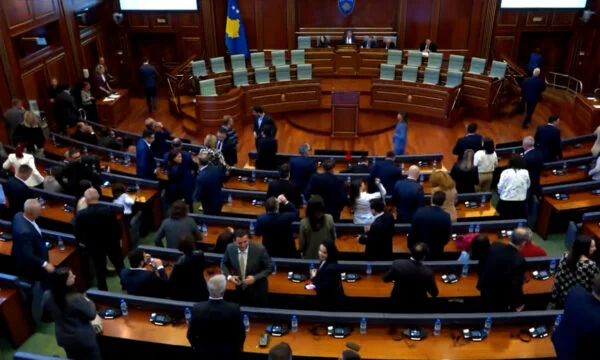
According to Agon Maliqi, a clear example was the constitutional session of August 26th, where the speaker of the Parliament was elected, but the necessary deputy speakers were not elected, the Serbian community's representative, respectively.
He says the former opposition parties, P DK, LDK and AAK fell to “racken” of Vetevendosje.
They did not vote the deputy leader proposed by the Serbian List, keeping the constitutional process blocked due to, as Maliqi says, fears of public opinion response and by Vetevendosje's naturist, which presents this party as Serbia's <x0 length-long”.
Without this vote, the Assembly remained unfinished, and thus Vetevendosje “managed to preserve the government's service of duty”.
“Opposition parties are accepting this kind of ʹloje) more because of electoral fears”, Malqi says of Radio Free Europe.
In the 58th continuation of the constitutional session, on 26 August, Vetevendosje Movement MP Dimal Basha was elected chairman by 73 votes, including those of the former opposition parties, PDK and AAK.
The same day, three deputy speakers from Albanian parties -- a deputy head of non-Serb minorities -- were elected, but not Serbian deputy leaders.
MPs refused to vote on the candidate proposed by the Serbian List, Slavko Sibiu, and similarly did not pass the other candidates Basha put into the polls.
Why didn't the Serbian deputy leader vote?
Radio Free Europe attempted to contact several deputies of the Democratic Party of Kosovo to clarify the reasons for the failure of the deputy head of the Parliament from the Serb community, but without success.
MP The PDK, Progress Gruda, said of T7 Television on Tuesday that his party does not vote MP Slavko Simi, proposed by the Serbian List, but does not rule out the possibility of support for another candidate from the same party.
The Democratic League of Kosovo did not participate in the vote by the Speaker of the Parliament, honouring an earlier pledge not to support any Vetevendosje candidate, nor Serbian candidate for deputy chairman.
Alliance for the Future of Kosovo MP Time Kadrijaj said the AAK's position was and remains not to vote for the deputy head of the Parliament from among the Serb community.
We didn't vote because we didn't. Simply, it's the position of deputies we've been there”, Kadrijaj said.
Now, should we perform all the tasks of Vetevendosje Movement? Albin [Curty] to stay in the first chair there and we solve the problem of even the House Constitution, and perhaps even forming government? Are you wrong to place a burden on us?
Enemy, otherwise, is under investigation for attacks on journalists in the north.
Politologist Dritro Arifi says that since the start of the Parliament's transition on April 15th, political parties have set traps each other.
According to him, the former opposition, refusing to vote on names that were part of the past Vetevendosje-led government, gave the latter the opportunity to impose its candidate for Parliament chairman, Dimal Basha.
Basha known for its harsh language to opponents, justice system and the media, was MP in past legislatures.
Header The PDK, Memli Krasniqi, said his party voted Basha to unblock the constitution, but added it does not believe even Vetevendosje deputies are fully satisfied with this election, hinting that his appointment was a compromise imposed by the political situation.
A day after Basha's confirmation at the legislature's helm, his co-party, Libun Aliu, resigned from the position of acting Minister of Environment, Space Planning and Infrastructure.
But, even according to Arifi, the former facility fell to “gracken” of Vetevendosje.
Refusing to vote on the Serbian deputy chairman, it enabled Vetevendosje to set the pace of the blockade, he says.
“... because there is no sense that a minority will delay the majority's decision. If they have a problem with the Serbian List, it should always be considered legally. If those deputies [of the Serbian List] have been certified and passed the filters, it is absurd that you now try to primitively remove them from the Kosovo Assembly”, Arifi says.
He adds that the former opposition parties, perhaps, would have failed to elect the Serbian deputy leader without Vetevendosje votes.
But, according to him, they risked entering Vetevendosje's “illegal and unconstitutional play”, which, like the mostly parliamentary party in the Assembly, indicated it does not want to have a Serbian List deputy chairman.
It seems that Vetevendosje wants to prevent the constitution and therefore the formation of the Government. And that brings us to the time limit set by the Constitutional Court, when after September 17th it expires the 30th day [for the constitutionalised Assembly]. What then?
One scenario, according to him, would be that the manner of voting of vice-presidents from non-party separate parties and not in packages as required ʹ would be used as an excuse by deputies appointed to request interpretation by the Constitutional Court.
This process would further extend the time of the full restoration of the Assembly, going to the seventh of Vetevendosje, Arifi says.
If that happens, the “risks exist that, in the absence of a constitutional Convention and a new Government, the country's budget can't be voted in either, which would lead the country to bankroll”, he adds.
Maliqi expects the 30-day deadline for the constitution, set by the Constitutional Court on 18 August, to be respected.
“This [blockage of the constitution's constitutionalisation] will be passed in a moment, in one way or another, whether by votes in the Assembly, or by the Constitutional Court's decision on [the vote of the Parliament's vice-presidents from the ranks of non-party communities]. But even when overcome, there is hardly any interest in [new] Government with this composition of the” Assembly, Maliqi points out.
According to him, neither party has enough votes to create a stable and long-term Government.
In the February 9th elections, Vetevendosje with its partners won 48 seats from 120; PDK 24; LDK 20 and the AAK-Nisma 8 seat coalition.
Without a governing partner, Vetevendosje cannot secure the majority, and according to some analysts, its aim is to go to new elections or to drag on forming the Government to avoid difficult processes, such as implementing the Agreement for normalising relations with Serbia.
However, incumbent Prime Minister Albin Kurti has pledged that his Vetevendosje will form new institutions.