3 hours ago
Five Cases Before the EU This fall
Periskopi(10 months ago)
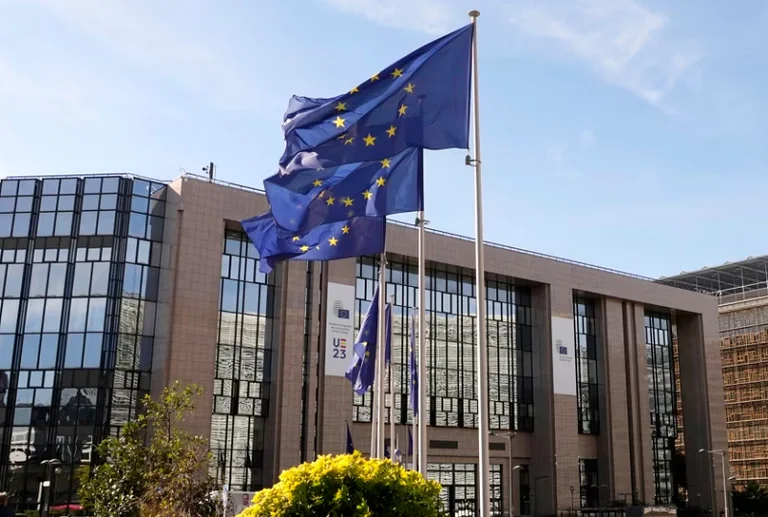
(10 months ago)The European Union is most of August at summer break, without the European Parliament's plenary sessions, without Council meetings and without committee meetings. Simply put, during these weeks there is no discussion, and no less placed on any important matter. But once diplomats and officials return [...]
The European Union is most of August at summer break, without the European Parliament's plenary sessions, without Council meetings and without committee meetings.
Simply put, during these weeks there is no discussion, and no less placed on any important matter.
But once diplomats and officials return to their offices in September, the EU will face possible difficult decisions and dilemmas during the autumn.
Radio Free Europe brings about five main issues expected to be the focus of attention in the following months.
Will Russia's assets be unblocked?
Over 200 billion euros of Russia's frozen assets are located in the European Union since February 2022, when the bloc began imposing sanctions on Moscow after the launch of Ukraine's Russian occupation.
Since then, a heated debate over what to do with this money has continued.
On August 29th-30th, EU foreign ministers gather in Denmark for an informal meeting known as “Gymnic”, which often marks the opening of the autumn session for the bloc.
EU foreign policy chief Kaya Kallas has made it clear that this is the time to decide on the fate of assets by labeling it a powerful means of shopping for the future, but also a source of legal dilemmas.
Many EU member states, particularly those in the east that have a tougher approach to Moscow, require that money be confiscated to finance weapons for Ukraine or to recharge the bloc's arsenal. Their argument is that this could cover the potential lack of US funding and that it is more appropriate for Russia's money to be used for that purpose instead of European taxpayers.
EU vows to continue Ukrainian arming
Others, especially larger countries, are not ready for seizures yet. They say this money could serve as a negotiating card for peace or truce, as Moscow wants to regain part of it. It is also cited as a means of pressure on the Kremlin to cooperate with the new war tribullal. Another option is for assets to remain frozen to finance the reconstruction of Ukraine after the war ended.
The European Central Bank has expressed fears that seizures of assets could damage the euro's reputation as a global currency and discourage countries from investing in the Eurozone.
Belgium, where the central security deposit is located “Eurochaclear” which holds most of these sovereign assets, is also cautious of unilateral actions. The Belgian argument is that frozen assets are a “gold opportunity”, as the unexpected profits they generate -- about 1-2 billion euros every three months -- go directly to Ukraine's ark.
Will Moldova and Ukraine be divided on their path towards EU integration?
So far, Ukraine and Moldova have moved together on the road towards membership in the European Union. Both received candidate status in 2022 and, at the end of 2023, EU member states agreed to start membership talks with them.
Most European diplomats expected the first half of this year to bring the opening of the first chapters of 33 in total, both Chisin and Kiev. But Hungary is blocking the start of these negotiations, claiming Ukraine does not guarantee the rights of the Hungarian minority. What must Ukraine and Moldova do to become EU members?
Since Moldova and Ukraine are “connected to” so far in this process, the blockade affects Chisin as well. This spring there were discussions to split these two countries into the membership process, so that at least Moldova could move forward, but no consensus was reached.
Hungary has signalled that it will not back down on that stance, especially after a non-binding referendum earlier this year, in which 95 per cent of participants voiced themselves against Ukraine's EU membership. Many EU officials believe this position will not change until after the Hungarian parliamentary elections in April 2026.
Moldova, meanwhile, holds elections on September 28th, where the pro-European government requires a new mandate. Rumours are circulating in Brussels that Ukraine and its supporters have accepted a division of the process, where Moldova would advance alone. Such a decision could be made in early September to potentially influence pro-EU forces in Moldovan elections.
What will the EU do for Georgia?
Brussels is expected to continue this autumn facing the return of democracy to Georgia, and some decisions may reflect this reality. The European Commission sent a letter to the Georgian Government in July, asking that by the end of August, it fulfil the eight conditions set out at the end of 2024, including the abolition of the controversial Law for the Serbian “agents” and the equally controversial legal package for the “family values and the protection of minors”.
Few in Brussels expect Tbilisi to make major moves on these issues, so the question remains: how and when will the EU respond?
So far there have been no sanctions against ruling party officials Georgia Dream or judges considered responsible for targeting opposition and protesters, as Hungary and Slovakia have blocked them and are expected to do so again. EU warns Georgia of violation of fundamental rights, warns visa suspension
In Brussels it is working on suspending Georgia's visa liberalisation with the bloc. Only a qualified majority of EU member states (55 percent of member states representing 65 percent of the EU population) are needed for this measure, and that majority appears to have been secured. It would be the first time the EU suspended visa liberalisation for a candidate country, but Brussels appears to be preparing the necessary legal framework.
We can also see the suspension of some parts of the EU-Georgia Association Agreement, including its aspects of free trade. The question remains in terms of time: EU foreign ministers do not officially gather in Council forms by the end of October, leaving Tbilisi more time to respond. Until then, Georgia will also have held local elections on October 4th another indication of the direction this republic of the South Caucasus is taking.
Implementation of the New Travel System
After much delays, on 12 October, the European Union will finally start implementing the (EES) login system. This system matters to all citizens who are not from EU countries and who travel to 24 participating member states (all EU countries except Cyprus and Ireland, while Denmark can join later), as well as to four non-EU member states Norway, Iceland, Switzerland and Liechtenstein.
EES ends the manual sealing of passports and aims to replace it with a sophisticated technological system at any international airport, port and land border point, which records access, exits, fingerprints and facial images.
Implementation will take place gradually over the next six months. EU member states that have large international travel centres fear that an immediate and full start of this system would cause collapse. For a long time it was believed that the EES technological system was not technically sustainable, but EU officials now express confidence that everything is ready for operation.
By October, implementation of new travel regulations in Schengen area begins
If fully implemented The EES ends in the first quarter of 2026, it can also be expected that ETIAS (the European Travel Information and Authorisation System) will begin later that year, as both systems are interconnected.
ETIAS is the equivalent of the EU for the Electronic Organisation Authority System (ESTA) of the United States, and is expected to have a major impact on travellers entering the EU without visas.
Some 1.4 billion persons, including citizens of Great Britain, Georgia, Moldova, Ukraine, the United States and the countries of the Western Balkans, who are not part of the EU, will need this authorization before first entering the bloc. It will be worth three years and will cost seven euros.
Where are elections expected?
Not many elections in Europe are expected this fall, which is rare. Moldova holds a decisive vote in September, while early elections will be held in the Netherlands at the end of October, where it is expected that the right-wing PVVV party will come first, but it is likely that a coalition of centre-left and green will form Government.
Perhaps the most interesting vote will be in Czechia on 3-4 October. All polls show populist Andrej Babish will return to power. The main issue to follow is whether his ANO party will rule alone, with the support of forces even more radical to the left and right of the political spectrum, or whether any party from the current pro-European coalition will give support. This will determine what kind of Czech will appear on the European stage.
Slovakia's Prime Minister Robert Fico, and Hungary's Victor Orban, will likely welcome a partner in Prague, with which they share their positions. Meanwhile, after populist Carol Nawrocki was recently sworn in as Poland's president with the expectation of blocking the legislation of the most liberal Prime Minister Donald Tusk, rumours in Warsaw that his government could fall, paving the way for the return of the conservative Law and Justice party.
A (V4) Visegrad Group, with similar attitudes, is again emerging. This four-nation Central European bloc has played an important role in shaping EU policies for years. But, due to recent political differences, the V4 had largely remained a passive concept. Now he can return as a factor to be followed closely, writes REL.
Of course, there are still differences, especially in terms of relations with Russia, and Warsaw continues to be somewhat exempt, as Tusk is expected to continue his course. But if Babish returns this autumn with a clear popular mandate, then we will have three Central European capitals with a skeptical attitude towards both Brussels and Kiev.
This, of course, can change again when Hungary holds the long-awaited parliamentary elections in the spring of 2026, but at a key moment for Europe, the Visegrad countries can turn into a source of great surprises for developments to come./Periscopi/