6 hours ago
Supreme Sets Borders

Periskopi(a year ago)
(a year ago)The long-standing crisis over the formation of institutions in Kosovo recently added to a new challenge: the Supreme Court's decision, which considers the extraction of illegal acts by ministers who are at the same time MPs, as illegal and violation of constitutional provisions. The July 15th decision relates to abolishing administrative instruction for the exploitation of equipment [...]
The long-standing crisis over the formation of institutions in Kosovo recently added to a new challenge: the Supreme Court's decision, which considers the extraction of illegal acts by ministers who are at the same time MPs, as illegal and violation of constitutional provisions.
The decision on July 15th relates to abolishing the administrative directive for the exploitation of fiscal equipment, issued by incumbent Finance Minister Iron Murati Bit, who is also deputy and who the Supreme Court has declared illegal.
This act was followed by harsh reactions: The incumbent government named him “armir” and “not based on law” ) arguing that the Law for Government does not specifically prohibit ministers in office to issue sublegal acts as the Supreme Court warned that any interference in its judicial decisions is unacceptable.
The intervention in the judiciary is unacceptable”, European Union Ambassador to Kosovo Aivo Ora said.
Recognisors of constitutional issues say the Supreme Court's decision is fair and mandatory for implementation, stressing that any disregard for it could constitute criminal offenses.
Free Europe Radio asked Kosovo's incumbent government and incumbent Minister Murati what steps they would take after this act of judgment, but received no answers.
The government took no stance on whether or not it is considering the possibility that ministers, who are also deputies, stop exercising executive functions.
The Democratic League of Kosovo addressed the Special Prosecutor on 16 July to seek criminal investigations against the government in office, handing in the Supreme Court's ruling on the fiscal cases.
According to MPs from this party, Besian Mustafa and Alban Zogaj, this decision confirmed that the incumbent government has acted illegally following the extradition of ministers as MPs on 27 March.
KDI: Supreme decision highlights violations and paves way for legal disputes
Volnet Bugakku from the Kosovo Democratic Institute (KDI), which conveys the work of the Assembly, estimates that the Supreme Court's decision concerning the Minister's Administrastration of Finance, Hekuran Murati, is fair and almighty.
He points out that any disobedience or disrespect of this decision constitutes a criminal offense.
What's the government's resignation law say?
“Concretically, in question, Minister Murati, if he continues to hold it in force despite the Court (Supreme) has annulled the legality or content of this Administrative Guide ) then he does not comply with this act of the Supreme Court and commits criminal offense”, Bugakku says of Radio Free Europe.
He emphasises that the Supreme decision, currently, has only effect on the minister's Administration Guide, Murati. All other acts of ministers in office, who are also deputies, remain in force, unless they are disputed in court.
However, Bugakku says, this decision suggests that other similar decisions made by officials with double functions can be illegal and be tried legally.
This Supreme Court ruling could serve as a good precedent or as a sufficient legal basis for all those parties that are infected in a negative sense by public officials' decisions. So, use this Supreme Court bias as evidence to counter [the similar decisions] in the courts and, then, cancel them”, Bugakku says.
He adds that the Supreme Court's decision has well clarified the conflict stemming from the simultaneous exercise of executive and legislative functions by public officials, but expresses concern that it could be used by parliamentary parties for deepening political clashes.
Should members of the government resign after the mandate ends?
Such situation only toughens and cements the sides' positions, in this case of the major parliamentary parties, not to co-operate with each other”, Bugakku estimates.
Legal Consequences in Prosecutor's Hand
Constitutional Law Professor Mazlum Baraliu estimates that the Supreme Court's decision to declare the directive illegal in question is fair, but says it is up to the tracking organs to assess whether there are conditions for launching criminal procedures.
And the ministers on duty themselves... I believe they understand that they should not act with conflict of interest, because they can not only violate provisions that are mentioned in the court case, but may also be found legal grounds for someone to follow. What follows them is the country's prosecution and we cannot prejudge whether it will do so”, Baraliu says of Radio Free Europe.
He explains that Kosovo does not have a judicial system that is called in precedent, so the Supreme Court's recent ruling does not apply automatically to other cases.
According to him, citizens or businesses can seek justice through lawsuits if they think they have been damaged by any decision by ministers in office who also hold an MP mandate.
“So, they can definitely launch (suit) because the principle of analogy in justice is a principle that is highly valued and is a functional standard principle”, Baraliu says.
LDK hands over Supreme Court ruling, urges criminal investigation into government
The ministers in office now face at least 17 criminal charges, raised by the LDK.
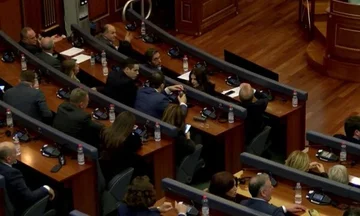
Kosovo continues to remain in office with government, as, after the February elections, the Assembly has failed to constitute itself due to deep political disputes.
The next attempt at the institution, 48th, will take place on July 17th.