9 hours ago
Special Court Speaker reasons keeping KLA leaders in custody: Respecting Standards
Periskopi(a year ago)
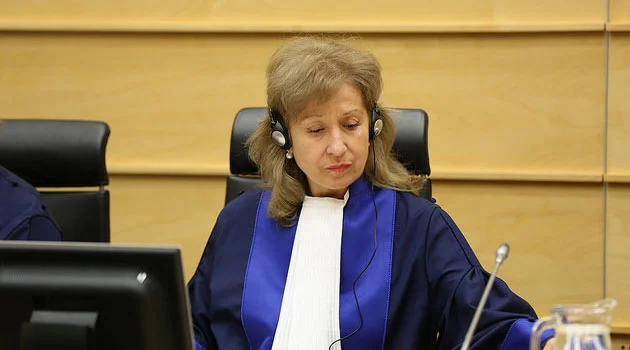
(a year ago)Ekaterina Trendafilova, head of The Hague Specialised Chambers, has argued the judge's decision that is refusing to be released from custody of KLA leaders. In a Nacional interview, Trendafilova has said judges thoroughly analyse all circumstances before the detention is continued. Asked whether the Special Court was taking [...]
In a Nacional interview, Trendafilova has said judges thoroughly analyse all circumstances before the detention is continued.
Asked whether the Special Court is violating international practices that detention is exemption, not rule, Trandafilova has said it does not stand.
The true “, detention is the exception, and this is the case with the Special Chambers. Given the legal regulation of the Specialised Chambers, the detention decision must be assessed and revised every two months. This two-month review takes place after a case-by-case analysis of the specific circumstances that stand at the foundation of each review, and detailed reasons in accordance with the circumstances. The judges order the continuation of the detention if they estimate there is danger of the defendant escaping, preventing procedures, or committing other crimes”, She said.
The fact that persons are not being released, given such complex and detailed analysis, cannot lead to the conclusion that detention has become a rule and provisional release of exemption. This is simply not an exact reflection of the legal framework, which is fully in line with international standards and judicial decisions made by the Specialised Chambers”, She said further.
The first of the Specialised Chambers also spoke of the height of sentences by Specialised Chambers, and the fact that there are doubts that the Convention on Human Rights is not being respected.
INT ERVISTA:
1. President Trendafilova, as an experienced judge, can you clarify the decision on continuing custody of Kadri Veselini, Rexhep Selimi and Jakup Krasniqi?
1.As an experienced judge, I will not comment on the decisions of other judges, who are absolutely independent in their work. Decisions offer detailed reasonings, which are public and available on the website for everyone who wants to analyze. I would like to stress that in all systems based on rule of law, the decision can be challenged in a higher court, so we should see if there will be appeals to this case. As you are aware, as Court Speaker, I lead you to the Supreme Court, which can decide on the detention case if decisions are rejected on that scale.
2. You are aware that detention, based on the International Convention on Human Rights, is an exception. In the case of Specialized Rooms, it seems to have become a rule. Why does detention continue to be established as a measure, even though the prosecution has ended up presenting its witnesses and evidence? Who can be influenced by the accused, and what are the evidence that can be compromised?
2.True, detention is the exception, and this is the case with the Special Chambers. Given the legal regulation of the Specialised Chambers, the detention decision must be assessed and revised every two months. This two-month review takes place after a case-by-case analysis of the specific circumstances that stand at the foundation of each review, and detailed reasons in accordance with the circumstances. The judges order the continuation of the detention if they assess there is danger of the defendant escaping, preventing procedures, or committing other crimes. They also consider whether any possible alternative measures, besides detention, can ease these risks. Recently, defendants have the right to reject any such decision for detention before an Appeals Panel and under certain circumstances, ahead of higher institutions.
The fact that persons are not being released, given such complex and detailed analysis, cannot lead to the conclusion that detention has become a rule and provisional release of exemption. This is simply not an exact reflection of the legal framework, which is fully in line with international standards and judicial decisions made by the Specialised Chambers.
Moreover, and as mentioned, such decisions may be rejected before various independent panels. This is a full and detailed process, during which the judges of these panels take into consideration the specific circumstances of the case. As far as the reasons given by the panels are concerned, judges have estimated there are still risks that accused persons could prevent the progress of procedures or perform other criminal acts.
It is also noteworthy that there have been and continue to be several cases in front of specialised rooms that have tried or claimed criminal acts for obstructing justice against a total of 11 people, including three accused of admitting guilt for witness intimidation and have been convicted respectively. Panettes have repeatedly emphasised a climate of witness intimidation in Kosovo. This is a reality and cannot be ignored. Finally, I want to remember that one person has been released on parole in the past and that another defendant is subject to the call to appear rather than detention.
3. The threat of escape has been dropped in some decisions by judges. The danger of repeating criminal acts is impossible. As far as the threat of witness influence and damage to evidence is concerned, the prosecution has ended up with them. What might be the reason there is now for continuing detention?
3. As already mentioned, I would refer to the specific reasons presented in the decisions, especially the assessments regarding witness intervention. Here, the panel noted that other important witnesses to procedures could be the object of intervention or revenge. It would be very simple to conclude that intervention with witnesses is no longer possible once the prosecution's presentation of the case ends. That depends on the individual circumstances that judges should assess.
4. On the other hand, so far, there has been no relief from the measures at the Centre of Pre-burging. Why?
4. Conditions at the Pre-prison Centre are monitored and completely by the Red Cross and the ombudsman to ensure that all the highest standards for all detainees are being respected. They can be socialised, play different sports, cook if they want, and engage in artistic and professional activities. They have 10 visits with relatives and friends every month and private visits with spouses and children outside the detention officers, as well as phone calls throughout the month. Additional measures for three of the detainees were imposed, such as monitoring unprivileged visits on the part of the judges, as evidence presented by the prosecution showed that the detainees were revealing confidential information from the judicial process.
5. How do you comment that The Hague Specialised Prosecutor has criticised the Kosovo Police, even though police are roommates in many visits or implementation of decisions?
5. I don't comment anything the DA said. As you know, the prosecution and the Court are two separate and independent institutions. As a result, I do not comment on anything concerning the organisation, management, policies and strategy of the prosecution's operation.
6. A question of punishment. We had a Constitutional Court ruling in Salih Mustaf's case. Can you explain this audience in Kosovo briefly?
6. Again, decisions make good sense, and they are public on the Special Court page. However, briefly, Mr. Mustafa complained to the Constitutional Court on the grounds that the Supreme Court has failed to implement Kosovo's softest law in its condemnation, excluding the law that had been implemented at the time when criminal acts were committed. In its ruling, the Constitutional Court recalled that under Article 162 (1) of the Constitution, the Specialised Chambers function in line with their legal framework within Kosovo's justice system. As a result, fundamental rights and freedoms guaranteed by Chapter II of the Constitution apply to that independent framework.
The Chamber also found that the only law that has binding powers for sentences before the Specialised Chambers is the Law for Specialised Chambers and the Specialised Prosecutor's Office, which does not require criminal rooms to enforce other Kosovo laws when deciding on criminal sentences, but only to take into consideration. So she decided that Mr. Mustafa could not successfully claim a violation of the Kosovo Constitution or the European Convention for the Protection of Human Rights.
Mustafa's case clearly shows how decisions can be rejected before various specialised chamber panels, in line with their legal framework, fully in line with universal standards for reviewing judicial decisions. Mr. Mustafa has exploited all legal means and review phases, appealing more than once in front of the Appeal Panels, the Supreme Court Chamber and the Constitutional Chamber of Specialised Chambers. The judicial review system of Specialised Chambers reflects Kosovo's legal system and that of all legal democratic systems, where judicial independence is valued, respected and protected. The specialised chamber jurisdiction shows that the judicial revision system works well.
7. Based on the Convention on the Protection of Human Rights, no person can be punished more severely than the law that has been in force when criminal acts have been committed. This principle is international and applicable today. Why do Kosovo's Specialised Chambers not decide based on this principle?
7. I believe that you are referring to the European Convention for the Protection of Human Foundation Rights and Freedoms, which is affirmed by the Special Chambers and the principle of the softest law has been considered and implemented by the Constitutional Court. I would also remind you that the 15-year sentence of Mr. Mustafa is no higher than the sentence for which he himself has been involved.
8. Both, the Constitutional Court, under which the Specialised Chambers are created, and the Law on Specialised Chambers underlines the principle of the Convention on Human Rights. Why, President Trendafilova, does the Special Court differ from those principles?
8. As I explained earlier, the Law of Specialized Chambers is fully consistent with these principles. If an accused disagrees with a verdict or trial, he can appeal to the highest instance or complain to the Specialised Chambers of the Constitutional Court, and a completely new panel of international judges will review the issue and decide whether the previous panel has made a mistake or not in its conclusions.
9. On July 18, 2013, the European Court for Human Rights in the case of Maktouf and Damjanov found that the court in Bosnia had not observed the principle of the Convention regarding the most favourable law, and the entire structure of sentences there was changed. Why are the European Court for Human Rights precedents not respected by the Special Chambers of Kosovo?
9. The decision in the case of Maktouf and Damjanović against Bosnia and Herzegovina was not the only case of the European Court for Human Rights to be considered in the case Mustafa in front of Kosovo's Specialised Chambers (KSC). Rather, the European Court's entire relevant jurisdiction regarding the principle of the softest law was detailed. This comprehensive approach reflects the consistent practice of all KSC panels. This important precedent is undoubtedly respected. In fact, some panels refer to him in terms of the principle of law enforcement. However, it is important to note that specific circumstances in the case Mustafa and laws implemented on Kosovo's territory differed significantly from those in the case of Maktouf and Damyanović, and the law implemented on Bosnia and Herzegovina territory, both in fact and on the part of the legal regime that is implemented before the KSC. The European Court of Human Rights has always stood that each case should be assessed individually, taking into account the specific context. As a result, the issue of law enforcement is milder in Mr. Mustafa was praised within the KSC framework and the particular circumstances of the case, Mustafa. /Periscope/