6 hours ago
Salih Mustafa's complaint rejected that 15-year prison sentence on him violates the Constitution
Periskopi(a year ago)
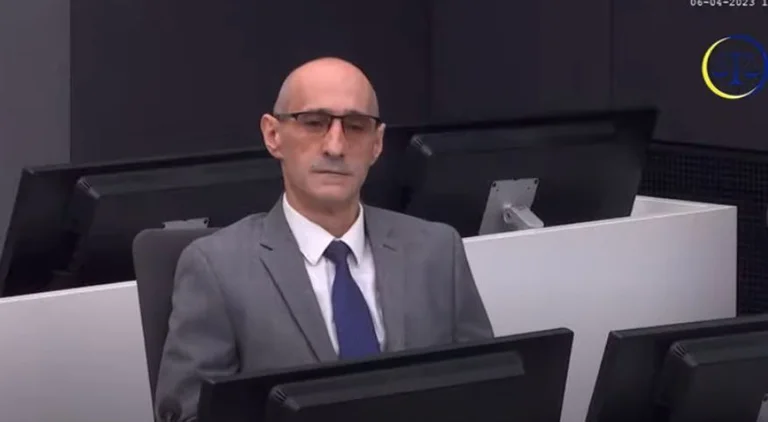
(a year ago)Constitutional Court of Specialised Chambers of Kosovo ( DPSK has dismissed Salih Mustaf's recent complaint, which has claimed that the 15-year prison sentence against him violates the Kosovo Constitution. According to Mustafa, his 15 - year sentence for unlawful murder as a war crime violates Article 33 (3) of [...]
According to Mustafa, his 15-year sentence for unlawful murder as a war crime violates Article 33 (3) of the Constitution of Kosovo, and that sentence was unproportional in relation to criminal acts.
On July 9, 2025, the Court found that the request was unacceptable, reports “The Justice Trust”, broadcast. Periscope.
In the decision, it has been found Mustafa has failed to prove that the conviction pronounced against him constituted violations of fundamental rights.
In his complaint handed down on April 24th 2025, Mustafa had said that constitutional rights guaranteed under Article 33 (3) of the Kosovo Constitution, which stipulates that the penalty rate must be proportional to criminal work.
Mustafa claimed that Apeli when he pronounced the new sentence has violated this provision, which aims to protect the accused and that the Supreme subsequently did not correct this mistake, but rejected the defence rejection.
According to him, the Supreme has not determined any standards of punishment, nor can a sentence be considered unproportional.
Mustafa's defense had said the Constitution should interpret this article, use it and also give clear instructions regarding its interpretation, since there is no such thing so far.
According to the defence, prognition concerns the degree of condemnation, rather than condemnation in general.
Calling the verdict 15 years in prison for Mustafa as arbitrator and unstable, the defence demanded from the Constitutional to approve this request and bring the case to retrial in the respective panel.
According to the Constitutional decision, Mustafa had reportedly complained in September 2024 about violations of Article 33 (2) and (4) of the Constitutional and Article 7 of the Evovarian Convention for Human Rights and Freedoms, saying the Supreme Panel had wrongly implemented the charity principle when it ruled out RSFJ Penal Code of 1976 and identified the Kosovo Penal Code of 2019 that provided the softest law for that kind of criminal work.
Article 33 of the Kosovo Constitution “Absolem of Legality and Proposality at Penal Cases” point 2 says “Sentencing for a criminal offence cannot be harsher than it has been prescribed by law at the time of the work done”. Point 4 of this same article says “Sentences are determined under the law that has been in effect at the time of the conduct of criminal acts, except for works for which later applicable law is more favourable for the head of the work”.
As a result, according to the ruling, the Supreme Court had annulled the second - degree act of condemnation and that the case was returned for review.
The decision on this complaint was made on April 17th 2025, where it was found no violation of the Constitution of Kosovo or the European Convention for Protection of Human Rights and Foundation Freedoms.
While the second statement to be made was against the Supreme Court's confirmation of Apel's 15-year sentence on Salih Mustaf in review.
Under the decision, Mustafa has essentially complained about the interpretation and implementation of the Law and Orders from criminal rooms.
They say the role of the Special Constitution has nothing to do with whether the find of the lower degrees is accurate in a fact or a legal way. According to them, such findings could be questioned only if they are flagrantly and obviously arbitrary, leading to violations of fundamental rights and freedoms guaranteed with the Constitution.
The Chamber stresses the importance of Article 33 (3) of the Constitution, which prohibits penalties that are unproportional to criminal acts. The constitution recalls that constitutional provisions for fundamental rights should be interpreted in line with the European Court for Human Rights's jurisdiction (GJEDNJ) and the European Convention. However, it notes that Article 7 of the Convention, which generally agrees with Article 33 of the Constitution, does not contain a provision similar to the paragraph 3 of this article that deals with the proportion of condemnation.
According to the decision, however, the proportion of condemnation can be assessed according to Article 3 of the Convention, if the sentence is extremely unproportional.
According to the decision, this is a standard that is fulfilled only in rare and extraordinary cases. It says that so far, GEDN has not ruled out violations of Article 3 due to nonproportionality between the work and the punishment, but only for other causes, such as, for example, life sentence without the possibility of release.
In addition, the Constitution has recalled that a constitutional provision could offer greater judicial protection than the Convention and that Article 33 (3) of the Constitution of Kosovo should be systematically interpreted with other norms of the Constitution. According to the decision, this article has largely to do with legal proportion, so that the law-designed sentence is appropriate for the importance of criminal acts.
To illustrate this, the Constitution cited similar provisions in the Cyprus Constitution and the European Union's Charter of Basic Rights, as well as the EU Court of Justice's jurisdiction on the principle of proportionality.
By contrast, Mustafa had made another complaint in the Constitution for violating his fundamental and constitutional rights during his trial at the Foundation and Appeals, about what decision in this case was taken on April 17th 2025.
According to the ruling, the Constitution has not listed actual or legal errors in the reasoning of lower courts, and therefore Mustaf's complaint was declared unacceptable.
The act against Mustafa in the first instance was announced on December 16th 2022, with which Mustafa has been sentenced to 26 years in prison.
While on April 6, 2023, Salih Mustafa was ordered to pay 207 thousand euros for the damage to the victims. Later, he had submitted 51 points to the Court of Appeals' panel against the punitive decision of the Special Foundation to him.
The Special Appeal, on December 14, 2023, has pronounced a case against Salih Mustaf, with whom he sentenced him to a unique sentence of 22 years in prison for war crimes.
According to DPS, Salih Mustafa had applied for protection of legitimacy in the Supreme, and the decision on this requirement was taken on 29 July 2024.
In his request for protection of legitimacy, Mr. Mustafa raised five points, which related to the translation of the Appeals Act into Albanian, his guilty plea for murder as a war crime, as well as the measure of sentence”, said at the DSF report.
The request for protection of legitimacy, Mustafa, had handed over on March 13th 2024 with whom he had demanded the Supreme Court of TSK to modify first and second degree judgments, canceling the sentences for arbitrary ban, torture and murder, thus declaring him innocent or completely canceling his convictions and turning the case into a retrial.
Mustafa has put forward five points, through which he has rejected Appeal's decision, with which he was sentenced to 22 years in prison. Mustafa's request had been accepted in part, so the Supreme One had restored the case to Apel to establish a new sentence on the accused.
In reasoning with the court, the head of the Appeals panel, Michele Picard, said that the first degree court had made an outstanding mistake in condemning Salih Mustaf. She also added that a sentence rated for 22 years in prison, even counting the past time in custody, reflects the overall criminal activity of Mustafa.
And on September 10, 2024, The Hague's Court of Appeals has decided to change the sentence from 22 to 15 years in prison for Salih Mustaf after the Supreme returned the case to that degree. Again, Cal complained to the Supremee about Apel's second decision, but the third scale gave him the sentence.