7 hours ago
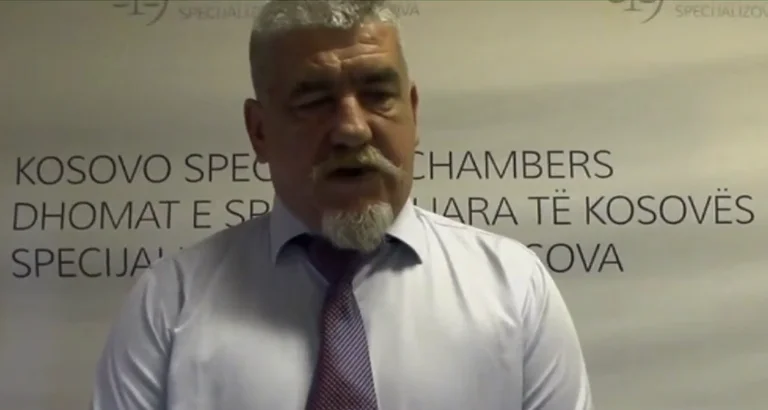
Peter Shala lands sentence in 13 years in prison
Periskopi(a year ago)
(a year ago)The Court of Appeals has reduced Peter Shala's sentence to 13 years in prison. He was sitting first with 18 years in prison. “Apel leaves a six-year prison sentence for point 1 of the indictment, annuls the 16-year sentence regarding the indictment's point 3, and charges with [...]
He was sitting first with 18 years in prison.
“Apel gives a six-year prison sentence for point 1 of the indictment, annuls the 16-year prison sentence regarding the indictment's point of 3, and sentences 13 years in prison, annuls the 18-year prison sentence in connection with point 4 of indictment, and sentences to 13 years in prison, annuls the sentence counted 18 years in prison for Mr. Shala, and appoints equal sentences to 13 years in prison, calculating time spent in detention”, Peter Shala said.
V COMPLAY:
The Appeals panel judges that in view of the Constitutional Court's act in the case, the softest condemnation of the sentence under local legislation is 5 to 15 years in prison in accordance with Yugoslavia's Criminal Code, changed to UNMIK regulation. Whatever this escalation of the sentence according to the local code, it does not limit the Special Court to grant higher sentences until life in prison. The panel does not judge that violations of the principle of legitimacy regarding penalties have been made. Second, regarding factors taken into account, the Appeals Panel judges that Mr. Shala did not identify mistakes and drop objections with them. What about Mr. Shala that he had no lead role at FPC, the Appeals Panel finds that the court was wrong when it did not give Mr. Shala had no command role in the illegal murder. The panel undermines all other claims on relief factors.
Mr. Shala estimated that the court did not guarantee equality, and did not issue proprofession. The panel claims that the court did not give an reasoning opinion. As for the foundation of the complaint, the panel recalls that it is aware of the discrimination in serving sentence. Taking into account all factors, the panel judges that there are differences with Mr. Shala and other sentences analyzed by him. Sentence of 15 years to Mr. Mustafa, who had a commanding position, indicates that in this case the court exceeded the limits of its discrimination, saying penalties outside the reasonable proportion. The panel partially approves objections to the measure of condemnation and lowers the rest of the arguments. The court misused his discretion by saying unprofessional sentences. The panel considers it reasonable to lower the sentences. The Appeals panel stresses that lowering sentences does not suggest that the crimes it has been convicted of are not serious.
The Appeals panel stresses that neither the KLA nor the people of Kosovo were the object of this process, and they have not been judged responsible or convicted of these crimes.
Illegal murder: Mr. Shala appealed to the war crime for the murder. The panel notes that the framework of the joint target of the NKP is narrow, and is marked by a limited period of less than 3 weeks, from May 17, 1999 to the death of the victim on June 5, 1999. The panel notes that the court's authorisation that in this case the common goal had illegal murder does not relate to any fact that the NPK had returned to the camp for murder of persons. Mr. Shala argued that the illegal murder was part of the NPK's goal, the panel notes that the alternative degradation was intended to mistreat non-toė kill is not based on evidence, among these is severe mistreatment, including the May 20, 1999. Mr. Shala argued that they did not have the intention to kill, the panel judges the non-increasing argument, given the NPK members continued to mistreat the victim of murder, and that caused great bloodshed. The superiors kept beating him. Mr. Shala argued that the court was wrong when he said the NKP aimed at unlawful murder. In this regard the panel estimates that to prove that the purpose was murder. The panel holds convincing evidence in which the court supported that the NKP members had the intention to kill. Various statements discussed in the indictment, that Mr. Shala participated in the mistreatment on June 4, 1999, and three that Mr. Shala was present when other members shot the victim. The panel judges that the court did not err when it came to the conclusion that the purpose of The NPK was an illegal murder.
The panel finds that the court was not wrong when it said that members of the NKP had common intention of banning, questioning and torturing those accused of having links to Serbia. The panel claims that Mr. Shala has failed to prove, no reasonable judge of evidence that NKP members were aimed at stopping persons. The panel claims that Mr. Shala has failed to prove any mistake in concluding that he made substantial contributions to the arbitrary ban. The panel lowers subpoint 8A, partially approves point 12.
Mr. Shala claimed that his knowledge cannot be specified only with his presence at the event. Rather, the conclusion of the court was based on personal participation in Mr. Shala in carrying out arbitrary detention crime. The appeal lowers the other statements in support of this argument. The panel claims that Mr. Shala has failed to prove that the court was wrong in bringing an end to criminal intent on war crimes of arbitration.
The Appellate panel notes that there are no paragraphs in it. The court evidently considered that 9 of the 18 detainees were spies, traitors, or enemy associates. In this regard, Apel maintains that the completion of the court suggests that the detainees were targeted for stopping by the KLA. All the detainees denied the accusations against them. If the court took this into account, this is not clear from reasoning. Keeping in mind the higher, the Appeals Panel finds that Mr. Shala has proved that the judges gave no rational opinion that no criminal charge or security concern constituted the ban absolutely necessary. Partly prefers the 12th point of Appeal.
The arbitrary detention point will now be treated as a war crime. For legal errors, since Mr. Shala rejected the elements of guilt, the panel found this argument groundless. Apel earlier examined and dropped these arguments. Mr. Shala rejected the agreement that it does not matter whether the head of the ban is personally responsible for the detainees, Apel deems that Mr. Shala has not articulated why the court erred this principle. The panel notes even though Mr. Shala claims that Mr. The chief authority was competent, he failed to prove that Mr. The ruler could release any of the freed and exercise his authority. There was no competence for independent oversight. Regarding the murder victim and four witnesses, the panel has convinced a reasonable judge of facts that they were denied procedural guarantees and the opportunity to contest their detention. The panel has been convinced about 6 of the detainees that a reasonable judge of facts would be that they were not given procedural guarantees. Consequently, the panel finds that Mr. Shala has failed to testify that the court misused its discretion.
Unverified evidence. The court also relied on oral evidence in judgment. These findings involved personal participation in interviewing and mistreatment of detainees for Mr. Shala. The appeal lowers objections by point 7, and part point 12. Regarding the mistreatment of persons, the decision to support or not to unverified evidence is crucial. The panel was supported in the overall form of FPC mistreatment, collective mistreatment ended on June 5, 1999, with the arrival of new guards. The panel recalls that the parties have been unable to cite evidence to suggest that the court was wrong or that collective mistreatment continued after that date. After conducting an evaluation of the evidence, Apel concludes that verbal evidence of the concrete mistreatment of the 5 persons is not presented to them that these 5 persons were held in FPC before June 5th. This defect was critical that such ones were subject to inhumane conditions. Regarding three persons, no oral evidence was presented, the panel finds that the court was based on unverified evidence when it found Shala guilty of torturing these five people. After analyzing the evidence, Apel finds that the evidence was based on oral evidence, but Mr. Shala did not prove that verdicts on arbitrary ban were based on unverified evidence. The panel lowers objections by point 7. For two people, neither oral evidence nor the circumstances of their ban are presented. No evidence was given about stopping these two people at the FPC. The verdict of guilt for the ban on these two people's arbitrators was based to decisive extent on unverified evidence. The panel finds that the guilty verdicts for Shala for torture of 5 people -- arbitrary ban on two persons -- were handed in violation of the rule, and reversed these verdicts, partially adopts Apel.
Witness assessment. Mr. Shala rejected credibility for three key witnesses, Mr. Shala failed to prove that judges had misused his discretion in the way they applied credibility to these three witnesses. Mr. Shala failed to prove that the court applied double standards. In conclusion, Apel pulls down point 6. Mr. Shala was mistaken when he found that the court wrongly assessed the defence witnesses.
Where Mr. Shala complains of shortcomings, the panel has convinced that judges were not wrong when based on evidence, eventually identified that Mr. The mayor of Limaj were members of the NKP. The court did not claim that the indictment was mangy, but Apel found that the defect in the indictment was corrected, and Mr. Shala was informed of the identities of other victims. Court error does not underestimate the verdict, and the panel drops this point.
At 5th Mr. Shala claims that the panel was wrong with the arbitrary ban on torture for 18 victims, while it is blamed for 9 victims in the indictment. The panel argues that the expression “at least 9 persons” was not concrete, and the indictment had shortcomings for the other 9 persons reportedly detained in the Fabric. This defect in the indictment was correctable because it did not constitute a new accusation. It didn't lead to a substantial transfer. Mignity in the indictment was corrected, referring to the ban on referees and mistreatment of 18 persons. Mr. Shala was reportedly charged with at least 18 victims. The Appeals panel overturns this complaint.
At Apel's point 3, Shala appealed that with the conviction of the Joint Criminal Enterprise, she violated the principle of legitimacy, Constitution, and the Human Rights Convention. Shala argued that implementation of the customary right by judges, and guilt under international law, violated the principle of legitimacy, as neither the Code of Yugoslavia nor the Constitution of Kosovo allow the implementation of international law unless the standards of dualisation are met. The panel collapses, as they are handled by the judge of the preliminary procedure, Appeal and Constitutional. The panel notes that Mr. Shala reiterates the arguments presented and dropped by Appeals in previous decisions. The Appeals Panel finds that Mr. Shala has failed to try any mistakes and drop point 3.
Mr. Shala filed claims on a number of mistakes related to the accession and assessment of previous statements. There are transcripts of interviews at The Hague Tribunal 2005 and 2007, and Federal Belge Police in 2016 and 2019. The panel does not understand how accepted evidence during the trial could constitute violations. The court was wrong to come up with various findings after Shala was not allowed a lawyer in his statements to Belgium Police. Appely left the court's decision that the declaration was not unacceptable. Consequently, the panel lowers Mr. Shala.
Overall claims of breaching material must be dropped because there is no necessary basis. Mr. Shala has failed to prove the claim of harm, and the court was not mistaken for bringing down Mr. Shala during the trial.
Second, the panel addresses the 9B claim that the court imposed excessive restrictions on witnesses who could be called by protection. The panel claims that Mr. Shala has given up his right to challenge the decision in Appeals. Neither did he raise opposition during judgment nor try other circumstances.
Thirdly, Mr. 9C. Shala contends the trial began before the defence was ready, and before the investigation was completed. Mr. Shala has failed to prove the court wrong. Based on the higher, the Appeal drops point 9.