6 hours ago
Hundreds of citizens' complaints about improper police behavior address the responsibility for the death of 27 years?
Periskopi(a year ago)
(a year ago)The case of a 27-year-old man's death in Lipjan during police arrest is being investigated, while the question is that the cause may have been a setback. Flamur Dylhas, a physician at the Institute of Legal Medicine in Pristina, where the victim's autopsy was carried out, tells Radio Free Europe that it can neither claim nor deny the cause of [...]
Flamur Dylhas, a physician at the Institute of Legal Medicine in Pristina, where the victim's autopsy was carried out, tells Radio Free Europe that it cannot confirm or deny the cause of death, as it communicates only with the prosecution.
But, Ehat Miftaraj, from the Kosovo Institute for Justice, says there is information that directly links the young man's death to police actions during the arrest.
On the basis of information that came to us from the Law Medicine Institute, it turns out that autopsy has determined that the victim has been seized by police. It means, the cops have somehow influenced the death of the young man”, Miftaraj says. Radio Free Europe, Transmitt Periscope.
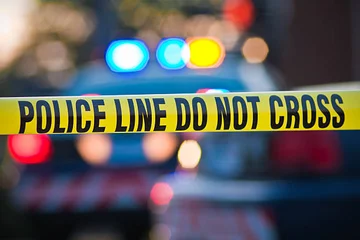
The case occurred in the first hours of July 7th in Lipjan municipality in the central part of Kosovo.
Police said the late man, who was later identified as Agon Zamenu, was allegedly under the influence of alcohol and by attacking vehicles and passersby when he was banned by law authorities.
That same evening, the Police Inspectorate announced the arrest of five police officials, under suspicion of committing criminal acts “suicides from carelessness”.
Kosovo Home Affairs Minister Jalal Svecla said the investigations are under way at maximum intensity and that anyone who results in the young man's death will receive due punishment.
In this still unclear situation, the family says it is disappointed with the provisional lack of transparency by authorities.
The victim's brother, speaking of several media in Pristina on July 8th, said family members have not received any clarification from the police, while the body of the deceased “has had many signs and breaking”.
From images spread in the social media, reportedly due to the case in Lipjan, the victim appears on hand-bound hands and knees, while then transported by ambulance.
Arber Beka, from the Kosovo Police Inspectorate, confirms to Radio Free Europe that this institution is continuing investigations into suspicious behaviors in this case and is examining all evidence, including the video footage and evidence received from the site.
Police Cancels, Continued Concern
The incidents for improper behaviour of Kosovo Police members are not rare.
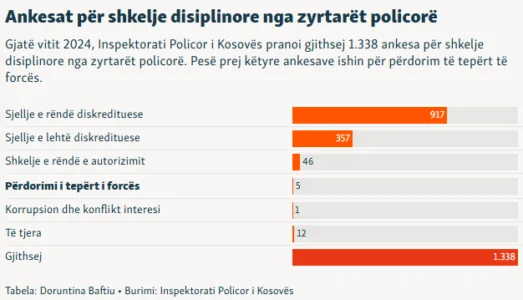
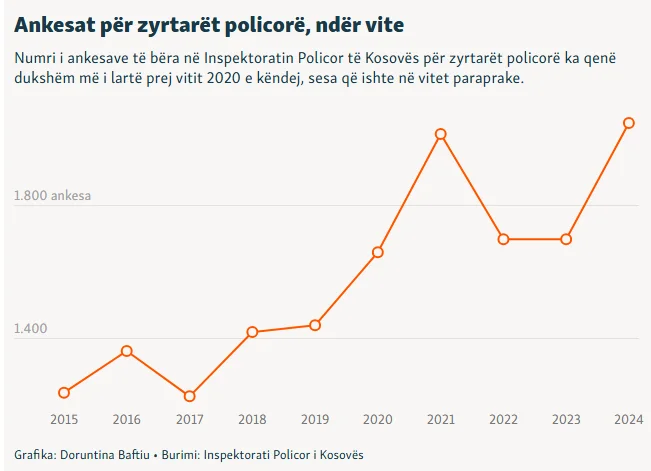
During the past year alone, the Kosovo Police Inspectorate accepted over 1,300 complaints against police officials, some of which concerned overcoming authorisation and excessive use of force.
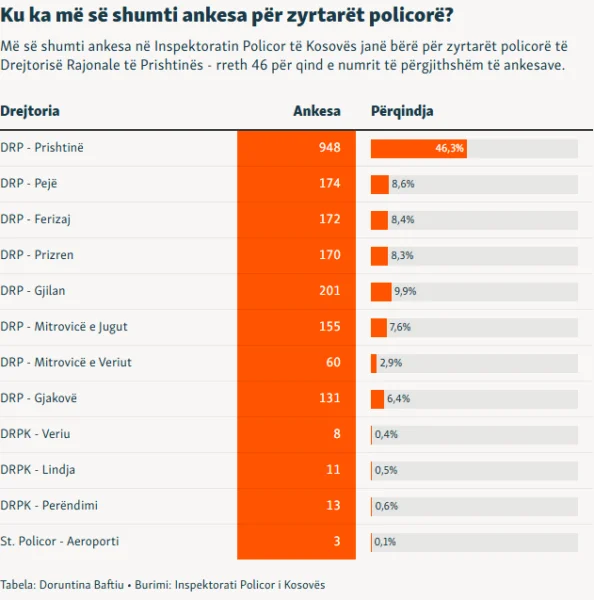
According to Kosovo Police Inspectorate data, almost half of the police complaints during the past year were against officials of the Regional Directorate in Pristina.
After that, Peja and Ferizaj ranked with smaller but still considerable numbers of complaints.
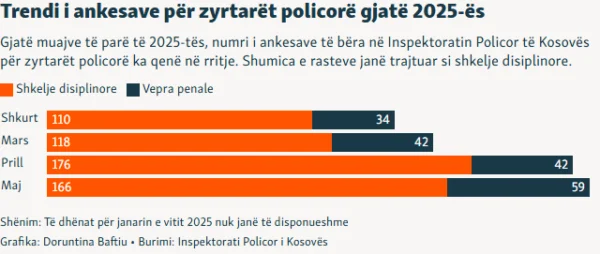
The trend of police complaints seems to be continuing to rise during 2025.
In the first half of the year, the Inspectorate has received hundreds of new complaints showing that citizens' trust in police behavior remains fragile.
Despite these complaints, incumbent Svechla reiterated that Kosovo police continue to remain a reliable and professional institution dedicated to the service of citizens.
Miftaraj does not fully agree, arguing that changes in police education and training policies are bringing serious challenges to this institution.
He says cases of improper behavior cannot be attributed to all police, but are signs of a growing problem.
“They must be taken as causes for building strategies, to build policies, to increase the accountability and increase the accountability of police officers, so that we do not come to situations like the one with the 27-year-old who found the death of”, Miftaraj says.
In November last year, Radio Free Europe reported that training for new police officers in Kosovo lasts only three months less than any other region.
Kosovo police said then that this change has been made more than a year ago, adapting the length of training from six to three months, due to <x0 needs and operational requirements”.
Miftaraj says the issue of police preparation should be taken more seriously, as inadequate professional preparation occurs that is then reflected on the ground.
He adds that many of the internal mechanisms in the Kosovo Police, which are supposed to address officials' indecent behavior, are without real influence.
The failure to punish those policemen (in excess of responsibilities) causes such cases” to be repeated, Miftaraj says.
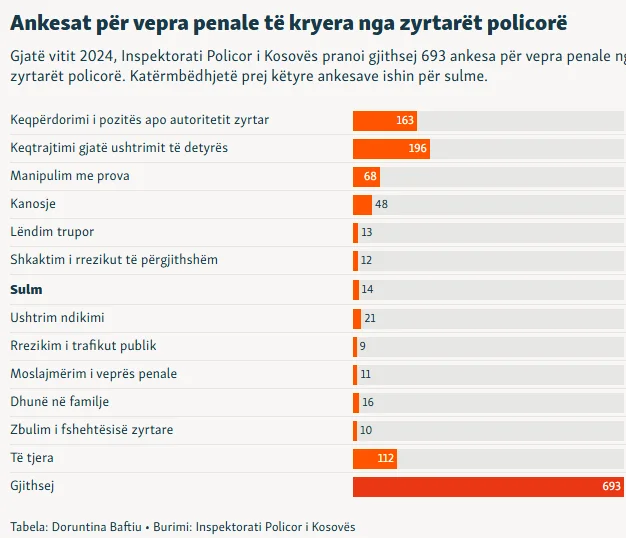
Kosovo Police Inspectorate data shows that during the past year there have been nearly 700 complaints of criminal acts by police officials in their midst some for attacks.
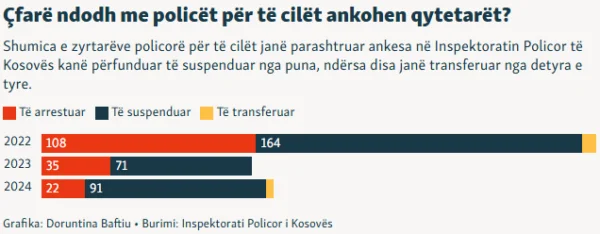
However, it seems that the disciplinary measure is taken for a considerable part of the cases.
Kosovo security issues expert Burim Ramadani, who has previously served as deputy defence minister, says citizens have no reason to lose confidence in the Kosovo Police.
But for that belief to be preserved, the prosecution, the government, the police themselves and other responsible mechanisms must be precise, strict and ruthless towards any case when police officers do not act professionally, he says.
For the case in Lipjan, Ramadani says it is clear that there has been a lack of professional reaction from the police.
When the cuffs are placed, the police are obliged to care for the person, for his breathing, for the physical aspect, to offer water or necessities, and to put him in a position where the citizen cannot be asphyxiated or unattended. This is the primary task of police”, Ramadani says of Radio Free Europe.
He adds that the case in Lipjan is “insulated”, but should serve as an alarm for improving behavior and training, especially for young police officers.
There is a moment, which would have to be placed in the head of management, the ministry, the police... to improve what went wrong”, Ramadani says.
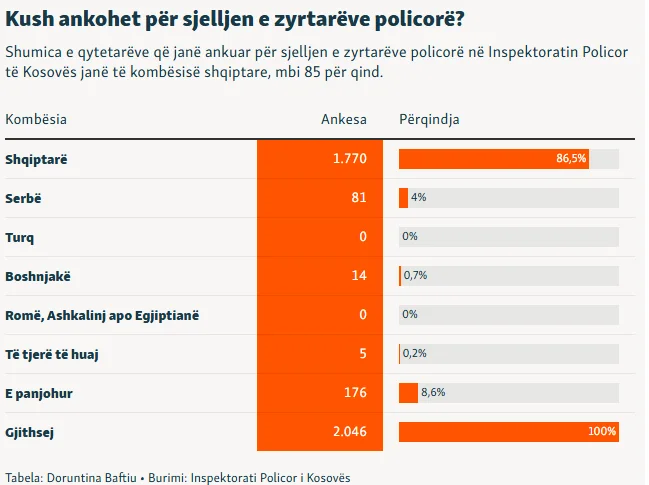
According to the Kosovo Police Inspectorate, most complaints about the conduct of police officials come from Kosovo Albanian citizens.
Over the years, data also shows that the number of police complaints has begun to rise at a faster pace since 2020.
Radio Free Europe learned that after the case in Lipjan, a message was delivered among police officers from their superiors, who said:
“Excessive violence, regardless of the circumstances, has no place in a democratic state aimed at Western standards. Justice cannot be delayed. Account must be inevitable. And most importantly, our system should ensure that citizens are treated with dignity and professionalism, no matter who they are”. /Periscope/