6 hours ago
Hasani: The constitutional situation at the session began when Dehar changed the agenda, the Constitution is obliged to say
Periskopi(a year ago)
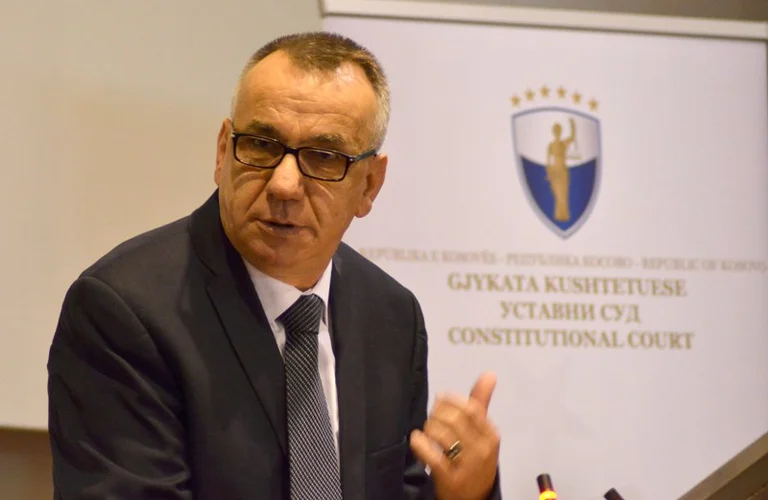
(a year ago)The former head of the Constitutional Court of Kosovo, Enver Hasani, in relation to the institutional crisis in Kosovo, estimated that the fundamental task of this court is to interpret the Constitution according to its letter and spirit, in line with the constitutional order and principles on which it is built. Hasan praised whether with the Constitutional Court's decision “R
Hasan estimated that if with the Constitutional Court ruling “the election goes to elections without the parliament being constitutionalised, then the Court is completely compromised”.
He emphasises that the Constitutional Court is obliged to assign “the reference timeline” when the unconstitutional situation began in the Framework Constitution process.
“After me, that moment is when the head of the constitutional session (of the Kosovo Parliament), Avni Dehari, has arbitrarily changed the agenda”, Hasani stressed for Beta News Agency.
Hasani also added that the PDK and LDK <x0 specifications are aimed at assessing the constitutionality of Dehar's behaviour, from the moment he failed to agree with other parties, decided to form the election commission for secret voting” respectively.
According to Hasan, from that point on, the start of the thirty-day deadline should be redefined, with a clear sanction -- “the same person cannot be rerun more than twice for chairman”.
“If the institution does not take place within the 30-day deadline, then the party's deputies are stripped of the mandate, and the following candidates” are coming instead, he said.
According to Hasani, the second party then takes the turn to propose within fifteen days from the new institution.
“If it fails, it passes to the third party and the second party's mandate is lifted. Only if that fails, then the need for elections is found, but on the condition that the deputies of the uncontained legislature are prohibited from running”, Hasani said.
He also praised that the deputy and chairman of Vetevendosje, Albin Kurti, is located “with both legs in an unconstitutional situation” Along with the ministers who are also deputies.
At the time I was in charge of the Constitutional Court, such a situation would not go through without decetification. Even if there were 100 percent of the vote, it wouldn't matter”, Hasani stressed.
As an example of the constitutional practice of lifting the mandate, he cited the Constitutional Court's decision from 2021, when the Court ruled on the unconstitutionalness of electing Avdullah Hoti to prime minister and ordered the dissolution of the Parliament.
Hasani also said that keeping the MP post simultaneously with an executive post leads to decertification.
It is not necessary for the Constitution to use the term desertification explicitly. That's what the Constitutional Court does. Otherwise, the term decertification is a doctrinal term”, he stressed.
He underlined that many things are not explicitly envisioned in the Constitution of Kosovo, but that, as he stressed, the Court has decided on the basis of its performanceal competencies.
The court interprets the Constitution and then applies. Other organs are obliged to act in line with the interpretation of the” Court, Hasani said.
Neither is the case of the Kosovo president's taskman for more than six months predicted, “except under the circumstances of insanity or objective inability to exercise function”.
“However, we (the Constitutional Court) have always defended the position that under certain circumstances there may be responsible incumbent on President”, he stressed.
He added that “with the same logic has been led by the Court in many other cases”.
According to him, “is enough to remember that not even the thirty-day term for the constitutionalisation of the Assembly is envisioned as a tempting deadline in the Constitution “but that is the “set by the decision of Judge”.
“This is the fundamental task of the Constitutional Court: to interpret the Constitution according to its letter and spirit, in accordance with the constitutional order and the principles on which it is built”, Hasani concluded.