8 hours ago
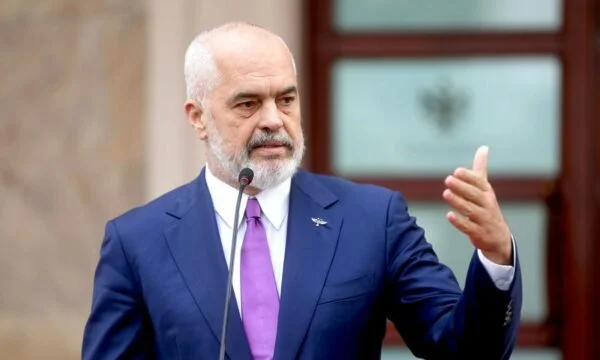
German newspaper “Suddeutsche Zeitung”: Edi Rama, painting and power
Periskopi(a year ago)
(a year ago)Albania's “Prime Minister Edi Rama finds pleasure in drawing, his hard coloured and psychodelic works are displayed in international galleries, and this has turned it into an attractive and unusual figure on the world stage”, so it begins its writing dedicated to Prime Minister Rama, the German newspaper Suddeutsche Zeitung. Suddeutsche Zeitung's writing is [...]
Writing Suddeutsche ZeitungIt's stopped in Prime Minister Rama's life as a politician, but also as an artist.
Shouldn't the city be renamed TiRama?
Construction is also widespread. Rama is focusing on architecture on a large scale. In the capital city of Tirana, with a population of about 60,000, an unusual building is being built next to the other, designed by architectural firm such as “Cop Himmelbül)au”, Daniel Libeskind and Stefano Boer, even if it is not very clear who will live here. According to the Federal Statistics Office, Albania's gross national income per capita in 2023 was $7,680. By comparison, there are $54,800 in Germany. Round balls at Skenderbeu Building 85m high, designed by Dutch architecture firm M V RDV, aims to represent the head of the national hero Skenderbeu. But, in Tirana, they say it looks like Edi Rama!
Overall: Shouldn't the city be renamed TiRama?
From the beginning, the city was his window. In 2000, Rama became mayor of Tirana and remained such for 11 years. He brought color into the gray socialist background; artists known as ãofur Elíasson and Liam Gillick participated in his idea to paint dozens of bright houses, and for the first time, Rama also experienced the press attack on a politician, who was also an artist. In 2003, his friend and former student, Anri Sala, performed the short film “Damm of Color” about the colorful changes that appeared in the Venice Bienenalen. Since then, the art world in particular has tended to close its eyes to Rama, an artist who is also a politician.
Because, despite all sympathy for the extravagant prime minister, there are big problems in the country with corruption, drug trafficking, money laundering and nepotism both towards the government and the opposition. But public criticism is rare; independent reporting as a journalist is difficult in Albania.
Alexander Cipa, chairman of the Union of Journalists in Albania, said recently that the most influential “approach of the media scene is influenced and controlled by the government's authority, especially by the authority of Prime Minister” himself.
However, Rama is considered a stabilizer in the Balkans within the EU; Ursula von der Leenen calls it “dear Eddie”. Its goal: to bring Albania into the EU by 2030. Accession negotiations have been under way since 2022, and according to EU Council President António Costa, the country has good prospects.
There is a risk of “anti-art background”, writes one of Rama's critics
Critics as Dutch journalist Vincent W. J. van Gerven Oei, who lived in Albania for several years, worries that Rama's profile as an artist distracts much from his politics. He argues that it is not his art, but that of being an artist, that is what brings him political benefit.
There is a danger of washing art, especially when viewed from outside, as described by journalist in his texts. When facing this criticism, Rama expresses misunderstanding. He does not understand how art can benefit politics. I haven't been a full-time artist for a long time. Art is my refuge, a counterweight to my daily political life, in which I am constantly surrounded by other”. Moreover, the arts and politics in Albania have been the same for a very long time, the horrible “s! ” He experienced this closely.
Rama was constantly painting at the age of three, and as a teenager, he began to develop an interest in art history. Not so easy: “just stopped with Gustave Courbet”, Rama says.
Any related art that followed the realistic painter who died in 1877 was taboo. When I realized how much more there was, a new world opened up for me”.
For a long time, he had known the works of loving artists such as Salvador Dali and Picasso only as photographs in banned books. Rama faced his first original work of art, a sculpture by Auguste Rodin, in 1989. At the time, he was traveling to Germany as a player in Albania's national basketball team. To visit “Kunsthalle” in Bremen, he sneaked out of the hotel where the team stayed one of the happiest days of his life, he indicated later. At the same time, knowing this new and wider world made life more difficult, “because the walls around me suddenly felt thicker”. He applied to art school and began to fight against those walls. “Art brought me to politics,” says Rama.
One day, then Prime Minister Fatos Nano called and asked if he would like to become minister of culture.
He had not found common political language with his father, Christaqi, who worked for the regime as a sculptor. My father was a Communist, but fortunately he didn't tell me what to do or believe.” After completing his studies, Rama worked as an art professor in Tirana, and a scholarship eventually took him to Paris. In 1998 his father died. The 34-year-old then actually wanted to leave the country after a few days, but that never happened. While preparing coffee for everyone after the funeral, then Prime Minister Fatos Nano called and asked if he would like to become minister of culture. “Okay,” said Rama. In his résumé, which the ministry then asked for the sake of the procedure, he simply wrote: Edi Rama, born 4 July. That should suffice; the rest is history.
People who have known Rama for years say that his years in power have changed him. His policies have autocratic features and seem to change his opinion even on fundamental issues depending on the political climate, such as asylum centres in the EU, which he flatly rejected in his country in 2018. In 2023 he then allowed Italy to build such centers, even if they are currently used differently than originally conceived by Prime Minister Giorgia Mellon. Currently, they house people whose asylum demands have already been rejected in Italy.
For artist Adi Dulae, a childhood friend, Rama has remained the same old man. It shares a studio with him in an industrial area in northeast Tirana, where they work together with clay. In the high - ceiling room, Rama always sits on the couch near the open chimney, which depends on a tube, Dula says. The blue model blanket on the couch shows that he must be sitting there many times.
In the end, he gives you an album for his art
Rama's sculptures look like 3D versions of his paintings. Our dads were both sculptors, so it's in our blood. ” Men have known each other for 50 years. “A friendship so long. One who can brag about this” is expressed with a smile by the close - shirted man who highlights his muscles. Despite the politics and despite Rama's connection to celebrities like Clinton, their proximity has never changed. “Eddie's just perfect”, Dula says. What else could he say in the presence of a journalist?
And how do you see yourself, Eddie? Is he the same as 27 years ago, when he entered politics, and that they want to hear about him at the end of all this. No, politics changes everybody. But I hope I've remained absolutely loyal to myself. He says he has become more patient over the years; otherwise, he would not be able to survive in the political circus. “However, sometimes I feel that I am no longer just one person, but two: politician and artist.” Although he has ceased to be a full-time “artist, as he says, he does not want to leave the artist as a politician entirely. The tall man leaps up and his next encounter is coming. “Just a minute,” says Rama, taking an album for his art and holding it in his hand. Although he had earlier emphasized how little he cared about his work, few artistic pride is necessary. /Periscope/