6 hours ago
What is expected of the Constitutional Court?
Periskopi(10 months ago)
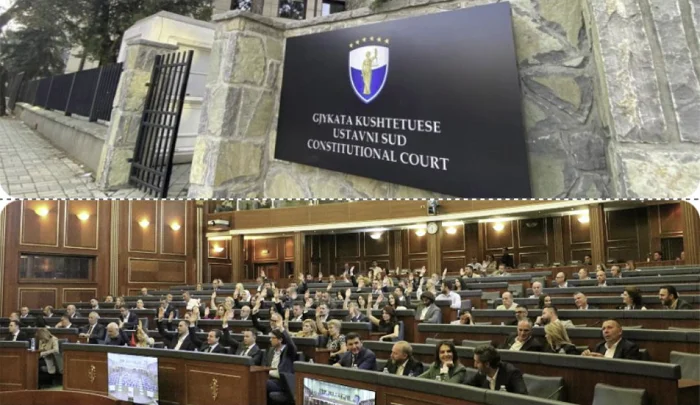
(10 months ago)The Constitutional Court should clarify in firm terms the manner of voting for Kosovo's Parliamentary Speaker, as well as show that the 30-day deadline for the constitution has not been consumed. So estimates Zahir Cherkini, professor of Constitutional Law at the University of “Isa Bolatini” in Mitrovica. He expects the Constitutional Court to re-focus that choice [...]
He expects the Constitutional Court to reiterate that the election of the Speaker and Vice Presidents of the Parliament must take place by open parliamentary vote. The Court (June 26th) said it in more constitutional terms. I expect it to be more open, more articulated in terms of the obligation that institutions sit down and vote openly for the constitution, the election of Speaker and Vice Chairman of the Parliament”, Cerkini points out for Radio Free Europe.
To clarify the constitutional issues regarding the constitution, the Constitutional Court has addressed the Democratic Party of Kosovo (PDK), the Democratic League of Kosovo (LDK) and the country's president, Vjosa Osmani. They are awaiting a new assessment of the Constitutional Court, as its June 26th ruling failed to clear the way for the constitution to be binding.
The Constitutional Court, on June 26th, granted 30 days to deputies of the Kosovo Assembly for the framework of the Assembly. But after 52 attempts, they failed to complete the process.
Kosovo's president has asked the Constitutional Court to clarify the legal consequences of non-compliance of the Parliament within the 30-day constitutional deadline. The request has been recorded as a special subject by the court.
Cerkini suggests that the Constitutional Court should confirm that this deadline should be returned to the flow point, where the agenda has been diverted.
I expect the Constitutional Court to show that the 30-day term has not yet been consumed, due to the fact that it has not gone to what the Court has said, so that it can go to the polls to elect the head of the Parliament, that is, for the constitutionalisation of the Parliament, but has repeatedly attempted to vote on the Commission (for the secret vote)”, Cerkini says.
According to him, it means that the Constitutional Court's deadline for the constitutional framework of the Parliament will be restored to the process on the day when the head of the constitutional hearing, Avni Dehari, has changed the agenda, demanding the Commission's vote for a secret vote. The Commission's idea of secret voting, Dehari proposed on 1 May, urging political parties from a member of the commission for the secret vote.
Until then, the continuation of the Parliament's Constituent Assembly, which started on April 15th, proposed by the Vetevendosje Movement for Parliament Speaker Albulen Haxhiu, sometimes failed to get the 61 necessary deputies' votes for the post through open voting. Other main parties -- the Democratic Party of Kosovo, the Democratic League of Kosovo, and the Alliance for the Future of Kosovo (AAK) -- have consistently rejected the secret vote and the membership proposal for the Commission for the secret vote.
On July 24th, the Constitutional Court imposed temporary measures, meaning that between July 27th and August 8th MPs should not act to constitute the Kosovo Assembly. Dehar's actions and repeated candidacy
In early July, The PDK has turned to the Constitutional Court for assessment, opposing the Vetevendosje Movement's request for members of the Commission for secret voting; casting the commission's own vote; and breaking the hearing after the commission's disapproval. Similarly, the LDK has asked the Constitutional Court to clarify the constitutional norms and regulation of the Kosovo Parliament's work in connection with the continuation of the constitutional hearing on June 29th, following the June 26th act of judgment. This party believes that the latest continuation of the constitutional hearing has become “in full opposition to” with the Constitution of Kosovo, as well as with the findings of the Constitutional Court's act on 26 June.
Gezim Shala from the Kosovo Institute for Justice (IKD) tells Radio Free Europe that the Constitutional Court is expected to assess the legality and constitutionality of the head of the Parliament's constitutional session. Even Mr. Dehar's actions, in the quality of the Speaker of the Parliament session, should be clarified firmly and relaxed in his wrongdoing so far”, Shala points out.
He adds that the Constitutional Court should clear the issue of the right to the mandate proposal for chairman of the Parliament, respectively if the Vetevendosje Movement -- as a party by the most votes -- has misused this right by constantly proposing the same name, despite failing to provide the votes needed for approval. The Constitutional Court has stressed that in these cases compromise is required to continue and simply, the Court must now show how to proceed if there is no compromise”, Shala points out.
Similar sentiments are shared by Professor Cherkini, who says the Constitutional Court should clearly determine what happens if the same candidate for the Parliament's chairman does not get the votes in several consecutive attempts. To get out of this situation, it is good for the Constitutional Court to probably show a positive ennumeration (concrete, fact, and detail numbered one after another) how many times a candidate can be a candidate for head of the Parliament... to show a certain number of how many times, within days, a name can be placed on candidacy”, Cerkin points out.
He added that such clarification does not imply the loss of the first winning party's right to propose the Speaker of the Parliament.
Constitutional “ruled out”
Unable to secure votes for Speakers of the Parliament, Vetevendosje MP Albulen Haxhiu since June suggested holding extraordinary parliamentary elections, along with local ones later this year.
This idea was reiterated by her party colleague, Mimoza Kusari-Lila, who, under the assumption of parties scheduled for co-government, has said the solution could be early elections. It has also cited the possibility of taking over the mandate of the Parliament's deputies, as a consequence of the inability to constitutionalise the Parliament.
Keeping early parliamentary elections, due to the blocking of the constitution, is seen as a possible option even by the Democratic Party of Kosovo. But, its leader, Memli Krasniqi, has ruled out the possibility of them being held together with local ones this year. The LDK has not mentioned the possibility of early elections, meanwhile, the AAK has said it does not demand them, but is ready if elections are held.
Professor Cerkin points out that the Constitutional Court has nothing to do with this idea.
“Ide whether the mandate can be taken from MPs on the part of the Constitutional Court, sending the country to elections... I think the Court should not do that. It is not up to the Constitutional Court to intervene in political power to send the country to elections”, Cerkini says.
Shala and IKD agree with that view. According to him, the non-compliance of the Parliament is not the envisioned situation in the Kosovo Constitution, which would determine the receiving of MPs' mandates. Although not known exactly what the Constitutional Court's decision will be, Shala says practices from past decision-making of this Court show there can be no new elections through its judgments.
The Constitutional Court, in 2014, has said that nowhere in the Constitution is it said not to elect the chairman of the Assembly to the election. However, we do not know whether the Constitutional Court will change the practice”, Shala points out. The two connoisseurs of constitutional cases estimate it remains uncertain that when the Constitutional Court can come up with clarifications regarding the requirements set forth at its address by the PDK and the LDK, as well as by President Osmani.
However, under consideration that August 8th expires the term of the Constitutional Court's interim move, which prohibits the action of MPs in the direction of the constitution, they expect a court ruling could be announced before that date.