6 hours ago
Citizens complain of long columns in Pristina, municipality talks about improvement
Periskopi(a year ago)
(a year ago)Citizens among citizens often hear complaints about long columns of vehicles on the streets of the capital. It is even considered one of the most disturbing problems in Pristina. However, the digitalisation and telecommunications expert in the municipality of Pristina, Lufter Braha, estimated that the communications situation in Pristina has improved significantly, thanks to 24-hour monitoring and interventions on key nodes [...]
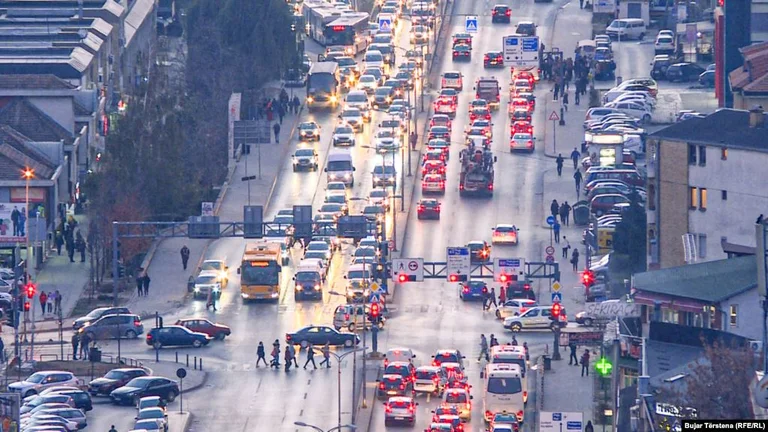
Citizens among citizens often hear complaints about long columns of vehicles on the streets of the capital. It is even considered one of the most disturbing problems in Pristina.
However, the digitalisation and telecommunications expert in Pristina municipality, Lufter Braha, estimated that the communications situation in Pristina has improved significantly, thanks to 24-hour monitoring and interventions in the main joints of the city.
He said that traffic flows have increased by over 20 percent, while road capacity has improved by over 30 percent.
“The situation in communications in Pristina is extremely better than it has been. We have it based on data with systems monitoring live traffic in 24 hours per week. We have an improved 20 percent of traffic flows. We've worked hard on the capital's main nodes, such as the cathedral, Bill Clinton, and the street égim Ramadanião to the Llap Mosque, releasing and increasing the potential of roads by over 30 percent. This has left a space for car processing and increased fluency. We're talking peak hours. Our fleet buses that are about 140 buses, which are measured in real time at the most peak hour, move 12 km/h, which indicates that there is fluency. We have several knots that are problematic, which is on the flag circuit, the QKUK district and the rotation on B Street, which we are handling for sustainable solutions”, Braha said.
He said that despite the large flow of cars during the summer and the presence of the diaspora there are no total blockades, but only cargo and slowdown.
In a city that only of a mobile operator has 780 thousand access to normal days, almost 2/3 of Kosovo come to operate in Pristina within the day, during the summer this increases 1.4 million. Even the flow of cars increases dramatically, is an increase of 140 thousand cars a day, increasing to 180 thousand minimally. One thing that changes during the day when the diaspora comes is the time difference. They're not the same cargo as the normal day that's morning and 1600. Pristina also copes with such an influx when there are free peak hours of course there will be few columns, but this is perfectly normal in a capital. Lacking the outer ring, we also have these knots, which are still problematic”, Braha added.
He says that despite the significant growth in the number of cars during the summer, Pristina is facing the situation without the need for emergency intervention.
There are no total blockades, there are loads and reductions of speed, but there is no need for emergency action. With the improvements we have made in the process with all the knots in the capital, we have increased our capacity to process our roads by over 30 percent. This has also been reflected in the cargo of roads. If last year at this time we had about 80-85 percent cargo on the streets of Pristina, today we have 61 percent maximum load on the streets of Pristina. Any citizen can see that it moves extremely easily and much faster on the streets of the capital”, he said.