6 hours ago
Over 60 illegal decisions: Like Kurt and his ministers overstepped the Constitution?
Periskopi(a year ago)
(a year ago)Over 60 decisions of Kosovo's incumbent government are suspected to be illegal and anti-unconstitutional. They were approved after March 27th, when Prime Minister Albin Kurti and the ministers of the government's cabin were certified as deputies of the IX legislature. Kurti and his ministers used the anti-unconstitutional mandate as executive officials until [...]
They were approved after March 27th, when Prime Minister Albin Kurti and the ministers of the government's cabin were certified as deputies of the IX legislature.
Kurti and his ministers used the anti-unconstitutional mandate as officials with executive office until they are simultaneously certified as deputies, the Supreme Court said in a plea published on July 7th.
For more than three months, the incumbent cabinet held ten meetings and approved closer to 100 decisions. Over 60 of them have been deemed illegal by civil society organisations and members monitoring the executive's work.
Democracy Member in Action ( DnV said over 60 decisions the government adopted after 27 March are in violation of the Constitution of the Republic of Kosovo.
According to him, the financial impact of decisions amounts to about 60m euros.
In the whole formal sense of the same, there's no logic that they're in those positions, but going to the office is not the biggest offense, we're dealing with the problem that the same ones are signing decisions. In the principled plan, neither prime minister nor ministers” should go to the office, Cakolli said on Tuesday.
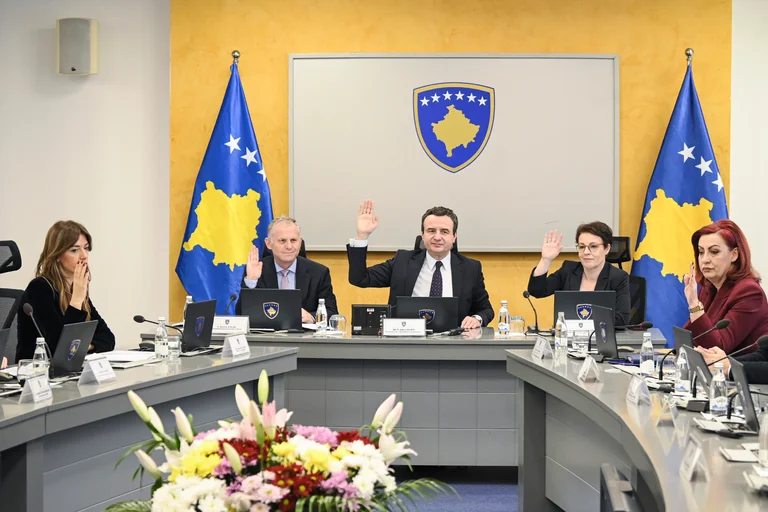
In a look back at the government meetings in office, held after July 27th, notes that Kurti and his ministers, certified MPs, have adopted decisions that are contrary to the Law on Government, which determines the duties and responsibilities of a outgoing government.
This Law makes very clear that the government's resignations carried out only the necessary and planned activities with the annual government plan and the annual budget Law, given the Supreme Court's justice, which declared an administrative directive issued by the acting minister of finance, Iron Murati.
At the first cabinet meeting in office, on March 28th, just a day after the ceremony as deputies of most of its members, the cabinet adopted financial reports, approved an administrative guide for ambalming and waste of the ambalage, and illegally appointed the board of a public company.
At this meeting, the government in office appointed the new members of the Steering Board of the Regional Water Company “SouthHydrogen” in Prizren, even though it is clearly specified in the Law on Government that the government in office cannot appoint people to senior leadership positions.
At the same meeting, the incumbent government approved a request by Kosovo Telecom for loans worth 10m euros.
In the May 29th meeting, contrary to laws and the Constitution, the incumbent government appointed an executive director of the Agency for Education and Professional Training and Education to stay in office. It continued with the appointment of a director at the Education Inspectorate and another at the Metrology Agency at the Ministry of Commerce.
On 27 June, at another executive meeting, the incumbent government of Prime Minister Kurti, certified as deputy, allocated fourm euros for the release of exiles from payment of the security policy.
The decisions affecting millions of euros are deemed illegal and unconstitutional, according to an act of the Supreme Court announced on 7 July.
The Supreme Court declared an administrative directive illegal by incumbent Finance Minister Iron Murati on the issue of fiscal crates. In reasoning, the Supreme Court deemed the act illegal because the incumbent government has no mandate to issue administrative guidelines.
The government in the resignation has no legitimacy to issue an act has expired the mandate and only acts on issues which should necessarily intervene and not provide administrative guidelines for reforming tax subjects, this is a policy which must be developed by the government, which has legitimacy and not by the Government in the resignation of”, according to the Supreme Court's judgment.
The acting minister, Iron Murati, rejected the Supreme Court's decision, naming it “absurd” and publicly criticising the Supreme Court judges by name.
This absurd decision by the Supreme Court implies disruptions of the digitalisation process and continuing to rob businesses through energy costs for old fiscal crates,”, he said.
The incumbent's government expressed “concern” and rejected the Supreme Act, naming it “not based on law” and “armir”.