6 hours ago
30 years later: Peace Impossible Between Muslims and Serbs in Srebrenica
Periskopi(a year ago)
(a year ago)Welcome to Bosnia's Las Vegas, we attract at least as much attention as the American city”. On Wednesday 9 July, Srebrenica Mayor Milos Vucic uses a strange form of humor, two days before the 11 July memorial day, marking the 30th anniversary of the genocide that took place in 1995 [...]
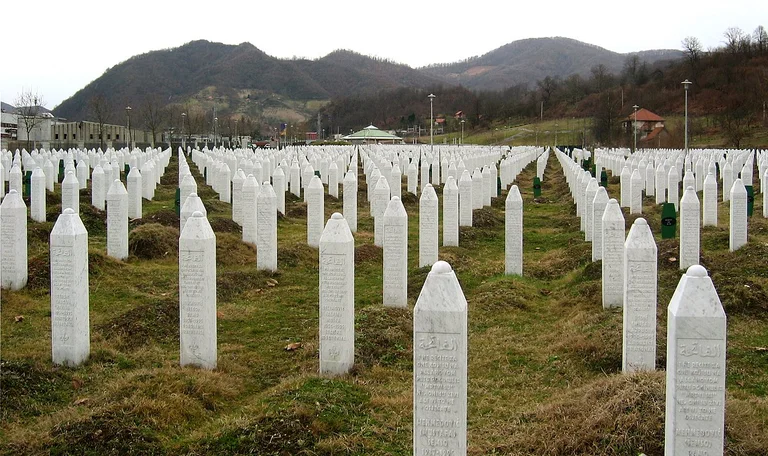
This Bosnian Serb, at the same time cousin to Serbian President Aleksandar Vucic, will not participate in the ceremonies planned to honour more than 80,000 Bosnian Muslims killed within a few days by Serbian General Ratko Mladic's forces, in what is considered the worst massacre of civilians committed in Europe since World War II ended.
I have not been invited and I see no reason why I should go, while my deputy [a Bosniak] does not come here to us,” explains this 37-year-old official during a small anti-ceemony that organises in a predominantly Serb neighbourhood. Faded with flags and associated with the national but Serbian anthem, the ceremony is dedicated only to the Serb victims of this war, which totally claimed about 100,000 lives between 1992 and 199.
“Serbs have been killed in far more horrible ways than Bosniaks, for example, beheadings, as it does in some Muslim countries, but have you ever read of massacres against them in the international press?”, Mr. Unrecognitions. Vucic, criticising what he calls “two standards” of the International Criminal Tribunal for the former Yugoslavia, which in 2021 eventually sentenced Mladic to genoci
Anti miting
It does not matter that the Serbs killed, who were reminded Wednesday of dozens of co-ordinators gathered around the Srebrenica chairman, have not died on exactly the same date.
Nor does it matter that the local commander of Bosniak forces, whom they accuse of responsibility in their deaths, has been systematically declared innocent of international and Bosnian justice. Their main goal is to organise an anti-mine rally on the eve of July 11th, the date which is expected this year to attract tens of thousands of people.
Many top European officials, such as European Council President Antonio Costa or French Minister for European Affairs Benjamin Haddad, are expected to participate in this municipality in eastern Bosnia and Herzegovina.
Although many of this town's buildings remain deeply marked by war and bullet holes in the walls have not yet disappeared, the real drama continues to develop, not in the facades, but in the minds of 13,000 Serbs and Bosniaks who continue to live in this ruined environment. They fail to break free from memory conflicts.
As in the rest of Bosnia and Serbia as far as neighbouring Belgrade, most Serbs still refuse to accept the genocide nature of massacres and continue to treat Ratko Mladic as a hero.
There was a terrible crime, but it's not genocide,” repeated during another rally.
Keeping on Saturday 5 July, Milorad Dodik, Republika Srpska president one of Bosnia's two constituent entities, still divided between Bosnian Muslims, Catholic Croats and Orthodox Serbs. Dodik continues to play the role of the Bosnian Serb strong man for fifteen years. This pro-Russian nationalist often ignites the fire of conflict by refusing to recognise international justice decisions or by threatening to secede from Bosnia's fragile central institutions.
Since 2016, when the first joint of Srebrenica was won by a Serb after the fall of the number of Bosnian residents, it has been listed with Dodik's stance. Thus, before every July 11th, the municipality glues only to the memory of its series or puts pictures of Serb victims by the side of the road leading to the Potocari memorial, where 8,000 Bosnian men were buried and separated from their wives and children before they were massacred.
“The Serbs always parallel their victims and those of Bosniaks, but the reality is that Serb victims were mainly soldiers, while Bosniaks were mostly civilians. This vicious circle leads nowhere,” angrily says Muhammad Avdic, a Bosniak who decided to return to live in his hometown in 2008. Today this area is just the shadow of his childhood city, but he hopes that one day he will find the traces of his father missing during the war.
My Serbian “neighbours know what happened, but they trust more Milorad Dodik and Aleksandar Vccci than what they have seen with their own eyes; they trust the lie case”, Hasanovic, the director of Srebrenica Memorial, said regretably during a June conference organised by the German foundation Heinrich-Böl.
Peace Will Never Come
Although Serbs and Bosniaks can live next to each other without having to crash, differences arise immediately whenever the memory of the war is spoken of.
When I go drinking coffee with my Serbian friends, many cry like me because of the war, but others do not want to appear in the same local because of fear of what people might say,” explains Musan Durakovic, a Bosniak injured during the war and who has returned to live in Srebrenica several years ago. He acknowledges that Serbian nationalist signs filling the landscape of Republika Srpska, such as murals to the glory of Ratko Mladic, “cause pain”, but choose to focus “on normal Serbs who admit they feel bad, even though they dare not say so publicly.
“The draw cannot come from below; those in power must make the decision to face the past,” repeat even Mr. Hasanovic, convinced that many Serbs are hostage to their nationalist leaders.
While not calling Ratko Mladic a war criminal, Srebrenica's own chairman, Milos Vucic, likes to present himself as an obstacle to the most extreme nationalist trends.
“I try to look to the future, respecting the past,” says he adding:
If I can get Serbs and Bosniaks to work together here, this could be an example for the entire country”. The mayor, claims this is enough to happen by relying on an economic rebirth, but it seems almost impossible in this corner of Bosnia, abandoned by residents for lack of perspective.
Just listen to Orthodox priest Srdjan Lalovic recall the same words that have served as ideological justification for Ratko Mladic and former Bosnian Serb political leader Radovan Karadzic to eliminate or expel Bosniaks from the majority Serbian territories.
“We don't need Bosnia, Muslims were all Serbs before being converted by Ottomans,” he declares, proudly pointing to a new wall in his church dedicated to the Serb victims of the XX century wars. “We are a single people and we could find a common language if the West did not intervene in our affairs,” he adds, blaming ʹ just as many Serbian nationalists a alleged NATO responsibility for the breakup of the former Yugoslavia.
In the hills surrounding Srebrenica, Luka Babic, the abbey of an Orthodox monastery, awaits visitors to a red house that looks like an Orthodox church, which he is illegally building in front of one of the cemetery of Bosnian victims. This tall bearded monk has a fighting view with the military vest covered with Russian symbols and Serbian paramilitary forces that have committed many war crimes during the 1990s.
According to him, peace with Bosniaks will never come.
There's a centuries-old war between us,” explains it between two glasses of rakie. Enlightened by local Serbian authorities, he adds provocations by placing Orthodox graves near Muslim cervix sections.
On Friday 11 July, he has planned to celebrate the release of Srebrenica” since the height of the house-house he is building without permission. /Periscope/
Jean Baptiste Chastan, Le Monde, adapted T. Lapsy key.al