6 hours ago
What after 30 days of Constitution? Here is who is warning new elections
Periskopi(a year ago)
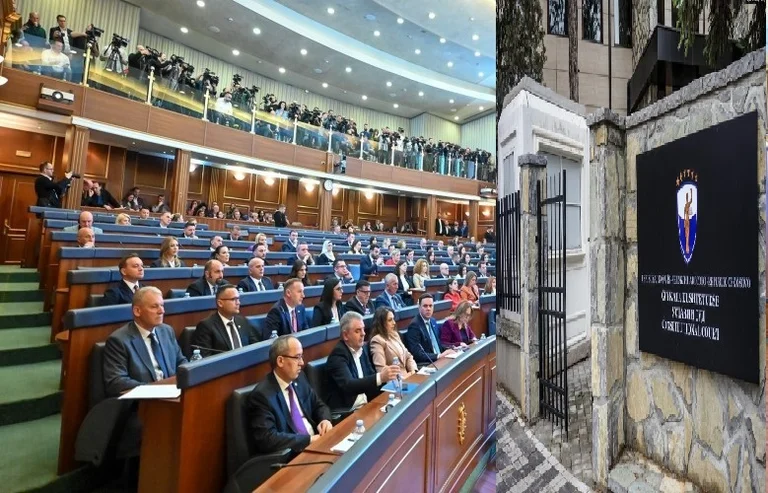
(a year ago)On June 26th 2025, Kosovo's Constitutional Court ruled in majority of votes that the Parliament must complete its constitutional session within 30 days of announcing the election result by appointing the chairman and vice-presidents. In spite of this, Tuesday's bid for the constitution failed for the 40th time, highlighting the absence of a [...]
On June 26th 2025, Kosovo's Constitutional Court ruled in majority of votes that the Parliament must complete its constitutional session within 30 days of announcing the election result by appointing the chairman and vice-presidents.
Despite that, Tuesday's bid for the constitution's constitutionalisation failed for the 40th time, highlighting the lack of a political consensus: MPs found no compliance with forming the commission for secret voting and the appointment of Albulen Hadziu.
In an effort to unblock the situation, Kosovo President Vjosa Osmani has invited leaders of parliamentary political parties to the meeting.
Former Constitutional Court Chairman Enver Hasani has criticised the Constitutional Court's decision to complete the constitutional session, stressing that setting a deadline without specifying the consequences in case of disrespect is problematic and unclear.
According to him, the Constitutional Court does not have a clear device that would enable its practical implementation.
“The Constitutional Court decisions in Kosovo are only applicable and do not have executive mechanisms or direct legal sanctions, as different from some European countries like Albania or Austria, where decisions are accompanied by criminal consequences or institutional measures,” said Hasani.
He explained that the Constitution envisions that the constitutional session should be concluded within 50 days, and that the party having the parliamentary majority should secure 61 votes to form new institutions.
If this does not happen within 30 days, the right must pass another political subject,” said Hasani.
Mazumum Baraliu, a legal and former Constitutional expert, considers the Court's decision to be fair and balanced.
The Constitutional Decision is reasonable and sustainable because 30 days, after all these months that MPs have not agreed on, is enough time,” he said.
According to him, if no agreement is reached within this term, then they would have to let go of those who have the opportunity, with only one raise in the interest of the state and the Assembly
If no agreement is reached between parties within this deadline would have to be issued by those who have only one chance to stand up in the interest of the state and the Parliament not to go to elections again, Baraliu said.
He adds that the Assembly needs only a few votes more to unblock the situation, and the first responsibility, according to him, falls on the subject it has won most votes in the election
The first primary responsibility belongs to the subject who has received the most votes and they would have to reflect, Baraliu concluded.
Lawyer Xhevdet Smakqi considers the Constitutional Act clear and in line with constitutional and judicial order.
He stresses that the court, except that it has set a 30-day deadline, has clarified that the secret vote remains in the discretion of the Parliament, and that no party can block the way of voting.
The parliamentary “Practic has been that the mayor and leadership are elected by open voting, as there is usually only one candidate, so in such cases the secret vote does not apply,” explains Smakqi.
He warns that if the Assembly is not constitutionalised within 30 days, it automatically loses the right of MPs to remain in the mandate and the country goes to extraordinary elections.
According to him, the president has the obligation to call the parties to set the election date if this situation continues.
If within 30 days, the Assembly is automatically lost the right of MPs to remain MPs and the country goes to extraordinary elections, the president must call the parties to set the date, he said.
Naim Jakaj, senior researcher at the Kosovo Institute for Justice (IKD), estimates that the Constitutional Court's recent decision is very problematic and contains exceeded demand.
He explains that the Constitution has been asked about refusing to establish the commission for the secret vote by the Speaker of the Parliament, but has made decisions on broader issues concerning the constitutional session, thus exceeding competencies.
First of all, the Constitutional Act is very problematic, because what we're seeing is overstepping demand. That is because the Constitutional Court has been asked about a decision to reject the commission's founding for the secret vote by the Speaker of the Parliament, while this has not decided precisely on that issue, but has decided on the session, Jakaj told FrontOnline.
Jakaj emphasises that the decision for the 30-day term for the constitutionalisation of the Parliament is absurd, as it does not specify any legal or constitutional consequences in the event of its disrespect.
“is the first time that a constitutional character deadline is set without specifying the consequences for its disrespect that will remain in institutional memory,” he said.
Jakaj warns that if the Parliament is not constitutionalised within 30 days of certificate results, the country will face an institutional crisis
If the Assembly fails to be constituted within the terms the Constitutional Court has given, which is 30 days from the certificate of results, then the country will face a serious institutional crisis that we have not seen before, Jakaj says.
Disrespecting the Constitutional decisions, according to Jakaj, jeopardises transition from democratic rule to institutional chaos.
Disrespecting the decisions of the Constitutional Court is a serious sign of risking the functioning of the state. In the case of failing to comply with this decision we will switch from democratic order to institutional chaos, he concluded.. /Periscopi/