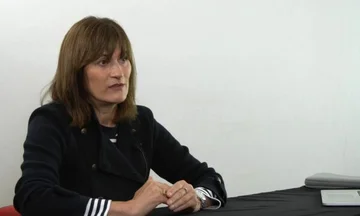

Fetije Atashi-Hetemi, who moves with the help of the cart, supports the demand made by nongovernmental organisations for the return of the Ministry of Social Goods, since, as she says, “persons in society's most sensitive state should be a priority”.
Since 2021, when Kosovo's Ministry of Labour and Social Management was merged with the Ministry of Finance, Labour and Transfers, dozens of civil society and activists have warned that social welfare has been left out of government priorities, while access to social services for vulnerable categories has deteriorated.
Atish-Hetemi, 56-year-old, lives alone and says she faces numerous challenges in everyday life.
From early childhood, she moves with the help of the cart, having suffered brain injury because of high body temperature, Periscope.
She says she has always had support from family and circle, which gave her the strength to activate for the rights of disabled people. But it requires that institutions improve conditions for this category of society.
For years, 56-year-old shows there has been a 150-euro aid from a social scheme.
It has taken eight years of legal battle to win the 430-euro pension belonging to paraplegics. But even this amount says it is insufficient for him.
The option I receive does not nearly cover the needs of a disabled person, either for medicine, medical visits, or expected problems, such as decubital wounds. With this money I have to pay an assistant to help me twice a week. I don't have any more options”, she tells Radio Free Europe.
Organisations protecting the rights of disabled and children say these vulnerable groups, apart from social stigma and prejudice, increasingly face a lack of sustainable institutional support.
Returning the Ministry of Social Health
Several months ago, through a public letter to political parties in Kosovo, the Coalition of NGOs for Child Protection (KOMF) has called for the return of a special ministry for social welfare.
According to the KOMF, such a structure is essential to ensure better access and coordination of services for children, disabled persons, needy families and other vulnerable categories.
But, until Kosovo, for months, is in a deep institutional crisis, this topic has not been covered publicly by political parties.
According to data from the KSF, only 10 percent of disabled children in Kosovo have access to real health and social services.
Meanwhile, more than 72 percent of children in the country continue to be disciplined through violent forms of another issue, which they say requires urgent answers from institutions.
Besides children, even pensioners, victims of violence, families in social aid, and war categories are among the groups that, according to the Centre for Social Information and Improvement (QIPS), suffer lack of institutional care.
Former Social Health Ministry officials and representatives of civil society warn that this ministry's failure to return will deepen the institutional regrass and leave thousands in need in a position.
Skender Recica, who has led that minister, says that its merger in the departments of a super-minister, “is evidence of a deep institutional insurrection”.
Social services have been degraded, and the ordinary citizen, who expects assistance and support, has been left at the mercy of fate and the heartless bureaucracy”, says Recica.
According to him, restoring the Ministry of Labour and Social Management “is not a luxury, it is a necessity”.
The time has come to say openly, there cannot be a social state without a dedicated institution, representing those who most need support”, Recica points out.
He adds that some projects initiated by the former ministerial dictatorship have already failed.
The “Reform for a social assistance scheme, which was in an advanced phase of preparation, has been abandoned. The model for reform of the pension system, aimed at social justice and contributing equality for all citizens, has been forgotten. Investments in social services, which had begun to structure, have been frozen”, says Recica for Radio Free Europe.
Social Services Quality Reduction
For the organisation Handikos Ferizaj, the merger of the Ministry of Social Management has created uncertainty in nongovernmental organisations, due to institutional uncertainties and lack of co-ordination.
According to this organization on the rights of disabled people, the quality of social services is now felt.
The creation of social services in other ministries has brought overloads of staff and unequivocal distribution of responsibilities, which has contributed to the slowdown in drafting and implementing social policies and strategies. This has created gaps in co-ordination and reduced the effectiveness of support for this category, making a more focused and organised approach at the central level of” necessary, say Handikos Ferizaj.
According to the organisation, co-operation with the Ministry of Justice, where there is the Division for the Rights of Persons with Limited Skills, has been good, but initiatives for support of children and disabled persons are said to have remained with short-term projects.
“It is necessary to ensure effective implementation of the Law for Social Services, to develop sustainable programmes and projects at a length of three to five years, to take steps to simplify bureaucratic procedures, and to create a powerful monitoring mechanism for NGOs offering these”, the Handikos' response to Radio Free Europe says.
Handikos Ferizaj also cites the lack of effective co-ordination and delays in providing services, “making life in need even more difficult, including disabled persons and poor families”.
Other nongovernmental organizations raise another concern about another category of society - children with autism.
A difficult approach to public institutions of children with autism
Leke Djurdjal from the Organisation “Ze”-The Logopedic Centre for Treatment and Exploration stresses that in Kosovo access to professional services for children with autism is problematic.
<x) Even access to professional logistical services is difficult in public institutions, taking into account the small number of logos engaged in these institutions, as well as the concentration of logoped involvement in public institutions only in Pristina”, he says.
For the yet more disturbing affair is the long waiting list for children who want to receive public sector treatment.
The wait lists in public institutions, as well as the treatment costs in the private sector and nongovernmental organisations are problematic. Only a small number of nongovernmental organisations offer free services”, he says of Radio Free Europe.
Gjurgy believes the return of the Ministry of Social Health would also improve inter-sectal co-operation between government institutions and civil society organisations dealing with child protection and their involvement.
For Bind Skeja, from the Centre for Social Information and Upgrade, the Union of the Ministry of Labour and Social Management with other ministries has caused confusion within institutions, where “s has been clear to the sharing of responsibilities”.
He estimates that in this merger of the ministry, even “institutional awareness” has been lost, since responsibilities for social services have gone to the entities, “s which do not have the social cause based on other priorities, but operate with other priorities”.
The concrete “al fuel is to transfer mental health services to the Ministry of Health. Caring for individuals with mental health problems exceeds medical treatment and requires social support programmes, such as residence/residence, employment, rehabilitation, etc. These are outside the health ministry's vision, which prevents the possibility of forming a physical mental health care system”, says Skeja.
He is also critical of a lack of social initiative and mental - health care.
“Social Services require special teams that understand the system and have improved the primary target system, to the point where social equality is achieved”, Skeja points out.
In 2021, when the Vetevendosje Movement took power, it decided through government reforms to reduce the number of ministries to cut operational spending and achieve administrative efficiency.
Radio Free Europe has sent questions to the Vetevendosje Movement's address to take a stance regarding calls for the return of the ministry, but until the publication of this text, this political subject has returned no response.
Similarly, other political parties have not answered Radio Europe's free questions on the subject.
Unlike Kosovo, most states in the region have special ministries for social welfare.
In Albania, social welfare issues are handled by the Ministry of Health and Social Protection. In Montenegro, the institution responsible for this is the Ministry of Labour and Social Management. And in Serbia there is the Ministry of Labour, Employment, Veterans' Affairs and Social Affairs as a organ for social welfare services. /REL/