7 hours ago
Politicians <x0)
Periskopi(a year ago)
(a year ago)Experts on judicial-unconstitutional issues warn of misuse of legal vacuum by parliamentary parties, which are indefinitely delaying the constitutionalisation of the Kosovo Assembly. Despite dozens of efforts, MPs failed to wrap up this process, while opposition parties Democratic Party of Kosovo, the Democratic League of Kosovo, the Alliance for the Future of Kosovo, as well as the Serbian List [...]
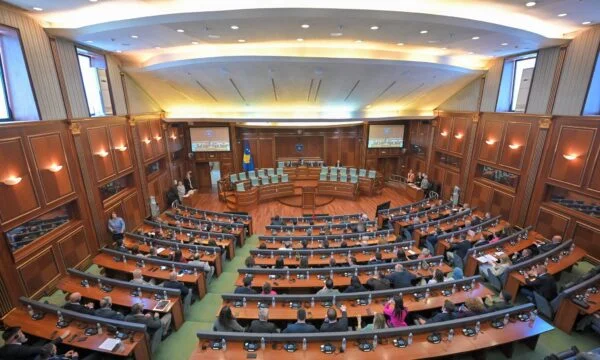
Experts on judicial-unconstitutional issues warn of misuse of legal vacuum by parliamentary parties, which are indefinitely delaying the constitutionalisation of the Kosovo Assembly.
Despite dozens of efforts, MPs failed to wrap up this process, while opposition parties Democratic Party of Kosovo, the Democratic League of Kosovo, the Alliance for the Future of Kosovo, as well as the Serbian List ʹ failed to propose members for the commission that would enable the secret vote on Albulen Hadziu's candidacy for Parliament chairmanship.
Haxhiu, so far, has failed to get the 61 votes needed in the open vote, while her party, Vetevendosje Movement, has refused to replace its name.
Kadri Kryeziu, former deputy chairman of the Constitutional Court of Kosovo, tells Radio Free Europe that the Constitution does not specify any clear timetable for the constitutionalisation of the Assembly, and that vacuum, according to him, is being misused by political parties.
The constitution's “ators have not been able to predict this desire, this design, which in normal form should not have happened”, Kryeziu says, referring to the blocking process.
According to him, the main responsibility falls on the Vetevendosje Movement as the winner of the February 9th parliamentary elections, but not even other parties -- the PDK, the LDK and AAK -- who are contributing to procrastination stalling.
In the same line is Constitutional Law Professor Mazlum Baraliu.
He stresses that political parties are exploiting the constitutional vacuum to hide, as he says, “the inability the party has won the most votes (the Vetevendosje Movement) for forming institutions”.
The lack of a legal deadline, according to him, has created room for fierce political warfare and party resentment.
In this case, I say responsibility lies with the first, relative winners, but also others, indiscriminately, because they are not interested in the political class for state and institutions, but in power, for falling to the edge of absurdity, anger and political battles”, Baraliu says of Radio Free Europe, Transmitt Periscope.
He adds that he is also being abused by the 2014 Constitutional Court's decision, which provides no instructions on what happens if the election of the chief parliament fails and does not determine clear deadlines for the completion of the constitution.
Stir over electing topparliamentary
The Kryeziu does not view as essential just the issue of nominating the Speaker of the Parliament, but also warns of neglecting political parties are making legal interpretations of the situation.
He recalls that the constitutional hearing, according to the Constitutional Court's decision, should continue every 48 hours, but that, according to him, cannot be extended indefinitely.
He says that, in concrete cases, logical and verbal legal interpretation should be used.
“Logical interpretation means that this (following the constitutional session every 48 hours) can only be done twice. There may be problems of technical nature the first time. The second time, this must end”, says Kryziu.
Any follow-up after the second time, he adds, is “outside political, moral, constitutional, regulatory, etc.”.
Baraliu, on the other hand, says abuses in the case of the Parliament's non-compliance are successive.
He says political parties have been sworn in controversial positions regarding Albulen Hadziu's election to the chief parliament.
According to him, MPs should use their mandate for the benefit of the state, institutions and citizens, but they are misusing it, preventing the completion of the institution's constitution.
Moreover, Baraliu estimates, political parties control the deputies' vote, “preventing them from voting according to conscience, state conviction and institutional interest”, even though the Constitution guarantees autonomy in decision-making.
How do you get out of the lock?
The Kryeziu describes the current situation of blocking the constitution as a state of emergency.
According to him, the solution should be sought through political agreements between parties, or even in the “partition of political and domestic judicial means”.
The subx0... He should call (political party) and insist that they create the” institutions, he says.
Kryeziu also says the president has the right to ask the Constitutional Court for agreement on whether constitutional provisions have been violated during the constitutional provisions of the constitution.
If that does not work, he says intervention of external factors, such as international partners, should be expected to mediate overcoming the crisis.
Osmani has held some consultations with political party leaders in an effort to resolve the stalemate, but without success.
Radio Free Europe asked her office if she plans to take any steps, such as addressing the Constitutional, and is awaiting the response.
Early this month, Osmani has said that delaying the constitution's constitutionalisation undermines the credibility of institutions and the country's progress towards the Euro-Atlantic agenda.
For Baraliu, the only way out of the impasse is through compromise and political agreements.
The pathway is, to say briefly, to have a political agreement. To have political and logical rationality of conduct and attitude in the sense of political maturity and democratic emancipation”, Baraliu points out.
Some politicians have also cited the possibility of organising new parliamentary elections together with local ones in October, however, not all are convinced that this would be an effective solution.
Experts underline that once the Assembly is constituted and institutions are formed, political parties must start the process of constitutional changes immediately.
The goal is to clearly determine the legal deadlines for the constitutionalisation of the Assembly in order to avoid situations like this one. /Periscope