6 hours ago
Migration Agreements: What does Kosovo benefit, and why are they criticized?
Periskopi(a year ago)
(a year ago)Europe's southeast corner, including Kosovo, is becoming the ground where the most powerful states try to shift one of their dilemmas -- what to do with migrants who do not want them within their borders? Finally, Kosovo has agreed to house 50 migrants from third states standing in the US, while there are [...]
Europe's southeast corner, including Kosovo, is becoming the ground where the most powerful states try to shift one of their dilemmas -- what to do with migrants who do not want them within their borders?
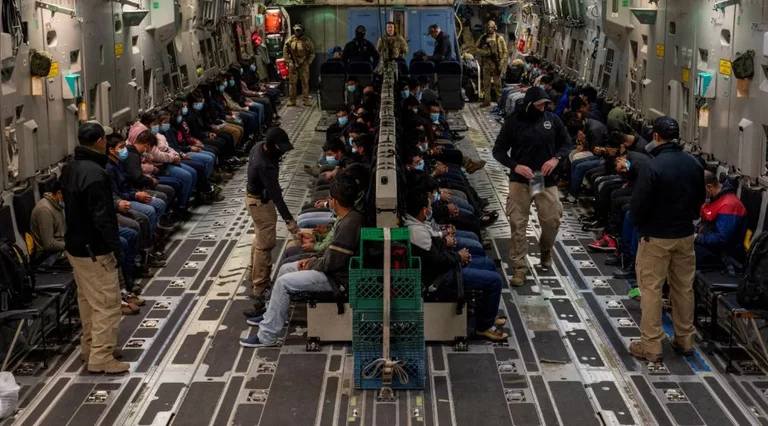
Finally, Kosovo has agreed to house 50 migrants from third states standing in the US, while expressing readiness to house even asylum seekers rejected by the United Kingdom.
The Kosovo government, along with the Ministry of Internal Affairs that will be tasked with implementing the agreement with the US, has not answered Radio Free Europe's questions on the subject.
What Kosovo gains from this deal has not shown even from the US State Department, which has only said that the US is “ungrateful to our partner, Kosovo, for accepting third-nation citizens expelled from the United States”.
Later, in charge of work at the American Embassy in Kosovo, Annu Prattipati thanked Kosovo on X, saying it became the first <x0nd) nation in Europe to announce it will accept citizens from third countries expelled from the United States”.
“Securation of the US border is the main priority of the Trump administration and I appreciate Government and the people of Kosovo for their” partnership, she added.
What does Kosovo get?
Are these agreements really strategic progress for Kosovo? Donika Emini, from the Balkan Policy Adviser Group in Europe, says these agreements should be understood “as a form of bilatheral co-operation, rather than as a transformative moment in Kosovo's international position”.
“This strengthens Kosovo's image as a reliable partner, but does not deeply change the dynamics of relations, especially when key political issues, such as Kosovo-Serbia dialogue, continue to be a source of tension between the two countries”, Emini tells Radio Free Europe.
As evidence of this, it cites an agreement between the European Union and Turkey on Syrian refugees, which says it shows that “co-operation in migration management does not necessarily translate into improving broader relations if deeper political disputes remain unresolved”.
Even former US Ambassador to Serbia Christopher Hill says it is not enough for Kosovo to show that it wants to help the US address its challenges.
“Symbolistic geniuses of this type, though important and useful, should be accompanied by a broader approach ensuring that Kosovo is not on the list of problems”, Hill tells Radio Free Europe.
But Kosovo is not the only one in the Balkans accepting such responsibilities for managing migrants.
Albania has agreements with Italy to accept migrants, northern Macedonia is cited as a potential country for agreements with the United Kingdom. While Bosnia and Herzegovina has co-operation with the EU for migration management, accepting funds and support for waiting centres.
Late last month, the Human Rights Watch (HRW) organisation called on the United Kingdom and the European Union not to use the Balkans as “maginative for migrants”.
Michael Bocenek, from this organization, says about REL that the Balkans have become the target of such plans of more powerful states for several reasons.
The Balkan “countries do not have a truly terrible history of human rights violations [compared to other countries used for these plans, such as Rwanda, South Sudan, Libya]”, he says.
Bocenek adds that the impact the European Union has on the countries of this region.
For better or worse, these governments may have a sense of obligation to the European Union and therefore may be more open to these types of requests”, Bocenek says.
Why are we talking about the European Union?
For three main reasons, says Olivia Sunberg Diez, of the Amnesty International organisation, which has been monitoring and criticising such agreements for many years.
There are three steps, she says, the European Union has recently undertaken for the processing of migrants to take place outside EU borders, as a way of facing a large wave of migrants.
In recent months, the European Union has brought proposals that enable rejection of the asylum requirement of an applicant, with the reasoning that it may seek asylum elsewhere; facilitating rejection and expulsion of asylum seekers from countries that the EU calls safe, and the possibility that asylum seekers are being sent to countries with which they have no connections.
“has a deliberate attempt to shift responsibility for the protection of refugees to countries outside the EU, without clear legal guarantees and with much uncertainty of responsibility”, Diez says of the REL.
And, the discussion of where such return centres could be built for migrants targeting the EU, but who have been denied asylum demand, has included exactly Western Balkan countries.
Emini says these states should understand that such agreements bring benefits, such as investment or specific support, but not progress towards EU membership.
“In the future, Kosovo and other Western Balkan countries should aim to position not just as sensitive service providers, which the richer states do not want to take over, but as pro-active and strategic actors in the international arena”, Amy says, adding that the Western Balkan region is <x2instrusolating without real benefits and long-term”.
In a similar agreement that had also sparked criticism, in 2022, Kosovo and Denmark agreed to rent 300 prison cells at the Corresponding Institution in Gjilan to house foreign prisoners expected to be expelled from Denmark after the sentence ended.
In exchange, Kosovo will benefit over 200m euros, which will be invested in the Correcting Service and renewable energy projects.
The first prisoners from Denmark are expected to be transferred to the prison in Gjilan in the first part of 2027.
Earlier, Kosovo had also sheltered about 1,900 Afghan nationals, who were evacuated from Afghanistan after the return of the ruling Taliban in 2021.
What Are the Migrants Lost?
In addition to the debate on the diplomatic benefits of Western Balkan states, such agreements are raising serious concerns even regarding migrants' rights.
Bocenek from Human Rights Watch says that “these agreements are political and an attempt to bypass human rights obligations”.
He adds that they often create legal uncertainty about migrants, especially those who have no connection with the host country.
“People do not know where they are, do not understand why they are sent there, feel lost and isolated”, he says.
Diez stresses that such agreements pose a risk of arbitrary bans, restrictions on access to judicial assistance and difficulties in following legal complaints.
“You can't apply this [agreement to return centres] in a way that is in line with human rights”, she says.
The agreement between Italy and Albania on transferring migrants has faced such difficulties since the start of implementation. More than 70 people originally sent to Albania have returned to Italy, following judicial decisions or because of medical needs.
“We have enough evidence from broad international research showing that such schemes are trying to shift responsibilities as far away from the borders of the European Union, driving people away from their eyes and minds out of operation and cannot be implemented in a way that is humane”, Diez says.
Both she and Bochenez stress that such schemes are also expensive for the states that finance them.
For this reason, they would prefer that the more powerful states invest in their capacities to manage migrants.
It looks like an extremely complicated way to deal with this issue unless the real purpose is simply to remove people and leave the problem to others”, Bochese says.
For Diesy from Amnesty International, even the lack of transparency that follows such agreements between states is a serious problem.
The agreements are often negotiated nontransparently, without the involvement of parliament or civil society organisations”, Diez says, adding that this makes any control independent difficult.
She and Bocenek say it is important that even activists and civil society of states that become a target for such turning centres question the decisions of their governments.
The more politicians and lawmakers are aware of the existence of local objections, the more they will be forced to take into account”, Bocenek says.
He adds that such agreements are often presented as good, as it is said the state will benefit funds or look good in the eyes of a more powerful state.
However, if these agreements are not carefully reviewed, if their negative sides are not highlighted, if public opinion is not taken into account and the real cost they carry is not understood, then the risk is”, Bocenek says.
He adds that in other cases of these world agreements, both Costa Rica, Panama, or South Sudan, “these agreements have resulted in much more problematic for host countries than was originally predicted”. / REL/ Periscopi/