6 hours ago
What About Iran's Gulf fleet
Periskopi(a year ago)
(a year ago)In the context of increased tensions in the Middle East, Iranian navy is increasingly emerging as an essential component of the Islamic Republic's military and geopolitical strategy. It has significantly expanded its capacities with modern submarines and warships, located at strategic points in the Persian Gulf and the Indian Ocean. And [...]
While international attention has focused on Iran's response to recent US air strikes, a key point remains the possible influence of the Iranian fleet on the strategic waters of the Gulf. Despite the constant confrontation with Israel, the navy has not played a direct role in the conflict so far, what is behind the question: Is Iran preparing a marine response and what abilities it really is?
Since the Islamic Revolution of 1979, Iran has built a double maritime structure: Marine Order (IRIN) and Revolutionary Guard Marina (IRGCN), with separate but compatible functions. This structure includes destructive, frigates, corveta, as well as a considerable fleet of submarines all designed to operate effectively in asymmetric conflict and to oppose the most advanced technological fleets.
With over 18,500 personnel and more than 100 ships, Iran's Order Navy operates in the Persian Gulf and the Caspian Sea, and is responsible for maintaining territorial waters and protecting maritime corridors. According to Global Firepower 2024, it ranks 37th in the world, an indicator of its increasing capacities, despite international sanctions.
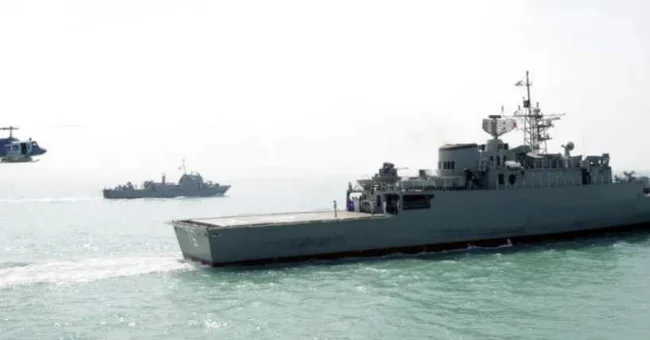
Modern destroyers, such as Zulfifer, Sahand and Zagros, are designed for precise missile operations and intelligence missions. Meanwhile, Moj and Alphand-class frigates and Tariq-type submarines Fateh and Ghadir provide a mixture of advanced skills and flexibility at sea.
Submarines, Iranian silent weapon
With between 19 and 27 units, Iranian submarines represent an essential component of the country's defence strategy and offensive. Especially, the Tariq (Russian-class Kilo) submarines have the capacity for floating missiles and strategic mines. Fateh represents domestic technological progress, while the Ghadir mini-informs are suitable for fast and secret operations in shallow waters.
Iranian naval bases have been distributed to key areas, from Bandar Abbas and Jask in the south to Bandar Anzali and Chabahar in the north and east. These bases provide production, maintenance and logistical support to the fleet. The base on Abu Musa Island, near the Strait of Hormuz, remains among the most sensitive and fortified in the face of tensions with the United States and Emirat.
IRC Navy and asymmetrical War
Unlike the conventional fleet, I RGB uses small, fast ships for surprise attacks, dangerous mines, and special operations. This includes over 45 units, such as Houdong, Peykaap II and MK13, designed to maneuver fast in narrow corridors like Hormuz Strait.
In recent years, Iranian navy has made significant advances in missile technology and fears. In 2024, Iran introduced floating missiles that avoided radar detection and conducted successful tests of submarine launching. Meanwhile, a 63,000-km-long mission in 2023, including the transition to the Magellan Strait, signalled Iran's aspirations to extend its influence beyond the region.
Although it cannot be compared to the fleets of world superpowers, the Iranian Navy poses a serious danger in the Gulf area. With a strategy based on asymmetric warfare, domestic technological development and smart strategic location, it has become an important instrument of Tehran's regional power and an element of instability in one of the world's most critical energy arteries, such as the Hormuz Strait. /Periscope/