6 hours ago
“Germans don't trust the US and Israel”
Periskopi(a year ago)
(a year ago)What countries are reliable partners for Germany? How do citizens appreciate Chancellor Merz? What do they think of the U.S. and Israel, and who would they vote for? How do we prepare for a meeting with US President Donald Trump? This is probably the question that every head of state or government should answer today, as Trump publicly humiliated [...]
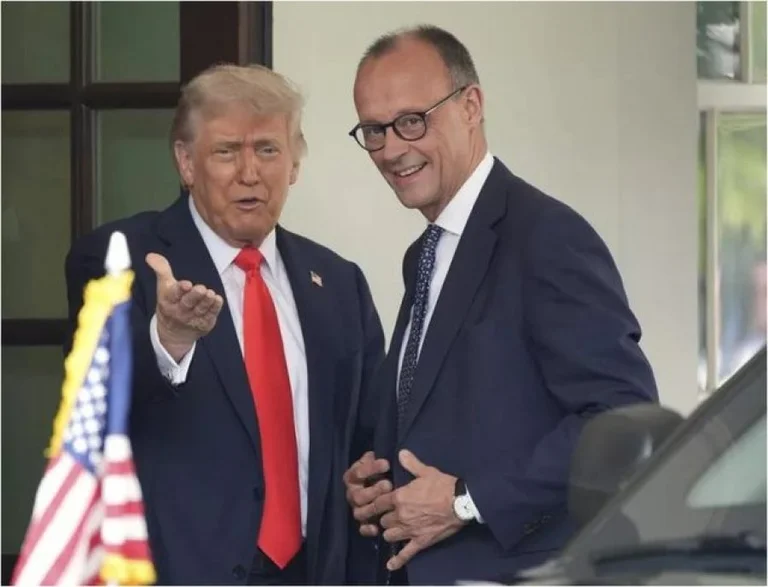
How do we prepare for a meeting with US President Donald Trump? This is probably the question that every head of state or government should answer today after Trump publicly humiliated Ukrainian pesidist Volodymyr Zelensky and South African President Cyril Ramaphosa in the Oval Office.
German government spokesman Stefan Cornelius stressed, that Chancellor Friedrich Merz (CDU) travelled to Washington relaxed, among other things, for the fact that Germany is the third largest economy in the world and has what to offer, followed Periscope.
Much More Money for Protection
Friedrich Merz in Washington also presented another plan to make Bundeswehr “the strongest conventional military in Europe”. The US president likes this, as well as the fact that it is being considered that all NATO members must share five percent of GDP for future protection.
However, only half of German citizens feel that this is appropriate. For a third of those surveyed, the five percent target goes too far. This is indicated by the results of recent public opinion survey ARD DeutschlandTranda, for which the Infratest diep agency surveyed 1.292 German voters in early June.
Pollsters also asked citizens what their expectations were of the meeting between Trump and Merz at the White House: 46 percent of them believe the German Chancellor will succeed in establishing a good relationship with the American president, while 44 percent believe he will not succeed in doing so.
In essence, 47 percent of citizens believe that the Chancellor does not have enough diplomatic capacity for foreign policy challenges, while 40 percent still attribute these skills to him.
What countries are reliable?
Close ties with the United States as well as with Israel are part of the identity of German politics. At the same time, it is clear that distance has increased even in the eyes of voters as well. After Donald Trump took over, trust in this country dropped significantly to the current 18 percent.
In October 2024, 27 percent of Germans believed that Israel is a reliable partner that Germany can trust now only 16 percent feel that way. And only 10 percent of German voters believe in Russia as a partner.
In this regard Ukraine has the support of 48 percent, while neighboring France is traditionally highly estimated at 83 percent.
Harsh Criticism of Israel
Israel's military response to the attacks of the Hamas terrorist organisation in the fall of 2023 left its mark. Many 63 percent of German citizens believe that Israel's action on the Gaza Strip is excessive, while only 18 percent view it as appropriate.
A total of 77 percent of respondents consider it accurate that Chancellor Merz criticised Israel for the actual military action at the Gaza Strip. Only every 12th in Germany thinks Germany should stay unconditionally close to Israel in the Middle East conflict.
At the same time, almost half of those surveyed find it difficult to accept the idea of a special German obligation to protect Israel. Germans previously blamed Hamas more than Israel for the humanitarian situation of the Palestinian civilian population in Gaza.
Now almost an equal number of citizens blame both Israel (69 percent) and Hamas Islamist (71 percent).
As a result, the majority is open to a review of German military aid: 43 percent favour restricting arms exports to Israel, while another 30 percent favour the complete disruption of supplies.
Only one in six respondents (17 percent) believe the German government should continue to approve arms exports to Israel without changes. Germany is, after the United States, Israel's most important weapons supplier.
Friedrich Merz's reputation increased
A new federal government consisting of CDU/ CSU and SPD are in power from May. 40 percent of citizens are satisfied with the first weeks of the Red and Black Coalition work. With the previous SPD government, Greens and FDPs, early in 2022, this percentage was slightly higher - 46 percent.
However, Friedrich Merz has gained considerable popularity since taking office as Chancellor. 39 percent of respondents are now satisfied with his work in April were 14 percent less. Vice-cancellari and Finance Minister Lars Klingbeil (SPD) also has 39 per cent support.
The only senior politician with whom most citizens are still satisfied is federal Defence Minister Boris Pistorius (SPD).
Moderate Waitings by New Government
How trusting do the Germans have in the new government? When it comes to pleasure, attitudes do not differ much from those recorded by pollsters immediately after early parliamentary elections.
Half of the citizens believe that the new government team can strengthen the German economy (55 percent; +1), as well as better represent German interests in the world (52 percent; +1).
However, skepticism is greater and has increased slightly when it comes to establishing domestic security (43 percent; 4) and effective migration management (38 percent; -4).
Doubts that the red and black coalition can preserve social security in Germany have also increased (37 percent; -6).
Union CDU/ CSU boosts superiority over AfD
If Bundestag were re-elected next Sunday, CDU/ CSU would win 29 per cent of the vote (+2) - a better result than in the February elections. The SPD, which is in the ruling coalition with the Union, marked a slight decline and would drop to 15 percent (-1).
AfD would remain on the same level as 23 percent support. Green and Left can rely on twelve (+1), nine percent (-1), respectively. All other parties would remain outside Bundestag. / DW