6 hours ago
DHSK Chairman: Process, transparent and internationally supervised
Periskopi(a year ago)
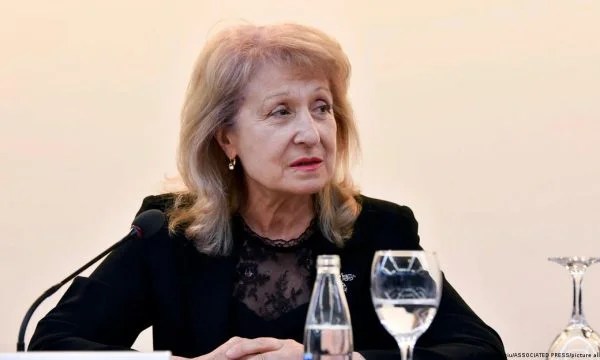
(a year ago)Kosovo Specialised Chambers Speaker (DHSK), Judge Ekaterina Trendafilova, told RTK, that special judges are fully independent in carrying out their judicial duties and are not prey to any influence outside the judicial processes. Trandafilova said that given the complexity of the court case, due to the number of indictees [...]
Trandafilova said that given the complexity of the court case, due to the number of indictees and the type of charges, the process is moving at regular pace and without major interruptions.
She also described the process as safe for witnesses, though, according to her, there have been attempts to influence witnesses or intimidate them.
According to Trandafilova, all the accused in front of the Specialised Chambers are represented by competent and professional defenders. Any indicted before the Specialised Chambers could appeal decisions to an independent panel consisting of other Court of Appeals judges, the Chamber of Supreme Court and the Specialised Chamber of Constitutional Court”.
How have you seen the process against Hashim Thaci, Kadri Veselin, Jakup Krasniqi and Rexhep Selimi so far?
Initially, I want to make it clear that my answers are based on available public information.
Given the complexity of the court case, due to the number of indictees and the kind of charges, I would say that the process is moving at a steady and steady pace.
I also find that the accused have professional and competent defenders, quite devoted to the case. They question witnesses, verify and reject the evidence presented, as well as exploit the various legal means that the legal framework of the Specialised Chambers offers.
Likewise, I would describe the process as safe for witnesses, though there have been attempts to influence witnesses or intimidate them.
Let's not forget that two people have been convicted of witness intimidation, and three others have admitted to Specialised Chambers guilty of witness intimidation. Without prejudging the outcome of the trial, five others are alleged to have given instructions on how to give a witness.
There can be no justice if victims and witnesses are afraid and feel safe to appear in court to confess their stories. And, in these cases, we have seen attempts to prevent witnesses from giving their own versions of events that happened in the past and to fulfill their civic duty, as well as alleged attempts to give witnesses instructions on what to say. That is why half the court cases deal with cases of obstruction of justice.
This climate of witness intimidation was the common concern of Kosovo and the EU and was reflected in the Paper Exchange, which is the international agreement on the development of criminal trials involved in the DHSK mandate outside Kosovo.
Just the same concerns, The DHSK gives high priority to security, defence and witness support. This also explains the number of private and closed sessions during which defence teams continue to have the opportunity to question witnesses and reject the evidence presented. Protecting witnesses and victims is the essential value of the DHSK.
Specialised rooms have been criticised for bias, injustice and violation of detained rights. Do you think the process so far has been fair, correct and transparent?
Yes, I consider that the Court is administering justice fairly, impartially and independently.
But, more specifically, I would like to stress again that all the accused in front of the Specialised Chambers are represented by competent and professional defenders. Any accused before the Specialised Chambers could appeal decisions to an independent panel consisting of other judges of the Court of Appeals, the Supreme Court Chamber and the Specialised Chamber of the Constitutional Court. The accused are exploiting this opportunity. This means that many decisions are verified by different panel judges at different stages of judicial processes.
This complaint procedure accurately reflects the procedure of complaints in courts operating in Kosovo and ensures that decisions made in judicial cases in the DHSK respect fundamental rights under the Constitution.
As for the criticisms in the Kosovo media that you mentioned, I have observed and taken those critical comments very seriously.
Over the years, comments have often focused on general aspects, such as the existence of specialised rooms or mandate given them by Kosovo authorities.
Criticism is often based on incorrect facts. After examining and analyzing those reports with proper respect and attention, the question is how it is possible for facts to be interpreted incorrectly, given the information available or given to the media by the DHSK, and which can easily be verified.
For example, it has been falsely declared that a person cannot be kept in custody for longer than a year.
I've clarified before that, according to our rules, detention with no more than a year is about cases where the person has not yet been charged with crimes through a confirmed indictment. And all the detainees currently in Specialised Chambers have confirmed charges against them. Consequently, they can be kept for a longer time if certain risks exist.
I've also seen claims that the detention facility is not independently monitored, and that's simply false. The International Committee of the Red Cross monitors and inspects the detention facility and can conduct unprecedented inspections.
As seen by these examples, many of these reports are based merely on false information.
In this concrete case, the media conference was cancelled at the recommendation of the Kosovo Police.
I came to Kosovo to answer questions about the Court, because I have the conviction that it is important that people receive transparent, accurate and direct information for DHSK and the judgments that take place there. Also, I had the sincere willingness to answer journalists' questions so they could exercise their profession as journalists, d.m. th. to inform the people on time, correctly and objectively.
Despite my sincere commitment to meet with them personally, I cannot do this if someone's safety is threatened. I do not tolerate violence during a media conference aimed at informing the people of Kosovo openly for us. In addition, we may have to ask the question of how this reflects the climate of intimidation in Kosovo regarding the court processes for alleged crimes the DHSK deals with.
This hostility, which was intended to prevent a peaceful and transparent meeting and discussion, explains and further justifys the reason why Kosovo and the EU made arrangements for these judgments to be carried out outside Kosovo. Sadly, disrespect for rule of law is seen.
You are the head of a court that is supposed to be a justice institution, why were you accompanied by strict security measures by the Kosovo Police, as long as you refused the help of this institution, the police, to supervise the detainees?
This aspect has nothing to do with me or my security when I'm in Kosovo.
Everything within a court case before a panel of judges is handled exclusively by judges of the competent panel. The chairman of a court has no competence in this direction, and the Speaker of Specialised Chambers is no exception to this fundamental principle. Judges are fully independent of their decisions and no one can interfere with their decision-making.
You are referring to earlier decisions concerning the provisional release requirement for which judges of a court made decisions on whether there was danger of escape, intervention of witnesses, or other criminal acts. To date, all three judges have concluded that release should not be adopted, given the assessment of these dangers.
Why don't you have faith in the Kosovo Police?
I refer to the answer I just gave. This has nothing to do with whether the Specialised Chambers trust the Kosovo Police.
On what grounds is the detention of the accused continuing?
The reasoning, which is public and everyone can read, is clear. To date, detention has been based on the assessment that there is danger of obstructing the process and risk of witness safety.
However, the detention is revised every two months to assess whether the conditions which rule it continue to exist, and the court's recent public decisions in this regard are still expected.
Will there be facilities for the detainees for having completed prosecution witnesses and not stand to reason that they can influence witnesses?
These are decisions the court makes on the basis of bias, court evidence, and the Law.
Will visiting and communicating with family members be permitted?
Private visits with family members to the detainees have always been granted.
Do you have any information on the source of the Special Chambers documents in 2020?
The investigation into the illegal distribution of documents is the responsibility of the Specialised Prosecutor's Office, and I as head of the DHSK cannot answer that question. DHSK and SPS are actually two independent institutions.
Also, it is the specialised prosecutor who decides who will prosecute and on whose grounds the charges are.
But, I can remind you that the specialised prosecutor said in an interview with the Time Ditore that the SPS had widely investigated this incident and that it continues to investigate the case.
What is co-operation with Kosovo institutions, Government, the Ministry of Justice, the Kosovo Police?
The Law for Specialised Chambers and the Specialised Prosecutor's Office stipulates that, given the rights of the accused, all authorities in Kosovo co-operate with DHSK and SPS and meet any requests for assistance or order or decision issued by the DHSK or SPS.
For example, during the performance of our duties we have collaborated with the Kosovo Police in the past and are grateful for the assistance provided.
Has stopping funds from US specialised rooms affected the work?
No. The operational budget of Specialised Chambers and the Specialised Prosecutor's Office is financed by the European Union.
About five years have passed since Thaci, Veselin, Krasniqi and Selimi are in prison. They have been held for almost two and a half years without being judged, and now the judgment has entered the third year. Can you tell us when this process is expected to end?
It is not correct to say that the accused have been kept nearly two and a half years without trial. Since the arrest of indictees on the basis of arrests and confirmed charges, the process against them was in the preparation phase. This phase, called the preliminary phase, is part of the process, and an accused can be held in custody during this feasibility phase if there are reasons for continuing detention, such as the risk of escape, intervention of witnesses or other criminal acts.
The assessment of whether the length of the detention period is reasonable should be made case by case, depending on concrete circumstances.
But what I would like to stress is that during the period mentioned you, the process continued to be carried out, not in the courtroom, but in the sense of preparation for trial, and every two months, rational decisions have been given about why detention should be continued.
As for your question of the outcome of the trial, it is still early to predict when the court case will be pronounced. Defence teams have indicated that they will submit a joint request to drop the charges and we have to wait to see what the court decides on their request. The following, depending on the outcome of the demand, if the charges are not dropped, is expected to present its evidence and arguments, which will last approximately a week.
After that, we will see how long the defence teams will assess the need to prepare their evidence and arguments and what deadlines the Judicial Chamber will set.
After completing the presentation of evidence by defence teams, judges of the court begin assembly for the act of judgment.
On the platform “LinkedIn”, Kosovo's specialised chamber judges and prosecutors are involved in political activities. Chief Prosecutor Kimberly West has enjoyed an insulting post against President Trump. Prosecutors Sylvia D'Ascoli, Alexander Insinga, Caesar Michalzuk, Tazneen Shahabud have enjoyed several posts that offend President Trump. Also, judges Mettraux and Masselot are involved in political activities. Mettraux has enjoyed several posts criticising President Trump and Defence Secretary Hegseth. The judge, Masselot, has enjoyed a photograph of Serbian President Aleksandar Vuciq. Also, the chief of the defense office, David Hein, has enjoyed dozens of approvals against President Trump and other American officials. How do you assess the involvement of your officials in politics, except for a state which is sponsor of Kosovo's Specialised Chambers?
I will not comment on the opinions of employees or judges on aspects that have nothing to do with specialized rooms or their work in the Special Chambers. The Code of Judicial Ethics accepts freedom of expression by judges for aspects that do not concern the Specialised Chambers or court cases in which they are appointed.
First you've claimed individuals are being tried, not the KLA. During the trial, prosecutors Jack Smith and Matt Halling have declared KLA crimes to be central cases in this trial, so the KLA is being tried. Why do public and judicial hearings change statements?
I can't talk about the Special Prosecutor's Office because it's an independent institution. However, despite their statements, the Specialised Chambers deal only with the investigation and prosecution of persons in connection with claims of their illegal acts -- their individual criminal responsibility. So, Specialised Chambers place responsibility only to individuals, not organizations. That means that, if individuals are mentioned in the courtroom as individuals of the KLA allegedly committed criminal acts, it is only about individuals and not the entire organisation.
Prosecutors Jack Smith, Alex Whitting and David Harbach investigated KLA leaders and the same went to investigate President Trump. Are there connections between these two cases?
That's a question for the Prosecutor's Office, but I don't see any connection.
The Court of Appeals judge, Kai Ambos, was the only judge who left open the possibility of parole of former President Thaci after bail from third countries, after which you removed him from the panel, what was the reason?
Judge Ambos was not removed from the panel as you say. This case was handled by the Specialised Chamber of the Constitutional Court, which found no rights violations. For clarification, appeals panels are assigned to decide on a concrete appeal, and after reviewing the corresponding appeal, the panel is dissolved on the basis of the Law and not because I do. For each appeal, I appoint new panel, on the basis of the criteria set out in the law, including the availability of judges. If you look at the public statements of appeals panels, you will see that Judge Ambos has been assigned to some of them since then.
Finally, it is the Law that determines possible parole. As judges, we only follow the Law under the concrete circumstances of the court and the detained person.
As internationally experienced judges, do you think the practices and procedures implemented by the Specialised Chambers could be implemented in another European Union country or in the United States?
Law and regulation of the Procedure and Tests of Specialised Chambers have been created to ensure the highest standards of criminal justice reflected in international human rights instruments, including the European Convention on Human Rights and the International Convention on Civil and Political Rights. If you read the decisions of the Specialised Chamber of Constitutional Court, you will see that it strictly adheres to the standards of the European Court of Human Rights. We've also noticed that courts and other international tribunals have followed some specialised chamber practices, which means we've served as an example to them.
Recently, we have seen numerous reactions from political parties in Kosovo, from Albanian politicians in the region, as well as from war organisations in Kosovo. Also, there have been reactions by many former soldiers who participated in the Kosovo war, the conflict in the Presevo Valley and North Macedonia. They seek a fair trial and the release of President Thaci and his fellow fighters. How do you comment on these requests and reactions?
Specialised chamber judges are obliged to develop fair and impartial processes independent of external influences
The Kosovo Assembly ratified an agreement with the EU, changed the Constitution and adopted a law to deal with these alleged crimes. DHSK judges are fully focused on conducting independent, impartial, fair and secure judgments on all court cases submitted by the Prosecutor. Judges have high integrity, experience and excellent professional reputation, and do not compromise their status, conscience, and integrity as judges.
You are holding meetings with diplomats in Kosovo, and reports are known to have such meetings, together with Chief Prosecutor West with diplomats at other centres. Why should a court considered independent report to diplomats?
As in other war crimes officers, the DHSK chairman and Administrator meet with parties of interest, such as contributing states and representatives of EU member states that finance the Court, to inform them of developments in the judicial processes. These procedures and meetings are included in the annual reports of the DHSK.
This is aimed at providing basic information concerning public processes, similar to information given to journalists and civil society in Kosovo.
I happen to go to activities where the prosecutor is present, but on other occasions I have appeared with defense lawyers.
However, judges are fully independent in carrying out their judicial duties and are not prey to any influence outside the judicial processes./Periscopi/