7 hours ago
The court finally decides: Vidovdan holiday party with Serbian flags and symbols in Kosovo
Periskopi(a year ago)
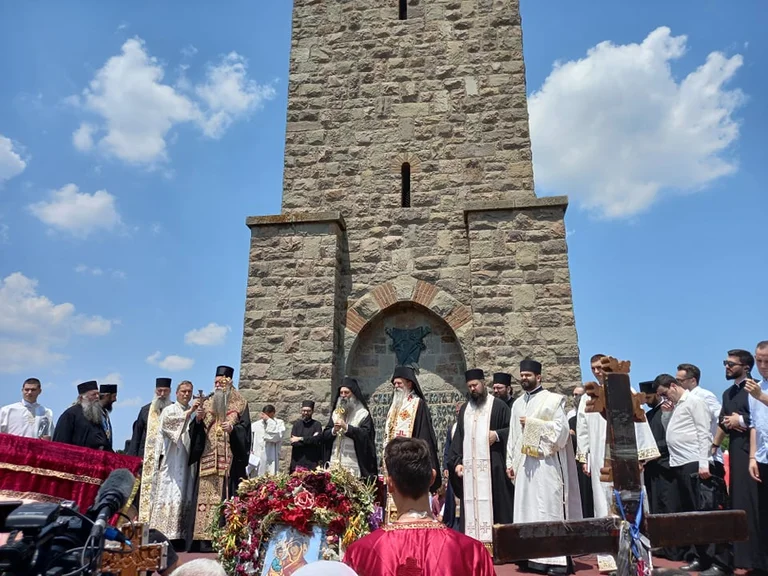
(a year ago)Gazimestan's monument, about 10km from Pristina, on June 28th becomes the most frequentd country by Kosovo Serbs, who mark Vidovdan's holiday as a memorial of Serbs' suffering in the battle against the Turkish Army in Kosovo in 1389. On June 10th of last year, the Gracanica municipality had made a decision [...]
Gazimestan's monument, about 10km from Pristina, on June 28th becomes the most frequentd country by Kosovo Serbs, who mark Vidovdan's holiday as a memorial of Serbs' suffering in the battle against the Turkish Army in Kosovo in 1389.
On June 10th of last year, the Gracanica municipality had decided that this holiday will be marked and celebrated with the symbols and flags of the Serbian state, which it had submitted to the Ministry of Management of Local Power for assessment of legitimacy.
Two days later, June 12, MAPL had forwarded this request to the Ministry of Internal Affairs for assessment of legitimacy.
MPB after assessing the act by 24.06.2024 has returned the answer to the municipality and to MAPL, saying that “28 June (Vidovdan) is not defined as an official or memorial holiday in the Republic of Kosovo”, questioning the legality of this municipal decision:
“The Assembly of the Gracanica municipality, had not reconsidered the decision and acted on the MPB's request”.
So, on July 31, 2024, MAPL has indicted the Gracanica municipality, asking the Constitutional Court in Pristina, the Administrative Department, to annul the municipality's decision in question.
It took 11 months for this court to decide.
In a decision issued on June 9th of this year, which he has secured Klan Kosova, The judge, who addressed the case, Kreshnik Kaciu, has made the decision to approve the MAPL's entire indictment and annul the Gracanica municipality's decision, adding that “this Act replaces the canceled act and has binding character”.
In reasoning, the Court has said that under the Law for Official Festivals in the Republic of Kosovo, “alone the Government in co-operation with the president of the Republic of Kosovo could determine the memorial days of which two days in consultation with the Serb community. The municipalities have no authority to proclaim separate public-inflicted holidays, including the use of state or national symbols in public spaces”.
Gracanica municipality's decision to give consent to the performance of another state's flag on the occasion of a holiday not recognised as an official holiday by the institutions of the Republic of Kosovo, the Court defines “overpassing the competencies defined by law”.
That decision, according to the interpretation of the Constitutional Court in Pristina, has seriously violated the unitary and constitutional character of the Republic of Kosovo.
“According to Article 1 of the Constitution of the Republic of Kosovo, Kosovo is a unique and inseparable state, and municipal authorities cannot take actions relating that principle. Allowing the flag of another state (Serbia) outside pre-lawed cases could be perceived as a symbolic act of dual sovereignty or political self-organisation contrary to constitutional order”, further said in the reasoning of the court's decision.
This is particularly important in the context of ethnic and political sensitivity in Kosovo. Any such provision without legal grounds can set a dangerous precedent for miniming the judiciary and state unity”.
The court estimated that the Gracanica municipality's decision seriously jeopardises public order and intercommunist co-existence.
The decision in question could provoke interethnic tensions, especially if perceived that municipal authorities are favouring a community contrary to the legal order and the feelings of other communities. This public order risk is even higher in the context when the symbol of another state appears in an organized manner by a municipal public authority, without consent or authorisation of central institutions”, the Constitutional Court's ruling in Pristina says.
Furthermore, the court has rejected Gracanica's municipality claims that “this decision does not have a formal or permanent legal effect but is clearly limited to 28.06.2024”.
In this regard, the court found that temporary character does not warrant lawlessness.
The legality of an administrative act is assessed in accordance with the law at the moment when it produces effect, not on the duration of the” effect, Judge Kaciu has praised in the decision issued on the case.
With this verdict, the court aims not only at the agreement of lawlessness in concrete cases but also at ensuring the consistency of judicial order and preventing similar violations in the future.
Therefore, it says that this Act reflects the need for the same to serve as a model for actions not only for the indictee but for all other municipalities in the future, reaffirming that the municipalities have no right to take action that violates the competencies of central power, cannot legalise public appearance of the symbols of foreign states through their independent decisions, contrary to the Ministry of Internal Affairs and relevant laws, and must respect the hierarchy of acts and decisions of the central bodies of the Republic of Kosovo. /Periscopi