6 hours ago
After the Constitutional Act, the ball on political agreement or president
Periskopi(a year ago)
(a year ago)Experts on legal-unconstitutional issues say the Constitutional Court's act did not bring solution to the institutional crisis in Kosovo. According to them, the solution can now come only through a political agreement, or the president's intervention. Kosovo's Constitutional Court issued the order, but there is neither implementation nor agreement in the Assembly. For the 39th time me [...]
Experts on legal-unconstitutional issues say the Constitutional Court's act did not bring solution to the institutional crisis in Kosovo. According to them, the solution can now come only through a political agreement, or the president's intervention.
Kosovo's Constitutional Court issued the order, but there is neither implementation nor agreement in the Assembly.
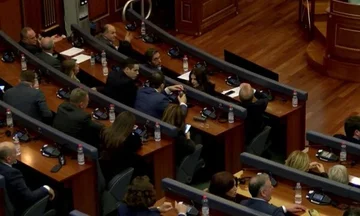
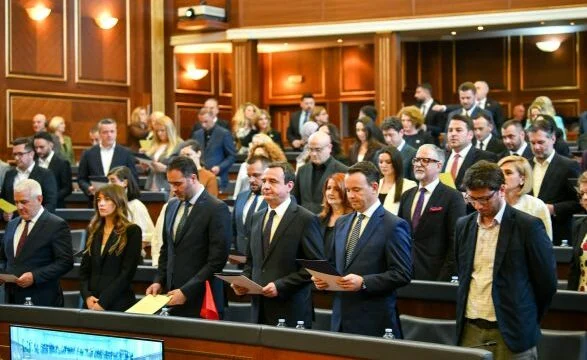
For the 39th time on 29 June, elected MPs failed to constitute the legislature.
While the 30-day term set by the Constitution for completion of the constitution goes, they remain blocked in deep political disputes.
Recognitions of legal and constitutional issues warn that if the Parliament does not complete this process by July 26th when the Constitutional Term expires, Kosovo risks being included by a comprehensive institutional paralysis.
Mazlum Baraliu, professor of Constitutional Law, says the responsibility for the current situation lies not only with political parties but also with the Constitutional Court's own ruling.
The Constitutional Court has not adequately and properly fixed things so as not to allow space for each person's interpretation, according to his own whims and desires”, he tells Radio Free Europe.
The incumbent Prime Minister, Albin Kurti, called political party representatives to the meeting, trying to unblock the situation, but after more than two hours of discussions on June 28th, the meeting ended without compromise with each side blaming the other and interpreting the Constitutional Court's decision in various ways.
What does the Constitutional Court say?
Kosovo's Constitutional Court ruled 26 that MPs are obliged not later than 30 days to complete the constitutional session of the Parliament, electing the chairman and vice president.
The Constitutional Court did not rule on the legality of refusing to vote in secret.
“The election of the chairman/s and deputy heads of the Parliament is a prerequisite for the Parliament to start functioning, and this requires all MPs to be present and vote for the constitution's framework so that the latter can start as soon as possible as the body of lawmakers, decision-makers”, the decision was said.
Ehat Miftaraj, executive director of the Kosovo Institute for Justice, says the Constitutional Court's act does not provide clarity for actions to be taken if the Assembly fails to be constitutionalised within the deadline.
He warns that parties could continue the blockade and clashes, attributing the blame to each other, while after 26 July the situation remains uncertain.
“The bias has not preceded any kind of consequence, if the (constitution of Parliament) does not occur until July 26th, or within 30 days, as is the prior legal deadline”, he tells Radio Free Europe.
Political Agreement Needed
To overcome this blockade, connoisseurs of judicial-unconstitutional issues estimate that a political agreement between parliamentary subjects is necessary.
Miftaraj says the main burden of responsibility for showing political will for agreement falls on the party that won the most votes in the February 9th elections . . .
“Unfortunately, this could last until the ruling party or Albin Kurti decides to change the candidate (for the Speaker of the Parliament) and offer solutions”, he says.
Baraliu shares similar opinions, but stresses that other main parties, such as: The Democratic Party of Kosovo, the Democratic League of Kosovo or the Alliance for the Future of Kosovo.
According to him, even though there are no legal sanctions for failing to reach the Convention Constitution Agreement by 26 July, parties bear political, ethical and moral responsibilities in front of the citizens they elected.
The “political parties are institutions. Political, ethical, and moral responsibility would have to be just as if not as much as that criminal”, Baraliu points out.
Kurti told reporters on June 30th that he is ready for constructive meetings and consultations with other political parties, as well as for trust co-operation in spirit.
He reiterated that, if Albulen Haxhiu is not elected chief parliamentary through the secret vote, the Vetevendosje Movement is open to change the candidate.
Hadziu, for several times, failed to get the 61 votes necessary for the chief parliament.
Other parties insist on the open vote, so they have also failed to respond to the constant demand of the head of the constitutional session, Avni Dehari, to propose representatives for the commission that would oversee the secret vote.
The president?
Given that political parties, currently, are not showing the will to pass the blockade at the Assembly Constitution, one of the addresses that must address this situation is Kosovo president, Miftaraj estimates.
According to him, President Vjosa Osmani has a mandate to ensure the democratic functioning of constitutional institutions.
In the concrete case, the functioning of the Assembly is not working properly, so Osman can head the Constitutional Court, he says.
“It can ask and send questions about whether it is abuse that the ruling party is doing by not changing the proposed candidate ) to make the constitution of the Assembly”, Miftaraj says.
Bekim Kupina, media adviser to President Osmani, announced that she will invite political party leaders to meetings over the next few days.
He said Osmani expects the parties represented in the Assembly to implement the Constitutional Court's act and conclude the constitutional session within the 30-day term, as requested by the Court.
If necessary, the president remains ready to address the Constitutional Court for additional clarification”, Cupina said on June 30th.
But Baraliu considers that the president is being delayed with treatment of paralysis in the Parliament.
The “needs these 30 days (before 26 July) to initiate the procedure in the Constitutional Court. With the constitutions authorised to initiate issues that are controversial and unclear between the” parties, he points out.
On Monday, over 50 civil society organisations reacted to the blocking of the Assembly's constitution, stressing that the institutional <x0vacum is leading to failure of constitutional institutions”.
The organisations underlined that the winning party has the right to propose the candidate for chairman, but that right is not absolute, as it must co-operate with other parties to secure the necessary majority.
According to them, the Constitution has made it clear that both the winning party and other parties must co-operate in confidence to elect the Speaker of the Parliament and that <x0-seconds violation of this principle is violation of the spirit of the Constitution”.
To be considered Constitute the Parliament, the chairman and five vice-presidents must get at least 61 votes from MPs. /Radio Free Europe/ Periscopi/