9 hours ago
World Bank reduces projections for Kosovo's economic growth for 2025 and 2026
Periskopi(a year ago)
(a year ago)The World Bank has produced new challenges for the global economy, marked by significant slowdown in growth and escalating trade tensions. In its latest report “Global Economic Perspections”, the World Bank has revised its projections, reducing Kosovo's economic growth projections for 2025 and 2026. According to the report of [...]
The World Bank has produced new challenges for the global economy, marked by significant slowdown in growth and escalating trade tensions. In its latest report “Global Economic Perspections”, the World Bank has revised its projections, reducing Kosovo's economic growth projections for 2025 and 2026.
According to the report released on Tuesday, global growth for 2025 is projected to drop by 0.4 percentage points, reaching only 2.3 percent. The main factors remain high tariffs and levels of unpredictableness, which are affecting almost all economies from the largest economic powers to developing markets.
Within the global train, neither is Kosovo an exception. Economic growth for 2024 is projected to reach 4.4 percent. As for 2025, 2026, and 2027, growth is estimated to be 3.8 percent each year. Compared to the January month's projections, growth for 2025 has dropped by 0.1 percentage points, while by 2026 it has dropped by 0.2 percentage points.
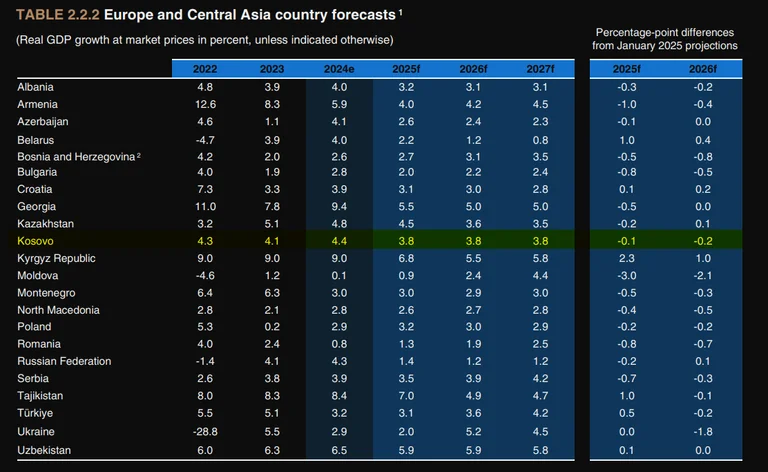
Although Kosovo's growth projections remain higher compared to those of neighbouring countries, they remain below the average period before the period before the period of Covid-19. During the 8 out of the 11 years before pandemic, economic growth has been over 4 percent, while in 5 of them it has exceeded 5 percent.
Kosovo experienced the negative flow of economic growth since 2022, breaking away from the stable trends of the past decade. With a forecast of only 4.3 per cent growth this year, the country's economy remains far from its potential, witnessed between 2009-2019.
World Bank projections remain significantly more conservative compared to those of the Kosovo Central Bank, which earlier in the year predicted economic growth of 4.2% for 2025 and 4.4% for 2026.
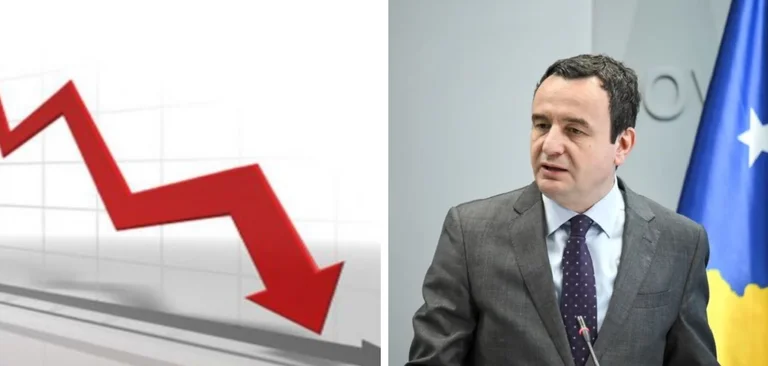
While Kosovo did not achieve recovery from the pandemic, VV deputy Albin Kurti continues to pretend that during the time of government, Kurti 2, Kosovo had good performance of economic growth.
According to World Bank data, presented by former Deputy Prime Minister at MEPTINS Edison Yacurti, Kosovo's economy until 2023 turns out that it has not yet fully recovered from pandemic.
Economics expert Edison Yacurti had explained that the gap between the current BPV and what it could be if growth followed a 10-year pre-indetermic pace was over -2 billion real dollars by 2023.
By 2023, which are part of three or more years from the opening of the economy, since many measures have started to leave since the second half of 2020, Kosovo's economy remains under pre-invisibility trends. In contrast, by 2023, Kosovo's economy has not recovered from pandemic. From 2020 onward, the gap between the BPV realised and a BPV that would follow the pre-invisibility trend is over -2 billion real dollars, 1.3 of which are only in the post-invisibility period 2021-23.” Yacurti said. /Periscope/