8 hours ago
Two years of violence in Zvecan, what has happened since then

Periskopi(a year ago)
(a year ago)While Kosovo police say the current situation in the north of the country two years after the violence between local Serbs and KFOR members is “quiet but delicate “and that “much has changed for the better”, Serb residents of this area say the situation has never been worse. The people with whom [...]
The people with whom Radio Free Europe spoke described their life after May 2023 as completely different, naming that month the turning <x0-2-5x1> when the closure of institutions operating according to Serbia's system in Kosovo began.
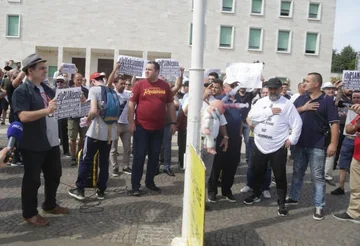
On May 29th 2023, a violent clash occurred in Zvecan between Serb protesters and NATO peacekeeping mission troops in Kosovo, KFOR. The protest was called against the Albanian chairman's entry into the municipality building, as Serbs had boycotted local elections with calls from the Serb List. The main party of Kosovo Serbs enjoying Belgrade's support. As a result, at the head of Serb majority municipalities in the north, northern Mitrovica, Leposaviq, Zvecan and Zubin Potok led Albanian leaders.
Of the clashes in Zvecan, 93 KFOR soldiers who were located in front of the municipality building remained seriously and easily injured. Meanwhile, about 50 Serbs were also injured, many of whom later fled to Serbia and are currently not accessible to justice in Kosovo.
KFOR named the attack on its members as untested and totally unacceptable “, demanding that all participants in the violence of “are urgently prosecuted”. This international mission also voiced hope that even authorities in Serbia are investigating the people who returned there after the riots, writes REL, broadcast Periscope.
Free Europe Radio has requested information from the Constitutional Court in Pristina and the prosecution for the number of persons prosecuted so far and for any ongoing process regarding the attack on KFOR, but has not received answers. Neither did the Supreme Public Prosecutor in Belgrade give answers to the case.
What is publicly known in Kosovo is that more than ten people have been arrested in connection with violence in Zvecan. Some have been sentenced to about a year in prison, following agreements with the prosecution on admitting guilt. Since they have been counted time in custody, these persons are already in freedom, while others have been protected in a free state.
On the other hand, it is still not known whether Serbian justice has opened or conducted any investigation into the case of the attack on KFOR.
Kosovo Police: Security situation in the north is under control
Kosovo Police Deputy Director for the Northern Region Veton Elshani, in a statement to Radio Free Europe, recalls that on May 29, 2023 in Zvecan happened, as he describes, a small “war”. But, according to him, today the situation is “legally different”.
The situation is still delicate because of the political aspect, but it's quiet”, Elshani says. He stresses that Kosovo Police now have “full control of” on security in the north, and that there are no more “armed groups” working for destabilisation.
On May 29th, 2023, there were people in the crowd of Serb protesters wearing masks who were involved in clashes with KFOR soldiers using shock-bombas, Molotovian cocktails and other strong tools.
These riots turned into the starting point of new tensions in northern Kosovo, which culminated in September 2023 when a group of armed Serbs attacked the Kosovo Police in the village of Banjska near Zvecan. Police sergeant Africa Bulnjak was killed in that attack, while three Serb attackers were killed during the shootout.
There are no more armed groups in Kosovo. As far as northern Kosovo is concerned, we can say it is safe. The situation has changed a lot”, Elshani says.
He adds that Kosovo police are in permanent contact with KFOR on issues related to the north, and that they jointly organise patrols or exchange important information.
What do citizens say?
Yellen from Northern Mitrovica tells Radio Free Europe that over the past two years, it has felt <x0-> alone and excluded”.
“As if no one cares about people again”, she says.
According to her, Kosovo institutions' decisions in this period have negatively affected the lives of the Serb community. As an example, it cites the ban on the use of the dinar and the closure of institutions operating according to Serbia's system.
Everything has become even more difficult. You have to go all the way to Race [city in Serbia] to attract the money. Everything is complicated, people don't trust anyone anymore, feel betrayed”, Yelen says.
A ATM imposed by Serbian authorities in Rashka, Serbia, just a few metres after crossing the border with Kosovo.
Serbs in Kosovo from Serbia's budget receive pensions, salaries or social aid, but since the beginning of 2023, when the Kosovo Central Bank adopted a regulation defining the euro as the only allowed currency, these payments are difficult.
Ivan, also from the north, says the lives of Serbs have deteriorated significantly in the past two years.
“Things have gone too far, life has faded, no more communication with local authorities”, he says.
According to him, the situation is further burdened by the closure of institutions that were under the authority of the Government of Serbia.
“Rugs are empty”, he says.
In addition to businesses, banks in the north have been opened, but Kosovo Post Office has also opened.
Kosovo considers institutions working according to Serbia's system as parallel and illegal structures. The process of shutting them down officially began early in 2024, but a major step toward this was taking control of municipal buildings in May 2023. Prior to that move, the municipalities of Zvecan, Leposaviqi and Zubin Potok were operating in the same objects with Serbia's so-called interim municipal organs. In some cases, municipal heads were the same in both systems.
Bojana from North Mitrovica says the last two years have been the worst “of her life”. She cites as problems the closure of Serbian institutions, the addition of the Kosovo Police presence and lack of confidence in Pristina institutions and their decisions.
Everything has gone down, nothing good has happened”, she says.
On the other hand, Albanians living in the north experience the situation differently. For them, the security situation “has never been better”.
In addition, the process of returning displaced Albanians has begun. One of them is Zahir Mehmeti, with whom the Radio Free Europe team spoke several months ago. He said he has returned to his home after 24 years, thanks to the assistance of Kosovo authorities.
Mehmeti also stressed good relations with Serbian neighbours in northern Mitrovica, where they make up the majority.
“Site to the north is always fragile”
Pristina security expert Nuredin Ibishi estimates that the current situation in northern Kosovo is calm, but remains fragile and that there is always the risk of escalation due to Serbia's influence.
Authorities in Kosovo believe Serbia stands behind the attack on Banjska and other tensions in the north, though this is flatly denied by official Belgrade.
In a proposal for Radio Free Europe, Ibishi says that after the armed attack in Banjska, evidence has been found about the existence of a paramilitary formation led by Milan Radojic, who, according to him, often moves close to the border with Kosovo. Hence, he adds, the risk of a possible escalation always remains present.
Radociq, former deputy chairman of the Serbian List, has taken responsibility for the September 2023 attack on Banjska. In Kosovo it also relates to criminal activities, corruption, war crimes, the murder of Serbian politician Oliver Ivanovic and the intimidation of witnesses in judicial processes.
Kosovo's “north remains a potential hot spot. It could be escalation. Currently, the situation is under control. There is no public unrest, police attacks or journalists, no explosions. The situation is better, but for a sustainable stabilisation, political talks are needed between Kosovo and Serbia”, Ibishi says.
Kosovo and Serbia have been involved in a process of dialogue on normalising relations with the European Union's mediation, but dialogue on the political level has been blocked since the attack on Banjska in September 2023. /Periscope/