8 hours ago
veterans send the letter to the EU commissioner: The specialist turned into something else, immediately starting an international investigation.
Periskopi(a year ago)
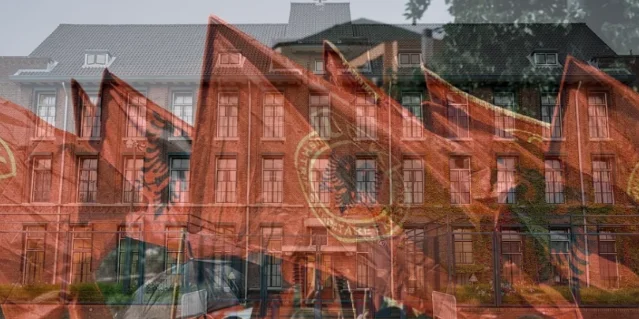
(a year ago)The Association of Veterans of the KLA War has been addressed with a letter to the Commissioner for Human Rights at the Council of Europe, Michael O'Flaherty. The letter says they are turning to “not to challenge justice, but to protect it”. It also says that specialized rooms no longer resemble an institution [...]
The Association of Veterans of the KLA War has been addressed with a letter to the Commissioner for Human Rights at the Council of Europe, Michael O'Flaherty.
The letter says they are turning to “not to challenge justice, but to protect it”.
Also reportedly, the Specialised Chambers no longer resemble a judicial institution built on European human rights values, but “have been transformed into a hermeticly closed structure, operating in complete isolation from Kosovo's legal system, its democratic institutions and constitutional supervision mechanisms”, follow Periscope.
They have called for international investigation into the <x0 systemic human rights violations and procedural abuses within the Specialised Chambers for Kosovo”.
Full letter:
Dear Commissioner Michael O'Flaherty,
We are addressing you as the Association of Veterans of the Kosovo Liberation Army (OVL-UÇK), not to challenge justice, but to protect it.
We have been among the strongest supporters of international justice and accountability. We believe, like many in our society, that truth and justice not only can afford any consideration but must be followed through principled and impartial legal procedures. We welcomed the idea of a justice that would function beyond power policy, with integrity to distinguish between vengeance and law. We felt this as our duty to our fellow citizens, and above all, to the memory of those who gave their lives to protect the right to live free from tyranny.
But what started as a legal instrument of justice has become something entirely different.
Today, the Specialised Chambers no longer resemble a judicial institution built on European human rights values. They have become an airtightly closed structure that functions in complete isolation from Kosovo's legal system, its democratic institutions and constitutional supervision mechanisms. Their procedures are tarnished by prolonged detentions, excessive document editing, delays in delivery of evidence and restrictions on legal assistance. The specialised chambers refuse to take into account both the Kosovo Ombudsman, the institution that exists precisely to protect fundamental rights and which has full rights, both within the Kosovo legal system and under international law, to investigate possible violations. But the court's position is clear, they provide neither answers nor consideration nor accountability.
This is not merely a legal matter. It's a matter of human rights.
Those who submit to the process are no longer treated as innocent citizens until the evidence of guilt. They are kept, for years, under conditions that destroy their dignity, families and rights. They are judged not only before a court but in a system where the prosecution enjoys unlimited power and where protection rights are not only weakened but are actively hindered.
For these reasons, we are obliged to make a painful but necessary comparison, now this institution is beginning to occur with an Inquisition rather than a court of justice. Covered with legal language, it acts without effective control, without local participation and without supervision that had distinguished a justice system from an oppressive mechanism. It judges, prosecutes and keeps in custody, all within a closed structure that refuses to recognise the instruments and legal institutions of the Republic of Kosovo. This is not just a procedural failure but a betrayal of the promise of justice.
We are not alone in expressing such concern. Respected lawyers, civil society organisations and even former officials within the specialised rooms themselves have warned that current direction risks not only delegateing the institution but also causing irresistibly damaging damage to public confidence in international justice. When justice is felt only by the accused, and never by the society on which it is exercised, then we no longer speak of justice. We're talking about tribulation.
For this reason, and with full respect for your mandate and for the principles of the Council of Europe, we direct this request:
An independent international investigation into systematic human rights violations and procedural abuses within Kosovo's specialised chambers is launched immediately.
This investigation should be led by independent law and human rights experts outside the current institutional structure of the court. The mandate must be given to assess the tribunal's compliance with the European Convention for Human Rights, the treatment of detainees, procedural restrictions on defence rights, the exclusion of monitoring mechanisms and the unproportional privileges of its officials.
Justice cannot exist in a vacuum. No institution, no matter how noble, is in origin, stands on consideration and accountability. No European court should be allowed to function without full compliance with the European values it claims to represent.
We have fought to complete tyranny, not to see how it is resurrected in the form of invulnerable legal institutions.
Dear Commissioner, we call you to act.
With the deepest respect,
Kosovo Liberation Army Veterans Organisation (OVL, SHIL,SHFD-UÇK)