7 hours ago
Why is there no noise of work in Pristina Square, but strife between institutions?
Periskopi(a year ago)
(a year ago)Works designed to transform George Bush” Square into the Kosovo capital, which have been conveyed with more controversy than work for two months. What is the problem, and how can it be solved? It looks simple on paper: A municipality plans a project, takes all necessary permits, secures the required budget, [...]
It looks simple on paper: A municipality plans a project, takes all necessary permits, secures the required budget, works begin and, in the end, the inauguration tape is expected.
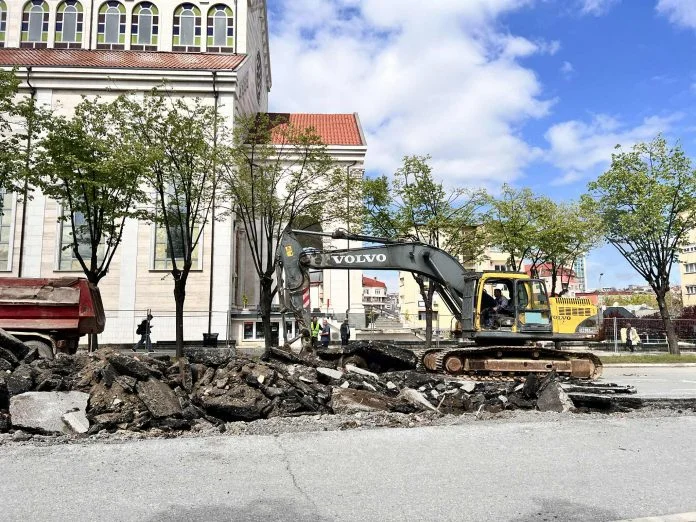
But, for two months, works that were designed to transform George Bush” Square into Kosovo's capital have been followed with more controversy than works.
What's the problem? In two words: Cultural heritage.
Works began on March 10th for the more than 18m-euro Pristina municipality project.
But they stopped just two days later. Then again on April 16, and again on April 29th. Now, this area, where asphalt has been cut, remains under the fence.
Why is the project being rejected in George Bush” Square?
The Kosovo Institute for Protection of Monuments (IKMM), which operates within the Ministry of Culture, Youth and Sports (MKRS), says the project is contrary to the Law on Cultural Heritage.
Several cultural monuments of what is known as the Pristina Historical Centre are located in this area.
Under the Law on Cultural Heritage, projects in these areas must be obtained from the IKMM permission Pristina Community does not enjoy.
The director of the Transformation Directorate in the Pristina municipality, Gzim Kastrati, tells Radio Free Europe that the application for this permit was made on 15 March, and that the work has continued at “public area that does not [interfer to] any protected assets”.
“Synnim is that these ikeonic objects are not only not affected but that they are further highlighted and valorized as part of a new urban asamble”, Kastati explains.
But the IKMM and MKRS disagree. They say the Pristina municipality has already intervened in the perimeter of the protected zone, which has the border right where the two road strips of “George Bush” were previously divided.
The Pristina municipality accuses these institutions that their actions are more political than professional. (The municipality is led by Rama's Democratic League of Kosovo progress, while the ministry by Hajrula Ceku of the Vetevendosje Movement. In October of this year, regular local elections are expected to be held in all Kosovo municipalities.
But the MKRS opposes this argument. She says she would approve any project that respects professional laws and standards.
As evidence of this, in a response to the REL, she mentioned that, likewise, last year, the work at the building of the former Garmia goods house in Pristina was stopped because of lack of permission.
However, after applying for permission to the cultural heritage institutions, the project was approved”, the MKRS say.
However, for the project in “George Bush”, MKRS has more scepticism. The ministry believes this project could damage Pristina's “cultural heritage”.
How to Preserve Cultural Heritage
The debate over what threatens cultural heritage assets has brought numerous clashes between Pristina President Rama and incumbent Culture Minister Ceku, and Finance Minister Hekuran Murati.
They have also warned criminal charges against each other, while Koha.net has reported that Kosovo police have already launched investigations. But despite all the attempts, the S.P.D. has confirmed this for REL-in, broadcast. Pericop.
However, for Sali Shoshi, executive director of the foundation Cultural Heritage Without Borders ( CHWB Kosovo, institutions must put political differences aside and work together to preserve Pristina's identity.
“
He adds that the process to decide what constitutes Pristina's identity and what should not be done through a consensus between citizens, Komunas and the Ministry.
And when an area is declared as a protection zone, he says that there must be a file that shows what kind of materials can be used for conservation in that area, at which height it can be built, which cadastral areas are affected and many other things.
“Without this file, all remains subject to subjective interpretation”, Shoshi estimates.
But, he points out that preserving cultural heritage assets does not mean that urban development can be available.
“One of them [recognised interventions] is walking free in unloaded square [with cars]. But if you can walk, which means you can build an object that prevents the appearance of something we're saying right now is worth”, it ends. /Periscope/