7 hours ago
Two weeks for a fragile “government” Who does?
Periskopi(a year ago)
(a year ago)About the remaining two weeks to keep the Kosovo Parliament's Constitutional Assembly session is sufficient for the Vetevendosje Movement, as the winner of the February 9th parliamentary elections, to hold talks with other political subjects for constitutionalisation of the legislature and the formation of the new government. They thus appreciate connoisseurs of political developments from [...]
Thus, they assess connoisseurs and political developments from the Kosovo Democratic Institute and the Group for Legal and Political Studies. But, they warn that the ruling coalition could result in the fragile “”, reports Radio Free EuropeFollow Periscope.
“I believe that [two weeks] is the necessary space of time for discussions to be held, at least on the topic of the 48x1> assembly, points out Eugen Cakoli from the Kosovo Democratic Institute.
Besar Grogi, a researcher in the Group for Legal and Political Studies, does not name the time of two weeks of problematic deadlines for achieving reconciliation for the constitutionalisation of the Assembly and the formation of the new Kosovo government.
“The political will [of political subjects] and their political maturity” is a problem, Gergi points out to the REL.
Kosovo President Vjosa Osmani on Tuesday called for the meeting for the Kosovo Assembly Constitution, to be held on 15 April.
A day later, she said that by then “has enough time” for technical preparations for the agreement of the Kosovo Assembly.
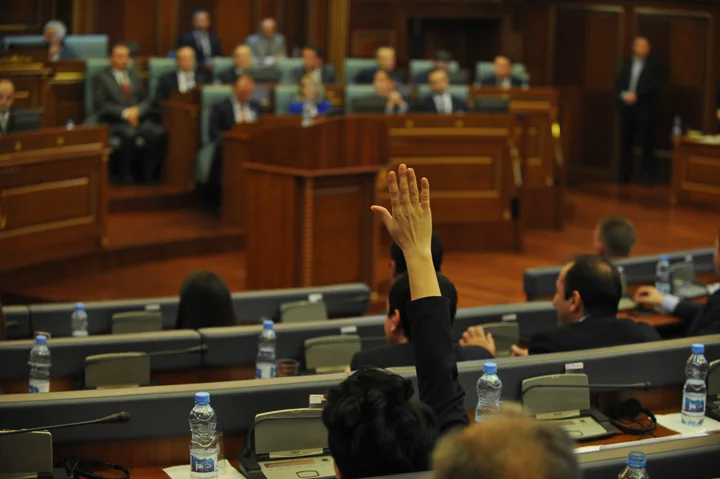
The assembly's full union precedes the election of its chairman and vice-presidents, with most of the votes of MPs.
The chairman of the assembly must be nominated by the Vetevendosje Movement.
The Vetevendosje Movement, as the winning party, in the February 9th elections has secured 48 seats in the Kosovo Assembly. However, they are not enough for the mayor's vote and deputy mayors of the assembly as well as for forming the government, which requires at least 61 votes.
As for the coalitions, the LVV has said it prefers to form the executive with some of the parties of the non-communist communities, which have 20 seats guaranteed in the Kosovo Assembly. Non-Serb minority communities have ten seats, while the Serbian List has won nine out of ten seats belonging to the Serb community.
Kosovo's acting prime minister, simultaneously chairman of the Vetevendosje (LVV) Movement, Albin Kurti, has started meetings with minority political parties on Wednesday to consult about forming the country's new government.
He has met with the head of the new Democratic Party (NDS) from the Bosniak community, at the same time deputy prime minister in office, Emilia Rexhepi, with the leader of the Party for Freedom, Justice and Survival from the Serb community, Nenad Rassic, and the party chairman of the New Democratic Initiative of Kosovo (IRDK), Elbert Krasniqi. During Thursday, Kurti has continued meetings with other non-Serb party representatives.
On March 30th, he warned the possibility that the Parliament and the Government of Kosovo will be formed in one day.
Possible deal to establish new government
Eugen Cakoli from the Kosovo Democratic Institute says that, before April 15th is set as the date for the assembly's constitutional session, political parties have had more than a month to talk about eventual coalitions for forming the new government.
According to him, they have had clear signals that the preliminary election result will not differ much from the result certified by the Central Election Commission on 27 March.
The Vetevendosje movement, so far, has ruled out the coalition's possibility with the other three political subjects -- the Democratic Party of Kosovo, the Democratic League of Kosovo and the Alliance for the Future of Kosovo coalition and the Social Democrat Initiative.
Who has “red” for the new government?
Unlike the LDK and the AAK, which have spoken against a ruling coalition with Vetevendosje Movement, The PDK and the Social Democrat Initiative have not set up “red” for no party.
Furthermore, the initiative, which has secured three seats in the assembly, unlike its partner in the pre-election coalition AAK with five deputies, has hinted that the initiative for the potential coalition should be undertaken by the LVV.
Cakoli, sees this as an opportunity for Vetevendosje Movement, which, along with the votes of the minority parties, will secure 61 votes for forming the new government, immediately after the assembly's institution.
With the deputies of the Initiative, the ten deputies of non-Serb minorities and Rashicin, LVV would secure 62 votes in the assembly.
Chocolate says the following days, until the assembly's constitutional session, are enough to ensure a reconciliation between the Vetevendosje Movement and MPs appointed by other parties.
“There are indicators that the Vetevendosje Movement can go towards individual negotiations with appointed deputies ʹ including those of the Initiative and perhaps others to secure that minimum constitutional threshold of 61 votes for electing the chairman of the assembly, but also for the new government”, Calcoli tells Radio Free Europe.
He adds that if the LVV manages to secure the necessary votes for the mayor's vote, then the institution's constitutionalisation could take place within hours.
In this context, he does not see it impossible that the same day -- on April 15th -- to also set up a session in the assembly for forming the new government, although procedures like the proposal of the new government by the Vetevendosje Movement, as well as then nominated mandate by Kosovo President Vjosa Osmani can take some time.
“The fragile sum with the unstable coalition”
Even Besar Gergi agrees that LVV will suffice two weeks to see if it can secure the MPs' 61 votes for the mayor's vote, the institution's constitutionalisation and the formation of the new government.
It does not rule out the possibility that this 61-vote majority will be secure along with non-US communities and MPs appointed by another party.
But according to him, this majority in the assembly would be the fragile “”, as would the new government.
In the context of regional and global geopolitical developments, according to him, Kosovo needs a stable government, which, he says, is impossible to form without a coalition between LVV and one of the two largest parties, PDK or LDK.
In public statements, we must dig very deeply to find any poor signal that there is some space for cooperation. But there is no clear statement, either from Vetevendosje or other parties, regarding the creation of a [government] coalition. If numbers are found for forming a government, if this is done with very fragile numbers, with a unstable coalition, then this again does not provide security to Kosovo and its people in this very complicated geopolitical situation”, Gergi points out.
He adds that a government secured by, as he calls the fragile “numbers of” votes, cannot survive the election of Kosovo president, expected in April of next year, when President Vjosa Osmani's 5-year term expires.
The election of a new president or Osman re-election requires a majority of 80 votes in the Assembly, in two rounds. If in the first two rounds the election fails for lack of this number of votes, the president is elected with a simple majority of 61 votes, provided 80 MPs are present at the session, meaning two-thirds of the 120 deputies as much as the Kosovo Assembly.
At this point, according to Grogit, there are expected clashes in the assembly among political parties, which may not create the necessary quorum. Failure to elect the president from Parliament sends the country to early parliamentary elections. / REL/