7 hours ago
Enver Hasani: Opposition Wrong politically
Periskopi(a year ago)
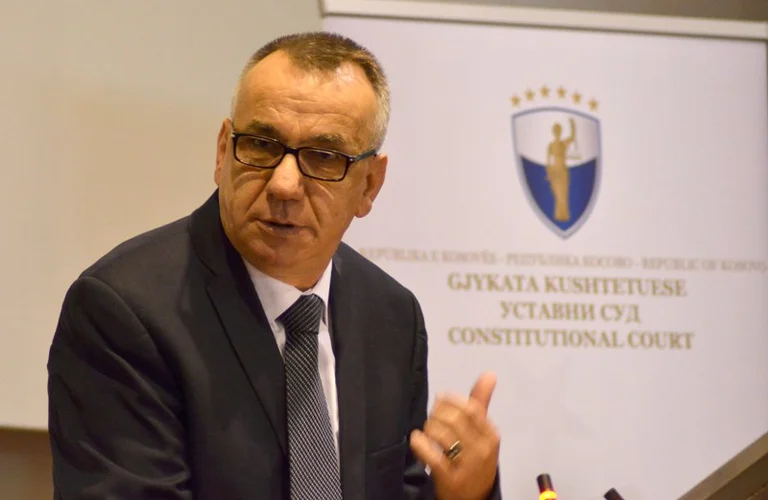
(a year ago)Former head of the Constitutional Court of Kosovo, currently professor of Law and International Relations at the University of Pristina, Enver Hasani, says the Kosovo Assembly has not been blocked and can be collected every 48 hours, as MPs failed to constitutionalise this institution. In an interview for Radio Free Europe, Hasan describes it as a failure [...]
In an interview for Radio Free Europe, Hasan describes the failure of the Democratic Party of Kosovo, the Democratic League of Kosovo and the Alliance for the Future of Kosovo's Commission report to verify the mandates.
These parties have questioned the resignations submitted by Albin Kurti and other members of the government, who have been elected MPs. But, Hasani says that with their oath as MPs, they could not exercise any executive function.
Radio Free Europe: Professor Hasan, how do you see the situation of today's blocking the Parliament's constitutionalisation process, since MPs have not voted the Commission's report on verifying mandates?
Enver Hasani: This cannot be said to be a deadlock, because, according to the Order (of the Kosovo Parliament), the Assembly should be collected every 48 hours until the transition. So there's an immune mechanism that objectively unblocks the situation.
Second, I think it was wrong (oppressive action), because this is all a formal process. MPs have not certified themselves and, in that sense, is politically some kind of absurdity, since they are mandated by the people. The way the report has not been adopted is not a pleasant thing for MPs themselves.
Radio Free Europe: A letter has been issued by Albin Kurti's resignation (from prime minister's post). The opposition is not accepting the prime minister's resignation. How do you comment?
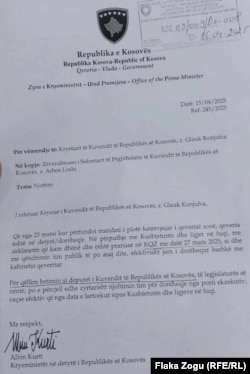
Enver Hasani: I haven't seen the letter, but the resignation should be clear and should be made public for the public, in time and be without ecuivok.
That letter, as far as I know, is fine when it's publicized a few days ago, weeks ago, so when Mr. Kurti said he doesn't have to resign, telling him the reasons.
The reason is constitutional, because the Parliament's mandate has expired. This can be accepted legally, somehow. But it is not equivalent to resignation because resignation should be expressive, as the law requires.
Therefore, I think they've made a mistake (deputations) that haven't approved (the Commission's report on the verification of mandates), because as soon as the prime minister or anyone else takes an oath, he can no longer exercise any executive function or other public office. It means, according to constitutional power, that post would be intermediate and could not return to Office (the prime minister).
Everything can happen to us, and he can keep doing everything.
But even if it were not for the Government Law, which forces (the prime minister) to resign without equivoke, prior to the moment of certificate (as MP) respectively, before the certificate, then the Constitution issue is clear when you pledge (as deputy) you cannot have two virtues.
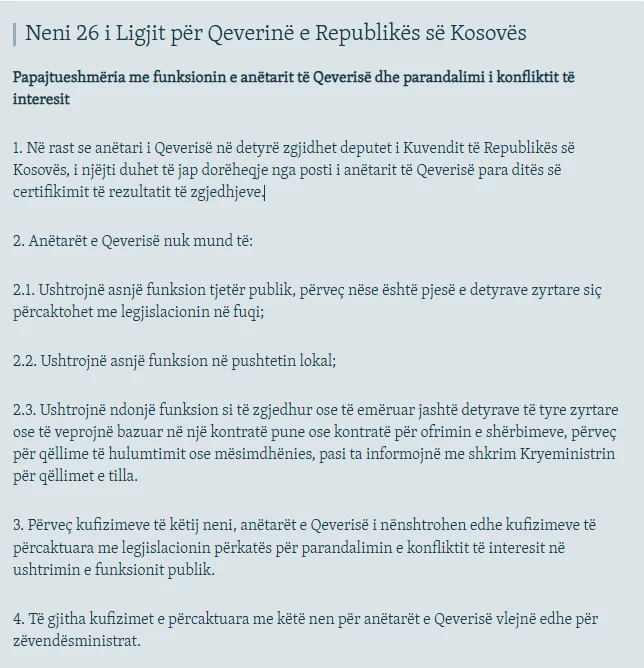
So I think they're wrong. They should have allowed the Parliament to be formed, and immediately after that, according to constitutional power, (the incumbent deputy prime minister) Faithful Bislem to continue his work. So those who are not deputies can continue to carry out the government's daily tasks.
Political parties accuse each other of failure to establish Parliament
Radio Free Europe: Professor Hasani, you mentioned the issue of resignation in time. Even the opposition says the resignation of the government cabinet would have to take place on time. What would this act of resignation be like, and what does the expression “mean at times”?
Enver Hasani: “Over time” means just like they did the law themselves. This government has made the Law and has had to submit to the law.
These guys are confusing the lack of mandate. The government has no warrant, because it has passed, as Kurti has said, so there is no need for resignation.
But they can't interpret it that way, because when it says the law and the Constitution that it should be either before the certificate, before the oath respectively, to resign and you can't exercise any function, it has nothing to do with the mandate of executive office or resignation, in no way.
Radio Free Europe: Does this mean that the opposition is right to capture this “vage” now?
Enver Hasani: Yes, without question. In a formal way, the opposition is right. But, I think the opposition has been politically wrong, for a reason, because they had to allow it to be sworn in (the Kurti) and then it could not under any circumstances (exercise the post of prime minister), because it would end in the Constitutional Court. Now no one can send him to the Constitutional Court or the Presidency, because there is no decision of the Parliament yet, it does not exist for the purposes of its function, as the representative of the people and lawmakers.
Radio Free EuropeProfessor Hasani, the head of the session, said they would address President Vjosa Osmani on how to move on. In fact, what is the role of the president in this context?
Enver HasaniZero. No role has the president/here. It's wrong. I don't know who said that.
Radio Free EuropeWhat, then, is the way out of this situation?
Enver Hasani: The breakthrough is to reach political agreement and vote (approval) the report (of the Commission to verify mandates).
Is it too late for talks on the new government?
Radio Free Europe: What should political agreement seem like?
Enver Hasani: Political agreement means the resignation of the prime minister and those in executive positions or approval of the report, as it is (the current state without the prime minister's resignation) to take the oath of MPs. At the time of the oath, there is no need for resignation because, objectively, the mandate (executive). According to constitutional power, you cannot even be an MP in the executive post or any other public post.
Let's get this straight. So the moment you take the oath (for deputy) whoever it is, it cannot and cannot go to the prime minister's office, because it is unconstitutional and absurd.
Radio Free EuropeSo legally ceases the government's mandate?
Enver Hasani: No. Those minimum tasks that the government must perform take on those who are not deputy, for example Deputy Prime Minister (Besnik Bislimi) or deputy ministers, until the formation of the new government. /Periscope/