11 minutes ago
Alarming, the number of citizens who have abandoned Kosovo reaches 359 thousand
Periskopi(a year ago)
(a year ago)The GAP Institute has published today the new report “Emigrim and the Kosovo labour market: Unused work force potential” This report was released under the discussion of the Platform Forum for Publico-Private Dialogue of the National Economic and Investment Council (KKEI) on the development of the workforce. According to the report's findings, it was [...]
This report was released under the discussion Council Public-Private Dialogue Forum National Economics and Investment (KKEI) on the development of the workforce.
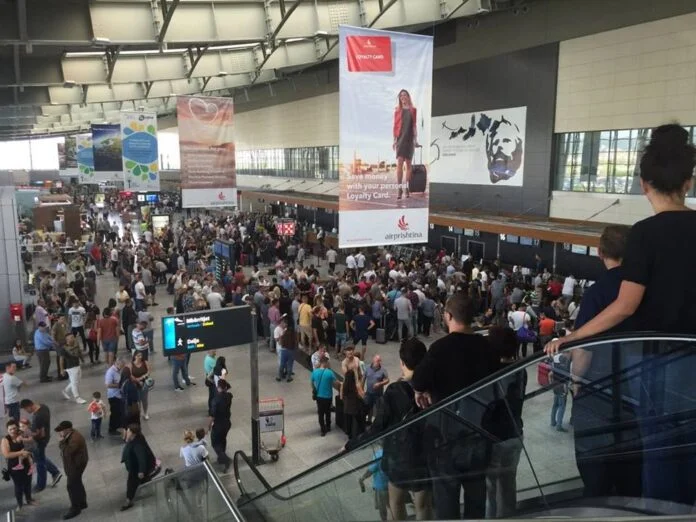
According to the report's findings, it was stressed that the labour market in Kosovo will continue to be challenged by the lack of labour force, mainly because of citizens' migration and the high degree of non-active workforce. By 2023, according to official data, the number of people who have left Kosovo to the different countries of the world has reached 359 thousand people, representing about 22.6% of the country's population, while the number of citizens returning to Kosovo and foreigners living in Kosovo is about 99,000 people.
“A part of the persons who are emigrating from Kosovo are from the active workforce, which is affecting increased domestic and foreign demand. In 2024, the Ministry of Internal Affairs (MBP) in Kosovo issued a total of 8,293 residence permits for foreign citizens, out of them 3,974 for employment reasons. Most of these immigrants are originally from countries in the region, such as Albania, Serbia, Northern Macedonia and countries outside the region as Turkey, Bangladesh, the Philippines and other Asian states. However, over half of these issued permits are the continuation of the early years. As a result, the balance of migration remains much higher than immigration, and foreign workers do not cover the lack created on the labour market”, the report says.
According to the report, the most sustainable solution to addressing the lack of labour force in Kosovo is to increase the market involvement of people who are of working age but who are currently not active in the market (who are not working and are not looking for jobs).
Kosovo has the highest rate of non-activity in the Western Balkans: out of about 1.1 million working age, only 461 thousand people (43%) are economically active, while 613 thousand people (57%) are inactive. Of the inactive persons, 66% are women and 34% are men, meaning that separately low female participation in the labour market remains a serious challenge. Kosovo ranks first in Europe and fifth at the world level for the lowest participation of women in the labour market. Also, 78 thousand young people (30%) are not engaged in education, work or training (NEET), a percentage far higher than the EU average (9.9%) and the highest in the region”, it is said further.
The main sectors affected by the lack of labor force are construction, majority and retail trade, gastronomy and hotels, and production, of which the tendency to emigrate is higher. Most of the jobs in these sectors do not require high qualifications, but include tasks that can be learned within a short period of time, suggesting that the local inactive power could meet these requirements.
“Raport provides some recommendations and measures aimed at improving the involvement of the non-active workforce in the labour market, such as training for advanced knowledge and easier involvement in the labour market; support for increased participation of women and young people in the labour market; strengthening the role of the Employment Agency; and supporting innovative technologies and advancing skills in the field of pure energy. Also attending were acts of public and private institutions, including business associations, and that GAP Institute recommendations will be identified and presented in further discussions under public-private dialogue”, the report notes. /Periscope/