8 hours ago
What will be Trump's strategy in the crucial call with Putin?
Periskopi(a year ago)
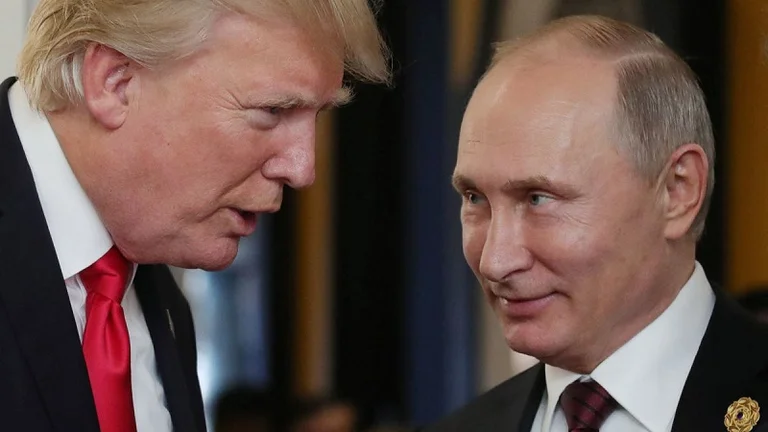
(a year ago)Common Washington is often concerned about confrontations between US President Donald Trump, and Russian counterpart President Vladimir Putin. The American leader has shown some kind of Africa with the authoritarian leader of the Kremlin, impressing critics and even allies, many of whom wonder whether the former KGB colonel can use [...]
The American leader has shown some kind of Africa with the authoritarian leader of the Kremlin, impressing critics and even allies, many of whom wonder whether the former KGB colonel can use flattery and other ways to settle the issues at his will.
Now, as Trump is preparing to negotiate with Putin through a crucial telephone call on March 18th to end the war in Ukraine, the world is waiting to see if he will remain steadfast and seek temporary ceasefire at least, or accept some of the Russian conditions.
For Ukraine, many things are on edge, including its territorial integrity, writes Radio Free Europe.
It is important that President Trump stand firm and insist on a clean truce. And if the Russians refuse, he must be willing to fulfill the promises he has made to increase pressure on Moscow”, Deputy Director of the Russian Programme for the Protection of Democracy Radio, told Free Europe.
On March 11th, Ukraine accepted Trump's proposal for a 30-day ceasefire, unconditionally, passing the ball to Putin for stopping the already three-year war.
At a press conference in Moscow three days later, the Russian leader kindly tried to cross the ball again, telling the world that although in principle he agreed with the American president's proposal, he wanted some issues addressed before accepting the deal.
Putin said he is concerned that Ukraine could use the interruption of fighting to rally itself, train and re-arm at a time when its forces have priority in the field of battle.
It also raised doubts about monitoring the front over 1,000 kilometers during the ceasefire and demanded that “reality on the ground” be taken into account in peace talks, meaning Russia's control over Ukrainian soil.
Experts have long warned that Putin is interested in ending the war only under his terms, including the full control of four Ukrainian regions Russia claimed annexed in 2022, the disarmament of Kiev and Ukraine's NATO membership.
At an annual geopolitical conference in New Delhi on March 18th, Ukraine's Foreign Minister, Andrey Syhbiza, voiced Kiev's belief that it could create a stable and just “peace with Trump's leadership and was expecting a “otherwise for ceasefire” from Russia.
“Now is the time for diplomacy, for strong diplomacy”, Syhbika said.
Trump has made the end of the war as soon as a top priority for his administration. Since Moscow and Kiev still have much incompatibility, there are concerns that Trump could exert pressure on Ukrainian President Volodymyr Zelensky to make more concessions than Putin.
Before the start of ceasefire talks, the US president said he opposed Ukraine's NATO membership and that Kiev would have to give up some territories by making visible concessions to Putin's two main demands, although Trump has not accepted them as preconditions for the ceasefire agreement.
The Russian leader believes he is winning the war and that the time is on his side, so he will try to drag off ceasefire talks instead of immediately dismissing the proposal, so as not to exacerbate Trump, experts have said.
Trump, however, has expressed optimism about the conversation warned with Putin, telling reporters on March 16th that “has done much work over the weekend” to achieve a ceasefire.
Trump sent his special envoy, Steve Whitoff, to Moscow last week to meet Putin, to prepare the conversation by telephone on March 18th.
He said he will talk to Putin about both <x0-reservative” and “termermorals”, possibly referring to the largest nuclear power plant in Europe, which Russia controls in Ukraine.
I think we've already discussed many of these issues, both from Ukraine and Russia. We're already talking about sharing some assets”, Trump said.
“I think we have a very good chance” to end the war, he added.
John Herbst, former US Ambassador to Ukraine (2003-2006) and analyst at the Atlantic Council, told REL that the rhetoric coming from the Kremlin does not match the White House's optimistic tone.
According to Herbst, Russia has given no indication that it is willing to make concessions.
“
Ian Bremmer, founder of the Council of Political Risks company Eurasia Group, said in a video published on March 17th on X that Trump's struggle for ceasefire is the key <x0-step”, given Ukraine's difficulties on the battlefield.
Russia has been pushing ahead east of Ukraine since the end of 2023 after Ukraine's failed counteroffensiveness despite major human losses and equipment. With its considerable advantage in soldiers, some military experts say they see no clear way for Ukraine to regain its territories.
We'd be in a better position today if [former Joe president] Beden would have been more willing to pressure Zelensky and European allies, and to show that America understood Ukraine's position was weakening over Russia and that the war was leading only more expenses and more lives lost by both sides”, Bremmer said.
Using Trump's terminology, Bremmer said the American president, with the support of allies, has the cards in his hands on these negotiations, but warned that Putin knows how to play well with even a weak hand.
Hardie shared the same concern, saying Putin would try to use the call “to shape” Trump's view of conflict through dezinformation. He stressed that Trump last week reiterated Putin's exaggerated claim that Ukrainian forces in Kursk were surrounded by Russian troops.
This is not the first time Trump has repeated Putin's view after talking to the Kremlin leader.
At the same time, Trump has also spoken with harsh tones towards Russia. He has threatened to impose tariffs and sanctions on Moscow if the Kremlin disagrees with the ceasefire. But he has not publicly declared any timetable, giving the Kremlin some opportunity to negotiate.
One of the main tools in his mind are oil sanctions, Hardie said.
Trump can lower the $60 price ceiling set by the US and EU in 2022 for Russian oil exports transported by western ships. The American president could also sanction more Russian oil transport vessels. Russia uses the money from oil exports to supply the economy and defence, making up about a third of the federal budget revenues.
During the election campaign, Trump rejected Ukraine's military support from the US, which could limit its possibility of using Ukraine's supply with weapons as pressure if Russia does not accept the ceasefire proposal.
However, Trump can use the remaining $3.8 billion from the 61 billion aid package approved last year to support Ukraine militarily, Hardie said.
Trump has said he will impose sanctions and tariffs on Russia if the Kremlin disagrees with the ceasefire. However, he has not set any timetable for this.