7 hours ago
The trial against former KLA leaders What does the Special Decision for documents from the Shala area and Karadaku contain?
Periskopi(a year ago)
(a year ago)In Kosovo Specialised Chambers ( The DPSK) in The Hague has been made a decision on accepting material evidence of several documents allegedly from the Shala and Karadaku Operative Zone, Periscopi broadcasts. This decision was taken on 4 March 2025 and stems from a SPS motion to accept these documents. Request [...]
This decision was taken on 4 March 2025 and stems from a SPS motion to accept these documents.
The SPS's request was submitted on July 24th, 2024, while on August 30th the defence response was answered in the request, which the SPS response was filed on September 9th.
In its request, the SPS said documents required for admission into material evidence are of the Kosovo Liberation Army and are mainly linked to these two operational zones, reports
In its presentation, the prosecution has said that these documents complement other documents presented in the process, as well as witness testimony, are relevant and authentic and have witness value.
While the defence had responded that the SPS has not fulfilled its obligation to present the highest value of witnesses in the evidence register and thus contributes to the size of the evidence register. As a result, the defence has said it can detect negatively in procedures and prevent acceleration.
Furthermore, the defence has rejected accepting evidence proposed by the Prosecutor, saying their reactions are not visible, are authentic and that they should be verified through witnesses.
In addition, the defence has said the panel should take into account defence objections regarding proposed documents that are seized from Rexhep Selimi's house, and also some defence evidence has weak links with facts and circumstances claimed in the indictment.
Under Defense, Z The SP is trying to determine the importance of a document through interference and that they can be harmed by accepting these documents because the SPS has not identified specific witnesses who might challenge the content of the evidence in question.
While the SPS has countered that the defence is misinterpreting the request and that previous objections already being reviewed and rejected by the panel of judges are being repeated.
The SPS had initially proposed documents from the Shala Operative Zone from 1 to 28. According to the panel, documents from 1 to 4 consist of documents containing military lists, training plans and a request to participate in special unit training.
For the proposed document, which is fifth in a row, the panel has said it is KLA service regulation.
For document 6, the panel has noted there are paper collections of relief for providing oil and gasoline. While the following document and 11 and 12 are times for the guards and service officers.
For document 8, the decision says it belongs to the KLA Operative Staff in Cyqavica with a list of names of people who would travel to Glodjan to get weapons.
The document 9 and 23 are made up of KLA orders for military issues by Shala Operative Zone Commander and civil affairs from Cyqavica's Local Staff Commander. Documents 10, 17, 18, 20, 21, 22 and 25 under the decision are footnotes, as well as notes printed as reports, journals, etc.
Document 13 is a first-hand speech by the deputy commander for logistics in the Shala Zone. While the next document is signed by a commander granting authorization to perform some repair work.
The 15th document under the decision is a photograph and a statement by a soldier agreeing to join the KLA. And the next document is a list of members of the brigade battalions “Meshe Uka” and a list of houses that have been burned. And the 19th document is a request of the 141 “Meshe Uka” to the Shala Operative Zone command.
In addition, at this session is the 28th document, which according to the decision is a request of a KLA member who applied to the ZO Shala Command to remain an officer. While, the document 24 is a travel permit issued by the Staff of Battalion 4 of the 141 Brigade. In contrast, documents 26 and 27 are lists of the KLA military police.
As a result, the panel noted that the SPS relied on these documents to demonstrate that the KLA registered and trained soldiers, organised service officers and watch hours, controlled movements including checkpoints, implemented discipline and took disciplinary measures, and collected information and compiled lists of wanted persons.
In addition, the SPS in these documents tried to demonstrate the authority of the General Staff, structure, logistics criminal responsibility, as well as that suspected persons and KLA opponents were licensed, arrested, banned and mistreated at various locations in the Shala Zone and transferred to other areas.
The panel said the proposed documents are sufficiently related to facts and circumstances in the indictment and that these documents are important.
For document 13 The panel has said SPS has failed to prove its authenticity because the first one is unwritten, without date, and without a stamp. The same document is also unknown by whom it is drafted. While document 17 is not dated, but unsigned and unsigned, no sign of who has drafted them.
For documents 1 to 12, 14 to 16 and 19 to 28, according to decision Z. The SP has managed to prove their primary authenticity as documents hold dates, are signed, have author names, have KLA logos, or even some of them have been seized from Selim's house. As a result, the panel has found that in principle these documents are authentic and have provative value.
Of these documents, the panel has rejected only those 13, 17 and 18, while others have been admitted to material evidence.
On the other hand, Z. The SP has submitted ten documents to Karadku Operative Zone for evidence.
The SPS's request for document admission, 5, 8 and 9, has been deemed invalid since these evidence was accepted earlier.
For document 2 the panel, however, has noted that it is from the Ministry of Defence of the Kosovo Interim Government, while it receives an admission notice and a vacation permit.
For the 4, SPS documents, it claims it is a template for the Karadaku Zone to give up weapons. And the documents 6 and 7 are orders from the commander of the Karadaku Zone. The last document, meanwhile, is a hand-written military report discussing events that took place in this area at the end of 99.
According to the decision, these documents demonstrate that organisational and logistical issues that had appeared in this area were addressed at the KLA General Staff and the Kosovo Permanent Government.
These documents are also said to demonstrate the close cooperation of the area with the Llap Zone.
On the other hand, according to the decision the documents show that by April 99, the Karadaku area had military police and had founded the 171 Brigade, while by 19 June and 20 June 1999 this Zone had started collecting weapons from Serbs and Albanians.
Also reportedly the commander of the Karadaku Zone had issued written orders for people to report to Karadaku's command.
According to documents, reportedly in the decision, this area controlled municipal structures of the Interim Government, public, municipal and management services.
Ahmet Isufi as commander of this area had issued orders banning agreements with the Serb side, KFOR or any other party, always under the decision.
This area, held training, materials, military police documents and registers of people who were not considered loyal to the KLA.
In addition, this command reportedly appointed commanders and created illegal UcK stations, police stations and bases in areas under its control. While between June and late July 1999, KLA members have arrested, mistreated and killed suspected persons as perceived accomplices and opponents, including victims involved in the process in The Hague.
These documents even reportedly indicate that a military police commander of the area reported to the General Staff and the Ministry of Public Order of Kosovo for a raid on a dorm in Gjilan and the arrest of several KLA soldiers by KFOR.
For documents in 2-4, 6-7 and 10, the panel has said that they connect to facts and circumstances in the indictment, are authentic and have provative value. It is also stressed that some of them have been seized by the home of Rexhep Selim.
As a result, the documents in question were accepted in material evidence.
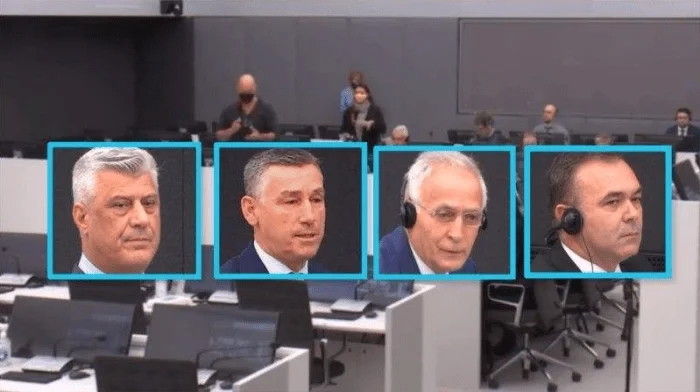
Otherwise, the Specialised Prosecutor's Office, on September 30th, 2022, has handed over the confirmed amended indictment against Hashim Thaci, Kadri Veselini, Jakup Krasniqi and Rexhep Selimi, which consists of ten points of charges, where the latter are charged with war crimes and crimes against humanity.
On April 29th 2022, the Specialised Prosecutor's Office had handed over a amended indictment to Hashim Thaci, Kadri Wessel, Rexhepi and Jakup Krasniqi, where four indictees have committed war crimes even in Gjilan, Budakov and Semtish.
On November 9th 2020, in their first appearances, Hashim Thaci's Jakup Krasniqi has been declared innocent of the charges placed on them. Wessel has also been declared in his presentation on November 10th, as has Rexhep Selimi on November 11th.
The act against Hashim Thaci, Kadri Veselin, Rexhep Selimit and Jakup Krasniqi is confirmed on October 26, 2020. /Betimy for Justice