8 hours ago
How long does the road to the House Constitution last?
Periskopi(a year ago)
(a year ago)Following the completion of any election process in Kosovo, one of the most important moments for functionalisation of institutions is the call of the Parliament's constitutional session. This step marks the official start of the new legislature and paves the way for verification of mandates, the oath of deputies, the election of the Speaker of the Parliament, vice-presidents and the formation of the government [...]
The data thus far shows that the time spent between Certificate of election results and maintaining this session has not been the same in past legislatures, though within the constitutional deadline.
In some cases, this process has been accomplished effectively and within a reasonable timeline, while in other cases it has dragged on, sometimes because of complicated political circumstances or lack of clear will for co-operation among political acts.
Comparison of legislatures, how long has it been between the certificate and the constitutional session?
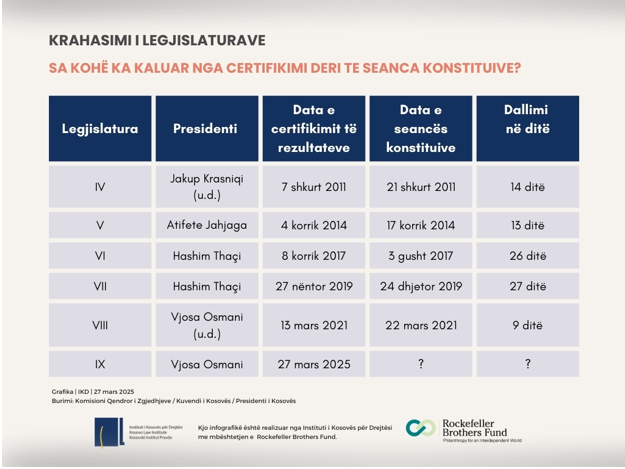
To better understand the institutional dynamic of calling for constitutional sessions, a sign was presented that summarizes the data for the IV's legislature until the IX legislature, focusing on the date of the certificate of election results, the date of the call of the first House session, and the number of waiting days between these two steps.
Moving deadlines from one legislature to another: What does this dynamic tell us?
From the table data, it turns out that there is no standard entirely harmonised for the duration of the post-election Assembly binding period. Although the Constitution envisions that the Assembly should be called within a 30-day deadline after the confirmation of the results, the actual waiting period has varied.
In 2011, when the fourth legislature was introduced, the process was carried out through calling the Constituent session by President Jakup Krasniqi's task manager. The session was called in 14 days, which represented a relatively fast deadline in the context of that time.
The fifth legislature, called by President Atifete Jahjaga, marked an even shorter time between 13 days and the constitutional hearing.
On the contrary, in 2017 and 2019, during the sixth and seventh legislature, the process was evidently extended, with 26 and 27 days, respectively. In these two cases, the president was Hashim Thaci. Such delays are often attributed to the political context and difficulties in reaching agreements on forming the parliamentary majority.
Unlike these two cases, the eighth legislature, which followed the 2021 elections, was marked by unusual institutional efficiency. Presidential duty officer Vjosa Osmani appointed the constitutional session only nine days after the Certificate of results, turning this process into the fastest since Kosovo's declaration of independence.
How long did the certificate of results last on February 9th compared to past elections?
The February 9th 2025 regular parliamentary elections are expected to be certified today on March 27th, a 46-day wait. This time is longer than certificate periods in some recent choices. However, public data reveals that the elections held on December 12th 2010 had the longest waiting time until the certificate of results: 57 days in all.
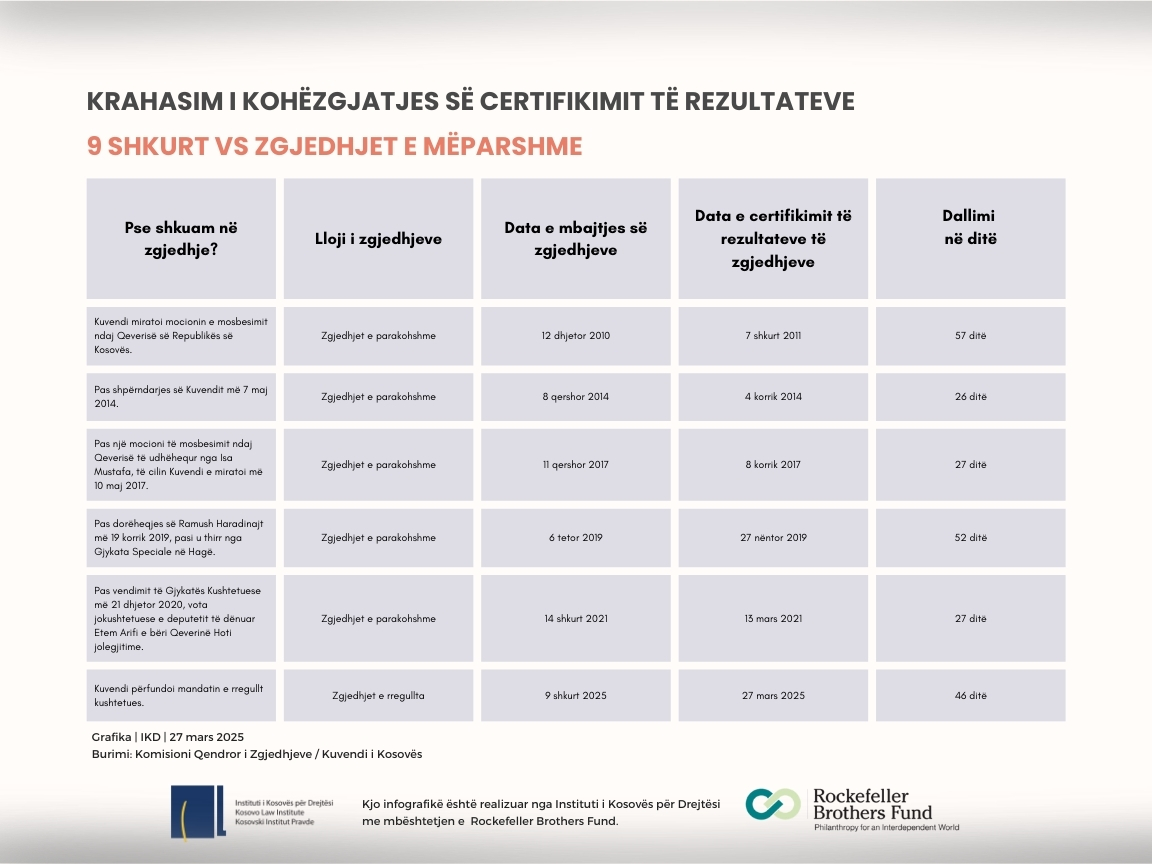
For later elections, notes improvements in certificate speed: the 2014 and 2017 elections have needed only 26 and 27 days to complete the process, respectively.
For the October 6th elections, 2019, although the system was more prepared, certificates required 52 days.
As for the February 14, 2021 elections, which followed the Constitutional Court's decision, the certificate was realised within 27 days.
What is expected for the ninth legislature?
Following the Supreme Court's ruling, where no political parties' complaint has already been approved, the CEC has set the 27 March 2025 date when the results of fair parliamentary elections held on February 9th 2025 will be certified.
President Vjosa Osmani, who is currently on a full mandate, will have the constitutional responsibility to call the Assembly's first session. Based on the experience of 2021, there are public and institutional expectations for this process to be followed with similar efficiency.
However, everything depends on the nature of the election result if the creation of the parliamentary majority is clear and there is no internal political crisis, the session can be held within an opinional time. Otherwise, any delay in the constitution is at risk of affecting the entire calendar of forming new institutions.
For the ninth legislature, it is important for positive practices to consolidate and create an institutional standard, guaranteeing rapid and transparent functioning of the Parliament. / Justice Trust