8 hours ago
Kosovo amid “political links” and security risks
Periskopi(a year ago)
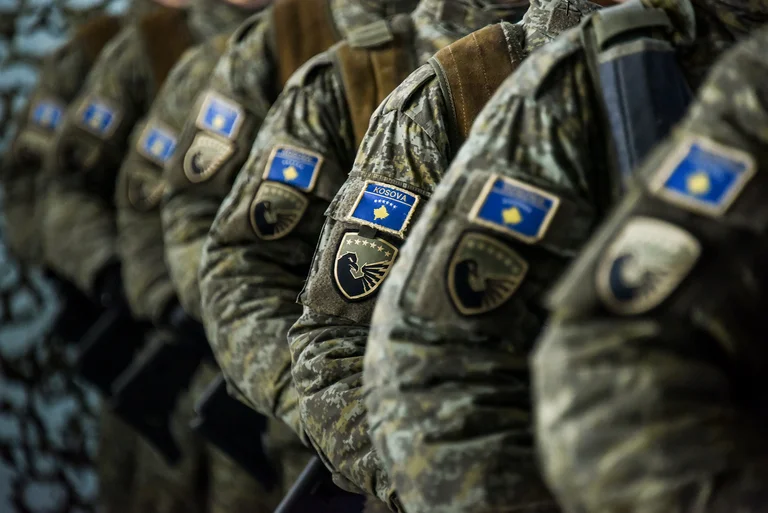
(a year ago)As Europe re-arms, NATO is in crisis and alliances under pressure, security in Kosovo comes under question. Authorities guarantee stability, but experts warn of its vulnerability and call on Kosovo leaders to be as present at the tables where the fate of security is discussed. Kosovo Defence Minister Ejup Macedonia argues [...]
Kosovo Defence Minister Ejup Macedonia argues defence and security capacities in the country have significantly improved in recent years.
He emphasises that investments in personnel, equipment and doctrine have played a key role in advancing the Kosovo Security Force, making it more capable of fulfilling its defence duties and adjusting to new security challenges.
However, because of the sensitivity of the information, Macedonia is limited to details it publicly shares and mentions only some of the systems Kosovo possesses.
We have a Bayraktar drone fleet. In addition, we have provided other pilot-free flight systems that have not been made public and we continue to procur, in order to meet not only the operational needs of the KSF, but also to have abundant capacities for any change in the” situation, says Macedonia for Radio Free Europe.
Kosovo, since the end of the war in 1999, relies mainly on NATO's peacekeeping force, KFOR.
In 2018, its Security Force began the 10-year process of complete military transformation.
Minister Macedonia says this year the third and final phase of transition is expected to begin, and stresses that some of the first goals to be achieved in 2028 have already been achieved.
Here, he mentions enough ammunition, as well as advances in staff recruiting.
We've already exceeded the number of 4,000. I think it's over 4,300 or 4,400. In this respect, we're earlier in time so we've achieved our goals earlier than before. I believe by next year we will have 5,000 [soldiers]”, says Macedonia.
By the end of the transformation, the Kosovo Security Force is expected to have over 7,500 members of them 5,000 active and others reserve.
From the beginning of the transition, the process has had the support of the United States, but not NATO's, which has insisted that the KSF should maintain its initial duties, such as crisis response or civil protection.
This stand was repeated this week by the secretary - general NATO, Mark Rutte, during a visit to Kosovo.
“The KSF must have everything it needs to be effective in carrying out its humanitarian role here in Kosovo. This is the mandate that NATO has to help The KSF thus develops and is a humanitarian force in this country, when humanitarian issues happen. This is the mandate we work for every day”, Rutte said, broadcast Periscope.
In response, Kosovo President Vjosa Osmani said the lack of recognition of Kosovo by four NATO nations complicates the progress of reports between the KSF and the alliance, but stressed that the KSF, in line with the laws in force, has full mandate for the protection of Kosovo's sovereignty and territorial integrity.
In addition, we have found other ways to advance the KSF's role and its contribution to peace and security in other countries, through co-operation agreements we have with [NATO] member states apart from”, Osmani said.
Of the six Western Balkan countries, Albania, Northern Macedonia and Montenegro are NATO member states; Serbia and Bosnia and Herzegovina are part of NATO's Partnership for Peace programme, while Kosovo remains out of this framework as well, due to non-recognition by four member states: Greece, Romania, Slovakia and Spain.
As a result, it is forced to rely on bilateral agreements, especially with allies like the US and Turkey.
Beyond the border, Serbia has, which does not recognise Kosovo's independence and has territorial claims against it, continues to strengthen the army with weapons from both the West and the East.
Kosovo considers it a major threat to its security and has had several cases, in recent years, when this neighbour has gathered troops at the border.
To avoid misunderstandings and escalation of tensions, Katarina Djokic, from the Stockholm International Institute for Peace Research, says the two countries, in addition to improving communication, should increase transparency for the military capacities they possess.
It would be nice if there was a broker willing to engage. KFOR has a good position, but is not in its mandate. Then, the European Union mediates a dialogue between Kosovo and Serbia even though it is stuck, it remains involved. So, there's room for creativity when it comes to diplomacy”, says Djokovic about the Expose program. Radio Free Europe.
For some security experts, the likelihood of a conventional military attack on Kosovo's sovereignty and territorial integrity is low, largely because of KFOR's presence.
But, with the ongoing fight in Ukraine, instability in the Middle East and changing the global security landscape, they say Kosovo, of course, should step up efforts to transform the KSF into a fully operational army.
Adrian Steun, from the International Centre against Terrorism, says this is no longer just a political issue, but “an urgent necessity”.
At this moment, Europe has been armed as never before since the end of the Cold War. This is not being done by wish, but by necessity, due to threats coming from the East, namely Russia. And the Balkans are in Europe, in the southeast, respectively, so closer to where the threats come from” come from, says Steun for Expose.
US President Donald Trump's administration, reportedly is considering repositioning its troops to Europe. At the same time, it is also increasing pressure on European allies to increase military spending and take on more responsibility for their defence.
Stein says this call applies to Kosovo as a European state as well.
There must be a lot to do with transforming the KSF into the military. We are in time of transition, very difficult, with many challenges, which requires increased defence capacities even from countries that have military structures for decades or hundreds of years, you can imagine what Kosovo has to do with”, Steun says.
The budget earmarked for the Ministry of Defence in Kosovo has gone up from 67.3m euros in 2021 to 207.8m euros this year.
Defence Minister Macedonia says that, in the course of recent geopolitical changes, for the next four years, a budget of over 1 billion euros for defence is envisioned.
But, Steun adds that in the face of a more isolated American policy, Kosovo should also diversify its security partnerships.
He cites the European Union's plan to spend 800 billion euros in defence, and says Kosovo must be strategically positioned to benefit from these funds and to be present at security fortunes discussed.
Security expert expressed indignation at the fact that, even more than a month after the elections, Kosovo continues to remain mired in voter debates.
At the time when much is being reformed in foreign policy, in defence policy and in global order, Kosovo leaders deal with “internal policy changes”, according to him.
I think this is irresponsible. Kosovo does not have the luxury to shrink, it needs to expand, to be present, not only with speeches, but actively, in a strategic, strategic way, with partners, to explain why a strong Kosovo, better protected, better armed, is at the benefit of Europe's security. Because, not only would it achieve the capacity to defend itself, but it would also release the capacities of other NATO member states, currently in Kosovo”, Steun says.
Radio Free Europe asked the U.S. State Department as well as the Defense Department how the Trump administration will continue to support the transformation of KSF into the military, but no institution received answers.
On Wednesday, March 12th, the Kosovo Government approved in principle the link to an agreement with the US for deepening co-operation in the field of defence.
For Minister Macedonia, this means that the US will help Kosovo build strategic military capacities.
From this place, Kosovo also hosts antiaircraft systems Yavelin known for their ability to advance against armoured vehicles.
Macedonia says that, currently, their payment is being made, but does not specify when they will arrive in Kosovo. The demand for the purchase of over 200 such antiaircraftists, Kosovo has made it in 2024.
That same year, Kosovo has made an agreement with Turkey for the construction of the first plant of various calibre ammunition.
Macedonia has told Radio Free Europe late last year that Kosovo, in four years, has spent over 269m euros on arms purchase.
And for State, every moment that has challenges also offers the possibility that intelligent leaders should exploit them in behalf of their people. In his words, the best “sometimes comes when you're up against the wall, because the circumstances are the same thing you have to come up with.”