8 hours ago
Spending public money in Kosovo: What do the data show?
Periskopi(a year ago)
(a year ago)Since Kosovo's 2008 declaration of independence, the country's annual budget has followed the constant growth trend. Over the years, different governments have had different priorities during the management of the annual budget. When the Government of Kosovo has first claimed responsibility for managing the annual budget from the UN Mission [...]
Since Kosovo's 2008 declaration of independence, the country's annual budget has followed the constant growth trend. Over the years, different governments have had different priorities during the management of the annual budget.
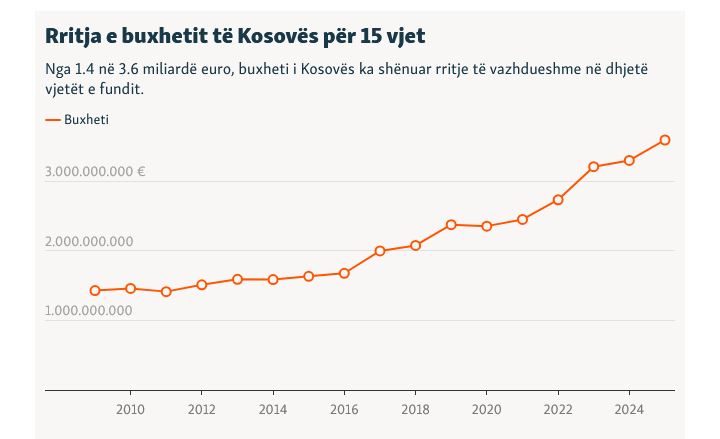
When the Kosovo government has first claimed responsibility for managing the annual budget from the United Nations Mission UNMIK in 2008, the budget has been slightly over a billion euros.
Since then, the budget has more than doubled.
With the change of governments, budget sharing in various ministries has also highlighted where those governments are focused.
But their frequent change has also caused the focus to change frequently.
The data shows that, earlier, a large portion of the budget has been spent on infrastructure and spatial planning, but that budget is now smaller than it was in 2010.
For health, meanwhile, the budget has remained almost the same over the years, despite overall budget growth.
The current government, led by Prime Minister Albin Kurti of the Vetevendosje Movement, is the first government to manage to complete the full four-year mandate.
Since 2015, the budget led Isa Mustafa of the Democratic League of Kosovo (LDK), Ramush Haradinaj of the Alliance for the Future of Kosovo (AAK), Albin Kurti of Vetevendosje in the first government in 2020, before being replaced by the LDK's Avdullah Hoti for less than a year.
But while the budget shows the government's plan for sharing public money, the Kosovo Statistics Agency (ASK) also shows the costs the government has made through reports that are published every three months.
Over the past few years, mostly money has been spent on social protection, thus replacing the previous priority for economic issues.
In some categories, such as environmental protection, the budget has undergone no drastic changes.
Environmental protection has remained throughout the decade as the category for which the smallest percentage of public money has been spent, regardless of who was in charge of the government.
The budget for public employees' salaries is also introduced within the per capita expenditures.
Over the years, both the number of workers and the amount of budget for their salaries have increased.
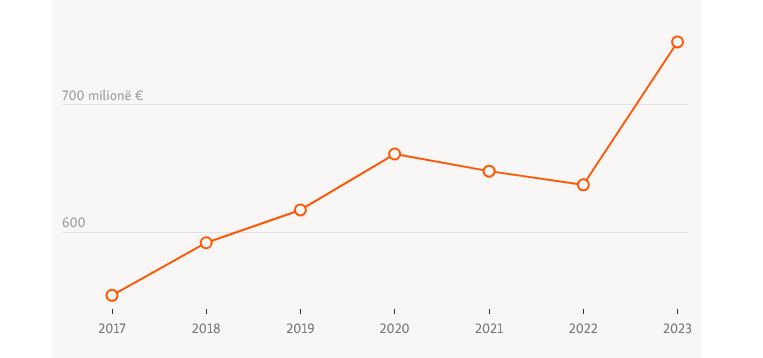
In general, the trend of wage growth is also observed outside public institutions in Kosovo. In October, the average gross salary in the country has been nearly 795 euros, compared to the average of 431 euros in 2017.