8 hours ago
CEC from Monday enters third week of vote counting, criticism that was sufficiently prepared for the process
Periskopi(a year ago)
(a year ago)The Central Election Commission (KQZ) in Kosovo has concluded counting the votes of candidates for MPs in the February 9th parliamentary elections, as well as completing the verification of votes for political sub-nets. Under the new election law, candidates for MPs' votes have been counted separately at the Municipal Counting Centres. This process has begun [...]
The Central Election Commission (KQZ) in Kosovo has concluded counting the votes of candidates for MPs in the February 9th parliamentary elections, as well as completing the verification of votes for political sub-nets.
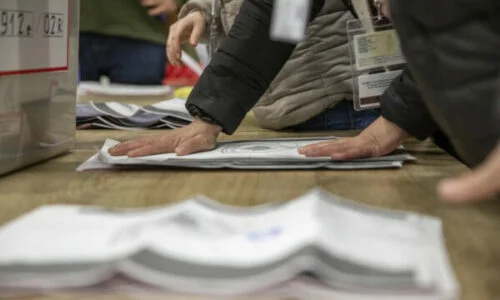
Under the new election law, candidates for MPs' votes have been counted separately at the Municipal Counting Centres. This process has started late, while election monitoring organisations have criticised the CEC itself for not being prepared well enough for the process.
In the coming days, counting on bail, votes of persons with special needs and over 800,000 votes from the diaspora are expected to begin.
After publishing 99.96 percent of the results on the CEC site, current Prime Minister Albin Kurti of the Vetevendosje Movement, who has been competing for a second term, has won the most votes on February 9th, 290.729 soos.
Among the five most voted in this party, after Kurt, are: Glauk Konjufca, Faton Peci, Iron Murati and Albulen Haxhiu.
The Vetevendosje (LVV) party has come out first in this election with 40.90 per cent of the vote, followed by the Democratic Party of Kosovo (PDK) with 22.03 per cent of the vote, the Democratic League of Kosovo (LDK) with 17.64 per cent of the vote, the coalition between the Alliance for the Future of Kosovo (AAK) and the Social Democrat Initiative with 7.46 per cent of the vote, as well as the Serbian List with 4.60 per cent of votes.
The five most voted persons from PDK ranks are: Bedri Hamza, Memli Krasniqi, Ismaili Bridge, Vora Citaku and Sala Jashari.
In the five of the LDK, the ranking is this: Lumir Abdjiku, Doarsa Kica eyli, Hykmete Bajrami, Mejim Shala and Avdullah Hoti.
In the coalition between the AAK and the Initiative, the five most voted figures are: Ramush Haradinaj, Daut Haradinaj, Fatmir Limaj, Beke Berisha and Time Kadriaj.
As for the Serbian List, at the top of the list is Branislav Nikolic, later Ljiljana Stefanovic, Srdjan Popovic, Slavko Sibiu and Igor Sibiu.
The chairman of the Serbian List ʹ the largest party of Serbs in Kosovo -- Zlatan Ellek -- is ranked seventh in the number of votes won.
This year's election release was 40 percent about 8 percent less than in the 2021 elections.
The most voted person in Kosovo continues to remain Kosovo's current president, Vjosa Osmani, who in the 2021 elections, had won 300,756 votes.
The Vetevendosje movement, which has largely secured votes in this election process, has pledged to form the new Government, though with the current results, does not have 61 MPs for approval of the new government cabinet.
Political analysts have cited the possibility of joining LVV forces with non-Serb communities, which have 10 seats guaranteed in the Parliament.
When will the new Kosovo government be formed?
Opposition parties, P DK, LDK, and AAK have dismissed the possibility of creating the coalition with LVV and have expressed readiness for forming a government together.
Political officials warn that in the coming days and weeks, Kosovo risks facing political turbulence, due to deepening divisions between the ruling party and those in opposition. / REL./