2 hours ago
US by law aims not to support change of borders in the Balkans, including that Kosovo, Serbia
Periskopi(7 months ago)
(7 months ago)If the Constitution of Democracy and Progress in the Western Balkans” is approved by the American Congress and Senate and signed by President Donald Trump, the United States will legally engage that their foreign policy does not support division of territories, secession or any other border change based on ethnicity in the Western Balkans, including between Kosovo [...]
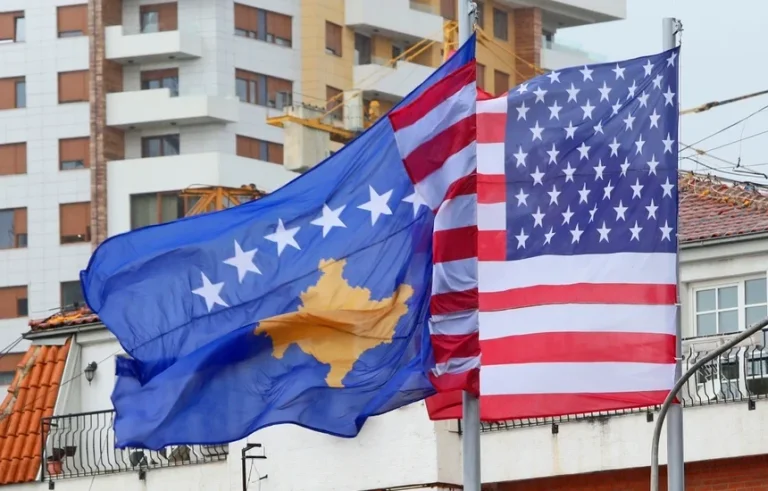
If “The Act of Democracy and Progress in the Western Balkans” is approved by the American Congress and Senate and signed by President Donald Trump, the United States will legally engage that their foreign policy does not support division of territories, secession or any other border change based on ethnicity in the Western Balkans, including Kosovo and Serbia, as well as the possible division of Republika Srpska.
This prediction is part of the 11th section of the bill, which deals with reports between Kosovo and Serbia, and stresses that the agreement on normalising relations between Belgrade and Pristina, reached on February 27th 2023 with the support of the European Union, must be implemented quickly. The law also promotes bilateral talks, concrete initiatives for boosting trade and investment, as well as US support for a final agreement.
For the first time, the bill also includes paragraph on “not changing borders”.
“The US will not follow any policy that supports exchanges of territories, secession or other forms of revising borders along ethnic lines in the Western Balkans as a means to arbitrate disputes between national states in the region”, It says in the bill.
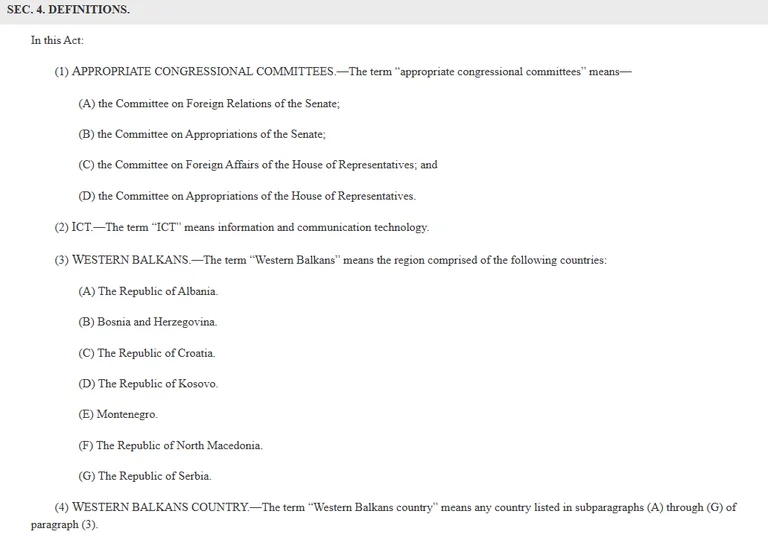
Currently, this bill on October 9th of this year has been referred to the Committee for Foreign Affairs and the Committee of Justice for considering parts belonging to each's jurisdiction. The screening deadline has not been determined yet, and the committees may require evidence, changes, or amendments before the law returns to the relevant House for vote. The law must pass the committee, and the committee may make changes or not approve of it at all. If he passes the committee, he goes to the House of Representatives or Senate for voting, depending on where the procedure began. Only after approval by both rooms and the presidential signing becomes law.
Another part of the bill focuses on Russian and Chinese influence in the region, demanding a report within 180 days by the Secretary of State and the heads of American agencies for malicious influences in the Balkans. The report will include analysis of Russia and China's goals, US activities to counter, as well as the list of all actors who interfere with democratic processes or restrict freedom of expression.
The law also focuses on economy and democracy, including increased trade and investment, regional integration, support for women's and youth enterprises, improved rule of law, diversification of energy and transition to green energy.
According to the draft law, especially the emphasis is that corruption, poverty, youth migration, false news campaigns, and Russian energy dependence are the region's main challenges. The law is expected to strengthen American engagement in the Western Balkans and ensure a clear approach against changes of borders by violence or based on ethnicity.
The dispute over the exchange of territories between Kosovo and Serbia has begun to be discussed more intensively around 2018, after years of deadlock in the dialogue mediated by the European Union. The idea envisioned changing borders, mainly for Serb majority areas in northern Kosovo and Albanian areas in other parts of Serbia. Then-President Hashim Thaci, as one of the supporters of this idea together with Serbian President Aleksandar Vuciq, had said the idea is not a partition, but a correction of the borders. But this idea was strongly opposed by the political spectrum in Kosovo, but also by some of Kosovo's allies.
One of the main reasons for the opposition has been that it would also promote the removal of the Republika Srpskas from Bosnia and Herzegovina, while straining reports in other countries in the region, both Macedonia and Montenegro./Periscopi/