3 hours ago
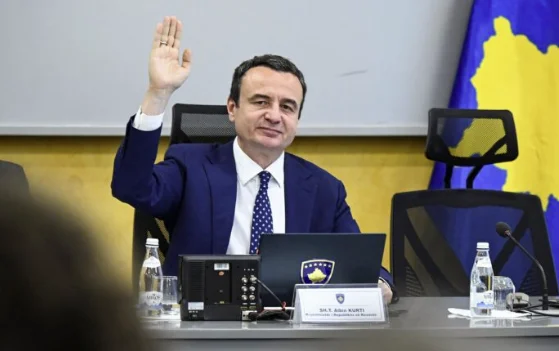
IKD: Kurti government made illegal and electoral decisions today
Periskopi(7 months ago)
(7 months ago)Kosovo's Institute for Justice (IKD) through a communique for the media has stated that it disputes and opposes the adoption of decisions by the incumbent Government. According to the IKD, these decisions were adopted by a composition of the government that, according to the Supreme Court, is incompatible with the Constitution and the Law and, more so, decisions made in expectation [...]
Kosovo's Institute for Justice (IKD) through a communique for the media has stated that it disputes and opposes the adoption of decisions by the incumbent Government. According to the IKD, these decisions were adopted by a composition of the government which, according to the Supreme Court, is incompatible with the Constitution and the Law, and furthermore, decisions made pending the first round of local elections, and with great possibility even before early parliamentary elections, IKD considers them electoral decisions.
“The IKD under no circumstances opposes rising wages, pensions or additions for certain categories. Moreover, at a time when the country is facing a high level of inflation, the issue of social justice would have to take on an added institutional focus. However, these issues should be made in full accordance with the Constitution and the Law, rather than these decisions being made in electoral context”, they say in their response.
Full response:
In a fraught economic situation and a general climate of disappointment, it is easy to reason on any action that seems to bring immediate benefit, despite disobeying laws and procedures. But laws and procedures exist precisely to protect citizens from abuse of power. When they are violated for political purposes, it may seem today that we gain something, but tomorrow we lose security, justice and equality before the law. Therefore, protection of the procedure is protection of law, institutions, and the very interests of citizens.
Under the Supreme Court's conviction, members of the government who have been certified as deputies have already lost their mandate as members of the government, due to incompatibility in maintaining both positions, that of the government member and deputy of the Assembly of the Republic of Kosovo. In contrast, all government members, who have been certified as deputies, are no longer members of the government and have no authority to make any decision. For this reason, the same have usurped government offices and, therefore, all these decisions, in the absence of competence, are illegal.
At Friday's meeting, the incumbent Government of the Republic of Kosovo first adopted the Business Division Bill for 2025 (Budgetin). This decision conflicts with the Law on Government of the Republic of Kosovo, the Law that was adopted by this Government and approved by the Parliament at the time this Government had the majority in the Assembly.
Article 31 of the Law on Government determines the government's restrictions on duty. Under these restrictions is the adoption of the Bills. This article, on the side of restrictions, also contains two (2) exclusive rights, one of which is budget approval. But that, according to the wording of this article, these two (2) rights belong only to the Government in resignation, not to a government that has completed its mandate. Article 30.2. Exactly what a government in resignation means.
On the other hand, paragraph 5 of Article 31 of this Law points out that “The provisions specified with this article apply also to Government in the situation as defined at Article 28 paragraph 1 under paragraph 1.1 of this law, until the election of the new government”, referring to the Government, which has completed the mandate. The language of this article stresses that in relation to the Government, which has completed the mandate, only limits apply to this article, and not to other exclusive rights.
On the other hand, even conceptually, this incumbent government is not the Government of this legislature, but of the previous legislature. As long as this Assembly or this legislature has not chosen this government, it cannot possibly share the same budget. For this reason, the Assembly must refuse to consider the budget proposed by the government.
Lawlessness does not end here.
In the budget vote, it also included paying for work experience to increase from 0.25% to 0.5%. Initially, it must be stressed that in the past, the fee for working experience has been 0.5%. The Law on Salaries in the Public Sector, adopted by this Government, had dropped to 0.25%. For this, the Constitutional Court found violations, ordering the decision, until 1 August 2024, to make the necessary changes to the Law on Salaries in the Public Sector. This government and the previous Assembly violated the term given by the Constitutional Court, disregarding its bias and failing to change the Law. Because of this, the courts have already been flooded with subjects from citizens who want to realise their right.
While at Friday's meeting, the Government of the Republic of Kosovo decided to include it in the budget, despite the fact that this should be done with the Law on the Salat in the Public Sector and in accordance with the Constitutional Court's act. Thus, even in this case, there are violations of the Constitution and the Law.
So is the 13th pay issue. The issue cannot be adjusted to a government decision, but systematic changes to basic laws are required. Adhering this matter through a government decision is a legally worthless decision. Moreover, such a decision would have to precede a deep economic analysis in the sense of implications. This should be seen in the prism of social justice, where state officials should not be equated with thousands of euros, with low-paid officials. Under that decision, the two categories will receive the 13th salary. On the other hand, the analysis should include incriminating the private sector to this extent. For this reason, in addition to being illegal, this decision is also conceptually wrong and risks affecting even copyright violations for equal treatment.
As far as the decision to raise the minimum wage is concerned, Mr. Iron Murati about the decision was taken in the absence of a proposal by the Economic and Social Council. Currently, the Ministry of Finance, Labour and Transfers has not functional this Council, so there was no way to come up with such a proposal.
Other Government decisions -- related to pension increases and increased additions for children -- are open electoral decisions when the second round of local elections is warned. The incumbent Prime Minister Kurti himself said he did not raise wages on the eve of campaigns, like preliminary governments.
The company of these actions, in the absence of legal competence, according to the Supreme Court's conviction, openly constitutes criminal acts of abuse of official office or authority, according to Article 414 of the Criminal Code of the Republic of Kosovo. KPRK's Article 414 points out that “official person, who by exploiting his office or official authority oversteps his authority or fails to fulfill his official duties in order to benefit any benefit for himself or the other person or to cause harm to the other person or to violate the other person's rights, is sentenced to imprisonment of (1) from eight (8) to 8)”. In this situation, acting as an official person, exploits his duty and, in the sense of the standard set by the Supreme Court, overcoming his competencies, the electoral benefits of these decisions are part of “whatever benefits for itself”, thus completing the figure of criminal work according to this article. For this reason, criminal responsibility must be addressed by the Special Prosecutor of the Republic of Kosovo.