7 hours ago
“Washington Post”: Albanians are leading international cocaine traffic
Periskopi(a year ago)
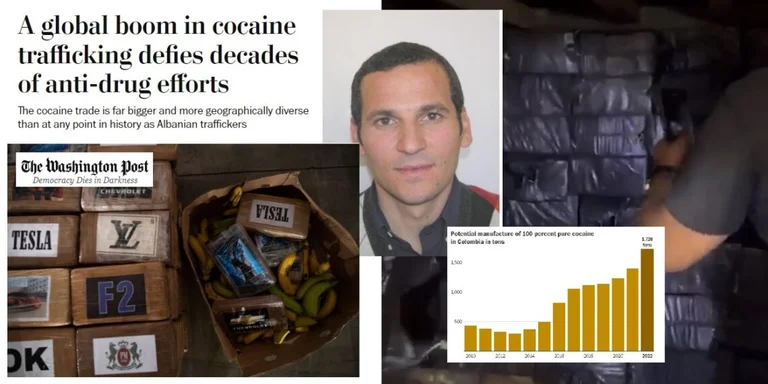
(a year ago)A global boom in cocaine traffic has been challenging decades of efforts against drugs” It is the title of a very long writing of the American daily “Washington Post”. Much of the writing that the pencil.al brings down is occupied by the role of Albanian groups, and in particular he [...]
Guayaquil, Ecuador The drug lord” had already escaped the law in three countries and was planning to do it again. In less than a decade, Dritan Rexhepi had built a traffic network that started from the fields of Colombia, to the ports of Ecuador, and then to the streets of Europe, Italian and Latin American investigators say, having him rivaled the powerful cartels of Mexico. His brand, carved into the cocaine packets, was the beautiful “Belo”
The establishment of Albanians from an armed person in his country to transatlantic king is part of a global explosion in the cocaine industry -- a trade that is much larger and more geographically diverse than at any moment in history. South America now produces more than twice as much cocaine than a decade ago.
The production of “koca” in Colombia, the origin of most cocaine in the world, has tripled, according to US figures. The surface of the land used to increase the basic drug component is more than 5 times more than it was when notorious drug lord Pablo Escobar was killed in 1993.
And production keeps growing. A record 2757 tonnes of cocaine was produced worldwide in 2022, a 20% increase compared to 2021, according to the UN Office on Drugs and Crime's latest global report.
“Going up and higher” says Thomas Pietschmann, an officer in UNODC. “Some years ago, people said the future is synthetic drugs... For now, it's still cocaine. ”
For decades, cocaine consumers were mostly Americans, and its ban was a priority of the American government. But despite the tens of billions of dollars spent in the U.S. drug fight in Latin America, the industry has not only grown, but has been globalised, with new roads, new markets and new criminal enterprises.
 Almost every one of the continental nations of Latin America has become a major drug producer, with Ecuador now one of the world's most important cocaine transit points. The demand is increasing in Europe, which is rivaling the United States as the world's top cocaine destination. Cocaine seizures in EU countries increased fivefold from 2011 to 2021 and exceeded them in the United States to 2022. As the United States remains a major market, cocaine use has dropped by about 20% by 2006, according to UNODC.

Balkan, Italian, Turkish and Russian criminal groups are all involved in Latin America to take part of the market. Few have managed to get into cocaine trafficking, like Albanian criminal networks, say investigators and analysts.
“We know there is not only one channel for cocaine” says Marco Martino, a senior Italian police official in charge of co-ordinating anti-narcotics operations. But “Albanians”, he says, “are the best and the largest”.
As cocaine production erupted, investigators say, Albanian criminal networks seized the possibility it offered. They were crucial to sending drugs to Europe and promoting consumption across the continent.

Rexhepi, 44, built most of his empire from an Ecuadoran prison cell, fostering ties with Latin American gangs and turning his cell block into an executive suite. A lawyer representing her in Albania refused to make comments. During an appeal in 2015, Rexhepi denied any involvement in drug trafficking, “being author, associate or assistant”. But in 2021, Italy requested his extradition, warning authorities in Ecuador in a letter from its embassy in Quito that Rex2> was the undisputed leader of an Albanian drug trafficking network with global extensions and access to the endless “cocaine”.
Rexhepi's appearance as a formidable power mediator within a federal prison in the Kotopax province was symptoms of the collapse of government control in Ecuador. But even though the authorities in Rome sought to imprison him for drug trafficking, he decided that it was time to move again.
A local judge, citing a medical need, ordered that he be held in house arrest in a rich neighbourhood in the port city of Guayaquil in August 2021, according to Ecuadoran officials.
Then, as expected, Rexhepi disappeared.

This investigation into global cocaine business expansion and the growth of Albanian drug traffickers is based on interviews with more than two dozen current officials and former officials in Ecuador, Colombia, Europe and the United States, gang members in Ecuador and thousands of pages of court documents from Ecuador, Albania and Italy. It finds how Albanian-led criminal networks penetrated ports, judiciary, prison systems and Ecuador's security forces to gain control of key parts of the cocaine supply chain and trigger a drug flood in Europe, a cocaine market of more than $12 billion a year, according to the EU Anti-Gugic Agency.
With these profits, these organisations managed to enter all public and private institutions, corrupting every” structure, the former Ecuador director against narcotics, General Willian Villaroel, says in an interview.
Drug trafficking entrepreneurs from Albania, a country with only about 2.8 million people, have begun rivaling the most powerful cartels in the world working with them, not against them, transforming the way traffic is directed. The new networks, investigators say, are often criminal coalitions of different and independent groups, rather than hierarchical and violent rivals.
READ BEAH: Account from Wall Street Journal/ Albanian narcos like Dritan Rexhepi
Europol is aware of dozens of non-Albanian-speaking clans “ ” or organised criminal networks currently operating in Europe, Robert Fay, head of the Europol anti-drug unit, said in an interview.
It's not about how many people you have” says Fatjona Maydini, an Albanian journalist at the Global Initiative Against Transnational Organised Crime. “It's about the right alliances you can create. ”
From the Ecuador prison cell, Rexhepi opened the way. He befriended the directors of Ecuador's most powerful band, “Los Choneros”, which while working for the “cartel Sinaloa” of Mexico, according to one of the founding members of the gang who, like others interviewed for this article, spoke on condition of anonymity because of concerns about security.
This led to strategic partnerships with both South American traffickers and gang leaders throughout Europe. Its goal was simple, investigators and journalists say: to sell as much cocaine at large as possible for all parties in the agreement.
<x)
Growing cocaine Production
The explosion in cocaine production can be seen in the demobilisation of Colombia's largest leftist rebel group, Columbia Revolutionary Forces (FARC). A historic peace agreement with the country's government in 2016 ended the longest civil conflict in the hemisphere, a conflict in which the United States played a critical role.
Since the beginning of the plan against narcotics and security known as “Colombia's” in 2000, the United States has sent about $14 billion in funds to Colombia, where at least 60% of them have gone to the army and police. The plan focused mainly on combating production and export of cocaine in the country, which FARC controlled, using revenues to finance the uprising and secure its territory.
When guerrillas dropped their weapons, the distribution of smaller armed groups, driven by profit and not by ideology, included the production areas of “kka”.

These drug traffickers “no longer have political interests”, says Leonardo Correa, head of the UNODC mission in Colombia. “What they want is to draw drugs as soon as possible to make as much money as possible. ”
Instead of providing head leaves from the country's central fields, cocaine producers in Colombia have created “enklava” near the country's borders and coasts to more easily export drugs. These enclaves became a “dygun with a stop” for a process that had previously been distributed. Already, the cultivation, extraction, and refining of drugs took place in the same area before moving beyond nearby borders. Three of the four most productive enclaves are limited to Ecuador.

The manufacturer even improved the plant itself, creating exceptionally productive hybrid cultures that extract more alkaloids from the same amount of leaves. Gustavo Petro's government, Colombia's first leftist president and a fierce opponent of the “war against drugs” led by the US, has pledged to dismantle the drug trafficking networks themselves, but it moved its focus away from rooting out the harvest of the head.
Analysts say it has only further promoted cultivation, but can also receive sharp criticism from Trump's future administration.
The amount of soil used to plant heads in Colombia increased by 10% in 2023, but the productivity of this land exploded. Cocaine production increased 53%, according to UNODC. As a result, these enclaves, which make up 14% of Colombian territory, produce about 40% of the country's head, according to UNODC. This has caused other areas of the country to face difficulties selling their cocaine crops.
As Colombian criminal groups industrialised their systems, European mafias offered the prospect of new ways to avoid intensified US patrols along Colombia's coast. Cocaine began to move in ever - increasing quantities through countries, including Ecuador, Costa Rica, and Paraguay, and on ships destined for Europe.
In Ecuador, a land that does not produce cocaine, authorities seized more drugs in 2023 than the total seizures of Peru and Bolivia, the second and third largest countries of its production. This year, until mid - December, Ecuador has seized 251 tons of cocaine from 197 tons last year. More than 81 tons were destined for Europe, compared with only about 18 tons destined for the United States and Mexico.
For only a pound of cocaine worth about 2,000 dollars in Colombia, drug traffickers could earn $250,000 by smuggling it to the United States, but that would amount to $31,500 if they arrived in Europe, according to UN and EU officials.
In 2022, for the sixth consecutive year, EU states reported a record number of cocaine seizures with Belgium, Spain and the Netherlands that registered the most. Almost 70% of these drug seizures were from container ships that arrived from Latin America.
A key transit point
It was one of the single largest cocaine seizures in the world that marked the record, but authorities found it by chance.
In late January, the Ecuadoran military officers were tracking a cache of weapons and explosives hidden in a swine farm in Los Rios province. Instead, in an underground basement, they found 22,000 packs of cocaine, 22 tonnes in total, a shipment worth more than $660m on the European market. Pacott had airline logo labels: Iberia, KLM, Qatar, Jet2.

According to intelligence officials and files of the Ecuadoran courts, the depot belonged to an Albanian criminal group.
For an Ecuadoran government that had almost collapsed because of drug violence, it was hailed as a major blow to the country's cocaine trade. He also confirmed Ecuador's global role as a key transit and logistical point for the most powerful drug traffickers in the world.
Situated among cocaine producers Colombia and Peru, Ecuador became an ideal place for traffickers, investigators say. It had limited coastal supervision, fragile institutions that were corrupt, soft visa policies that allowed the long-term stay for foreigners, and a strong group of local gangs eager to join European groups to transport drugs.
The country also boasted of a thriving shipping industry. Ecuador is the leading exporter of bananas to Europe, and a free trade agreement with the EU caused banana exports to grow by 40% by 2017, according to EU figures. The banana transport business, consisting of more than two thirds of the exports issued from Ecuador, provided an ideal form of transit, investigators said.
According to the Ecuadoran authorities, in 2023, about half of the cocaine seized in containers in Ecuador before leaving for Europe had been found on banana shipments.
The January seizure on the swine farm also illustrated the Albanian model of trafficking, intelligence officials said, with associates of third parties contracted for any link in the cocaine supply chain.
The Colombian armed groups deal with production and transportation across the border while the Ecuadoran gangs take it from there. To move 22 tons of cocaine, for example, was gang, “Los Lobos”, which transported drugs to the underground basement, according to an intelligence official who knew about the case. Another band, “Los Choneros” was tasked with guarding drugs, while a third, “Los Lagartos” had to move drugs to port. In the end network “Los Chone Kilers” had to make sure she was hiding in a container ship.
“Fugitive Artist”
Rexhepi arrived in Ecuador about 2011, part of a wave of Albanians, many of whom had deep ties with criminal groups in Europe, investigators said. Ecuador had begun to appear as a transit centre in the cocaine trade, residence was relatively easy to deal with, and there was little difficulty for foreigners in purchasing property and creating companies, said Ecuadoran officials.
Rexhepi, who had many false identities, appeared as a Greek businessman, investigators said.
The son of grape farmers in Velca, an Albanian mountain village, Rexhepi grew when pyramid schemes in the late 1990s triggered devastating economic collapses in Albania. Military bosses were looted, leading to the establishment of criminal gangs that turned part of the country into lawlessness.
“Everyone had guns in the village” says Rexhepi's uncle, Arben Jaapaj, 64, who runs a local in Velce. “As adults and children. ”

Rexhepi was soon established in the ranks of a network of international ambitions, Albanian officials said. He was arrested in 2006 after in the late 1990s, he killed a police officer and a random passerby. An act that turned Rexhepi into a known name in Albania, but he escaped from the day of his arrest by a commissioner in the coastal town of Durres, simply opening the door that was wrongly left open in the interrogation room in the basement. He went out, telling police officers who found out his investigations were over.
“He was viewed as smart, bold and willing to take risks”, said an Albanian law enforcement official, who spoke on condition of anonymity because he was not authorized to speak publicly.

In the years that followed, Rexhepi became one of Europe's most wanted criminals, followed by country to country. He was arrested on charges of drug trafficking in the Netherlands and extradited to Italy, where he was sentenced to 13 years in prison. In 2011, he and two other Albanians fled from a prison near Milan after using smuggled saws to cut down irons and dropped out of the window with an improvised rope made from sheets tied together. Months later, he was arrested in Spain but extradited to Belgium, where he was wanted for his role in a violent robbery years ago, but Belgian lower security prison did not suit Rexhepi. Once again, he escaped, this time climbing a prison wall.

But staying in Europe was becoming increasingly unstable because of the danger of another arrest on Rexhepi's escape to Ecuador.
According to Italian prosecutors, Rexhepi built his network using the first legitimate companies. He began to establish ties with Ecuadoran businesses that would help him build his smuggling operations and clear his money. One of his associates, an Albanian diplomatic deputy in Ecuador, had large parts in food and cannabis companies, according to public data and an Ecuadoran intelligence analyst who studied the network.
In just a few years in the town of Guayaquil, Rexhepi and his groups built a sophisticated system of drug logistics, buying port staff and transport companies that allowed them almost free access to European containers, investigators said. He created alliances with the entire spectrum of criminal groups in the country, they said, selling Europe as a new, open market, where everyone could benefit.
However, the law recaptured Rexhepi, and in 2014 he was arrested in Guayaquil, accused of drug trafficking and sentenced to 13 years in prison. The Ecuador prison system was run mainly by gangs, and Rexhepi continued to run his business, investigators said.
His uncle, Jaapaj, said his nephew claims he was wrongly charged and that he simply ran a sea food business in Ecuador.
In a 2015 appeal, Rexhepi, using the false name Lulzim Murataj accused the Ecuadoran authorities of confusing him with another man and deprived him of freedom “in an unfair way, with no single evidence against him or a single photo proving any evidence of participation. ”
My only sin, as it were, is that I am an Albanian citizen and I have come to this country because of publicity abroad, promoting investments”.
Procrastination in lawlessness
In September 2020, following a five-year investigation, hundreds of officers across Europe carried out a major blow against Rexhepi's network by arresting 20 individuals in Italy, the Netherlands, Germany, Greece, Romania, Hungary, Spain, Albania and Dubai.
Italian authorities sent a series of letters to Ecuadoran officials, urging them to initiate extradition procedures against Rexhepi. In a 2021 letter from the Italian Embassy, which was provided by the “The Washington Post”, it was warned that Rexhepi organized transatlantic drug shipments and ordered the killing of rivals “fals to a dense network of co-operation and corruption from prison, using all types of communication systems”.
But Rexhepi had his plans. In August 2021, a Guayaquil judge, Diego Poma, gave Rexhepi domestic arrest for “medical reasons” with a foot monitor. Days later, the judge ordered the removal of the ankle monitor and ordered Rexhepi to appear to the authorities every 15 days. The judge was later dismissed by the country's judicial council, which found that he had violated the independence of judicial officials in some decisions benefiting powerful drug bosses. Poma, in his disciplinary process, denied violations and said he had followed all legal protocols in making his decisions.
In 2023, Rexhepi's release was publicly denounced by presidential candidate Fernando Villavicencio as another example of Ecuador's descent into lawlessness. A few months later, Villaviccio, who promised to take action against the country's narcotics gangs, was killed.

Until then, it had become clear how much power Albanian drug traffickers had in Ecuador. Another prominent Albanian drug dealer, Dritan Gjika, had established a wide network of business and political ties, investigators discovered. He was allegedly under the protection of Ecuador police chief. Some European intelligence officials said they suspect that Gjika may be part of Rexhepi's network.
In January, the Ecuadoran gangs launched a wave of violence targeting the country's institutions and media. The country's new president, Daniel Noboa, responded by announcing the state of internal armed conflict against gangs, mobilizing the army to establish control in the country's cities and prisons. Since then, the government has declared an 18% drop in the murder rate, but kidnappings and extortion have continued to increase, and human rights organisations have accused the government of arresting thousands with little evidence and of irregular processes.
The decline in murders, said Renato Rivera, co-ordinator of Ecuador's Organised Crime Observatory, “is not a response to militarism, but rather to peace processes and criminal alliances” among gangs. Despite the president's statement of internal armed conflict, the country's most powerful criminal structures, such as the Albanians, remain “specifically the same”, he added.
These transnational groups are not really affected,” said Rivera.
New Markets in Africa and Asia
“Cocaine gods” continue to adapt, diversify and flourish. While law enforcement authorities in Europe have intensified ban operations, especially in the main ports in northern Europe, drug traffickers appear to be moving to other entry points. The Netherlands and Belgium, home to the largest ports in Europe, seized about half the amount of cocaine in the first half of 2024 compared with the same period last year.
Spain, which has continued to seize record quantities of cocaine, seems to be crossing Belgium and Holland as Europe's most important gateway to cocaine. Sweden and Norway also reported record cocaine seizures at ports in 2023, according to the EU. Germany saw more than double cocaine seizures between 2022 and 2023, according to UNODC.
Traffickers are increasingly using labs in Europe to process cocaine or separate it from other materials used to hide it. The EU reported the disposal of 39 cocaine labs in member states in 2022, from at least 16 to 2019; a laboratory, discovered by the authorities in Spain in 2023, extracted 200 kilograms of cocaine daily.
New markets across Europe continue to open in response to cocaine consumption. Australia reported the world's highest annual cocaine use priority, according to U. NODC, although sewage data suggests that most cocaine consumers use drugs only occasionally. In early December, Australian authorities seized over two tons of cocaine, the largest ever drug seized in the country. Just a few days ago, the Colombian navy announced the capture of 6 <x0narco- Submarines” carrying more than 225 tonnes of cocaine, including one carrying 5 tonnes of cocaine to Australia.

As Asia data is limited, cocaine consumption and seizures are growing in China and Japan, reports U NODC. It has also pointed to increased seizures in India, Malaysia and the Philippines, suggesting they could emerge as growth centres for traffickers. If Asia's consumption rates were to match Europe one day, the number of regular cocaine users there could rise from 2 million to over 40 million, according to UNODC.
“are children of high class who take it” said Pietschmann, UNODC research officer. “The potential is there... There's a new generation there, the younger generation has money and the younger generation goes to parties. ”
According to Australian officials, Albanian criminal groups reportedly have begun to create networks in Australia, exploiting weaknesses in the country's immigration system and capitalisingly capitalising on a thriving market at high cocaine prices.
Albanians have been able to perfect their operation almost everywhere, says Majidini.
There's no longer any limit to them” says Mejidini. The “Model that they have created, to create alliances, to co-operate with other foreigners, helps them go everywhere. Wherever there is a request, they will be the sender. ”
Some analysts speculate that Turkey, where officials reported an increase of 45% of cocaine seizures between 2020 and 2021, could become a crucial corridor for the drug movement to the east.
There the authorities found Rexhepi in November 2023, two years after he was released from prison in Ecuador. He was arrested in response to extradition requests from Italy and Albania.
“King” had exchanged a luxury life for another, after arriving in Turkey with a Colombian passport with the nickname Benjamin Omar Perez Garcia and settled in a white villa in an Istanbul coastal suburb, authorities said.
He remains behind bars in Turkey... for now.